- Grape-ocalypse now.
- Take the Healthy Roots Indigenous Wellness Challenge.
- A Kickstarter to map Crete’s ancient olive trees. And why not? Maybe Palestine next?
- Different sort of crowdfunding for Italian cheese.
- Please, sir, what’s a ujleer.
- Gates Foundation throws Big Fast Food under the bus.
- African smallholders told to diversify. Like they don’t know already.
- African smallholders told to link up with markets. African smallholders tired of getting advice.
Confused? You will be!
There is a nice set of presentations online on what it means in practical terms for a plant germplasm collection to be Nagoya and International Treaty compliant, in this particular case in the UK. I especially like the one by Penny Maplestone, Chief Executive of the British Society of Plant Breeders:
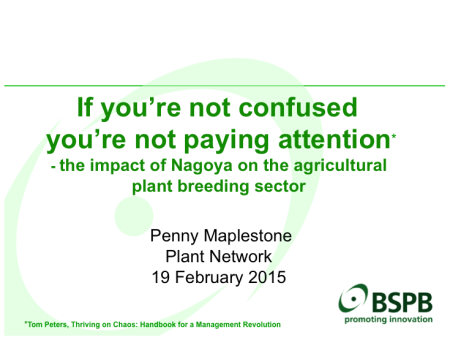
If you’re still confused, you might like to turn to Carolina Roa’s post on the SMTA.
Nibbles: Genebank data, Edible smut, Edible bugs, Healthful bluberries, Mining Indian food, Funny spuds pix, Old grape pits, Old einkorn stash, Phylogeny & conservation double, Rhizobacteria, Rapid phenotyping, Plata periurban ag, BRICs in Africa, Chinese terraces, SMTA
- GRIN-Global comes to Portugal. That makes two.
- Eating fungi.
- Eating bugs.
- Eating Indian.
- Eating blueberries is good for you.
- Would you eat these funny-looking potatoes?
- Veg ink.
- Old grape seed in Israel.
- Old einkorn seed in England.
- Atlas of Living Australia to include phylogenetic data. Kew thinking along same lines too.
- Grasses can absorb organic N. With some help.
- “Today’s international scientific community is dominated by big mercenaries who change their teams’ research subjects to get on the cover of Nature.” But INRA isn’t like that, apparently, at least with regards to high-throughput phenotyping.
- Argentinian periurban farmers grow varieties they like to eat. Well, it’s good to have the data.
- Rounding up China and Brazil in African agriculture.
- Meanwhile, back home, famous rice terraces are being used to grow maize.
- SMTA 101.
Nibbles: Citrus greening, Deforestation, OFSP, Sugarbeet breeding, Poverty & conservation, Indian tribals, Eat This Podcast, Musalit, Solomon Island bananas, Potato somaclonal variation, Genebank data management, WorldVeg DG search
- Getting to grips with citrus greening.
- A review of the effect of oil palm, soybean, and jatropha production on biodiversity and ecosystem functions in tropical forests is in the offing. Here’s what will be done.
- Sweet potatoes are good for the health of children. If you can get them to eat the things.
- The history of monogerm sugar beet.
- There’s no best way to link poverty alleviation and biodiversity conservation. The Global Meeting of the Indigenous Peoples’ Forum came up with a few ways, I’m sure.
- Vegetarian tribe in India is certainly doing that conservation, but the poverty alleviation?
- Jeremy takes a stroll around the allotment.
- Musalit is back in the game. And speaking of which, who would not have wanted to be at the Makira Banana Festival?
- Squeezing the most out of Russet Burbank. Oh, look at some new landraces, already!
- Portugal becomes second genebank to adopt GRIN-Global.
- AVRDC is looking for its next leader. Must know his/her onions.
Nibbles: Year of the Goat, Nutritional guidelines, Healthy diets, IK & conservation, Healthy orchards, Indian endemics trouble, CWR garden, NGS & food security, 3000 rice genomes at work, C4 rice, It’s economics stupid, US animal products map, Milk production history, Old Chinese cheese, Old Arabian seashells by the seashore, Gordon Bleu insects, African agriculture visions, Agroecology conference report, Smallholder diversity, Seed systems project, Supermarket farms, Toronto beer, Herbs factsheets, Ecosystems map, Contested Agronomy
Sorry about no blogging last week. Was watching sausages being made. Here’s a quick roundup of most of the stuff I would have Nibbled.
- But first of all, Happy Year of the Ram, everyone. No, wait…
- Brazil has the best nutritional guidelines.
- But Chad the best diet. Both are kinda ironic.
- Well, what can governments do about supporting healthy food preferences anyway?
- Folk knowledge vital to conservation.
- Well I never, say the East Timorese.
- Farming in a national park can be a win-win.
- Maybe even a win-win-win, if cider apples are involved.
- India’s endemic plants could be in trouble. Many crop wild relatives among them?
- Maybe they should do what the Royal Horticultural Society will be doing at the Malvern Spring Festival and make a garden with crop wild relatives. But then it won’t be the world’s first.
- Next generation genomics is this generation’s jetpack.
- No, wait, here’s that jetpack you’ve been expecting for so long… Well, more the first concept of the assembly instructions, really.
- We’ll get that jetpack before C4 rice, I expect. But we will get both.
- But of course it’s not all about production anyway.
- Squid is Rhode Island’s most lucrative animal product. Otherwise it’s mainly milk, in that part of the US.
- Maybe cheese was the Taklamakan’s. Three thousand years ago. And sea molluscs Saudi Arabia‘s. Five thousand years ago.
- When and where will insects be.
- “Large-scale investment in African agriculture and agribusiness, whether foreign, domestic, private, government-backed, or a combination of these, could pay a vital role in providing urgently needed financing, technology and markets, thereby assisting to ensure food security, contributing to poverty reduction and propelling agriculture-driven growth, with significant implications for achieving more inclusive growth.” Is that really all one sentence?
- Or maybe small-scale investment?
- How much investment in agroecology will there be, I wonder. Even after this report from last year’s FAO conference.
- Oh good, 75% of crop diversity still on small farms. Would that be 75% of the 25% remaining from the last century?
- What effect will the Integrated Seed Sector Development Project Africa have on that 75%, I wonder.
- The farm as a supermarket. Almost makes you believe in that 75%.
- The beery history of Toronto. Yes, Toronto.
- The National Center for Complementary and Integrative Health (NCCIH) has nutritional fact sheets on herbs.
- A great new global ecosystem map has the GIS nerds all excited.
- “Contested Agronomy 2016 is a conference about the battlefields in agricultural research, past and present.” Oh to have the live-tweeting gig. Hell, I’d do it for free. Wait, don’t I already do it for free? Hasn’t this whole Nibbles been about contestation in agricultural development?
And on that note, that’s all folks. Because this was such a pain to put together after a week’s hiatus, I’m going to leave it on the front page for a day or two before sending it to the Siberia of the sidebar. Oh and BTW, people. We want to reach 6,000 followers on Twitter, preferably before that jetpack arrives, so follow us already, and tell your hipster friends.
Wait, too needy?