- Leafy greens MIA in India.
- Agroecology and ecoagriculture settle their differences?
- The hazelnuts of Trabzon … romantic nuts.
- “Geographical Indications, Biodiversity and Poor Communities: The opportunity of geographical indications to provide protection of traditional indigenous biodiversity products and benefits to poor agricultural communities. A Desk Study on six target countries: Cambodia, Laos, Indonesia, Vietnam, Ethiopia, Mauritania.” I kid you not. Be still my beating heart.
Nibbles: Australian agrobiodiversity, European forests, Eva, Brazil in Africa, Seasons in the sun, FFS, IRC2014, Shiva farrago, Tricky crops, Genome editing, Amish revolution, Thai rat, Disease spread, Coffee culture
- Bush tucker may be viable business proposition. But doesn’t it taste like crap? And do any crop wild relatives qualify?
- Europe mapping its high value forests. No word on whether crop wild relatives come into the assessment.
- Sorghum breeder reveals all.
- Embrapa supporting African agriculture with help from Gates Foundation.
- How many seasons are there anyway?
- Test yourself on Farmer Field Schools.
- Delve into abstracts for the 4th International Rice Congress (IRC2014).
- New Yorker replies to Vandana Shiva reply to her profile in the New Yorker.
- Some crops resist mechanization.
- Editing the horns from cattle genome.
- A young Amish farmer with big ideas.
- Your organic rat, sir.
- Crop pests and diseases are coming to get you.
- Fun reddit with Peter Giuliano, barista extraordinaire.
Brainfood: Goat diversity, Sheep diversity, Camel keeping, Weird Zambian cattle, Pepper diversity, Strawberry diversity, Breeding wheat, Sustainable cacao, Food supply diversity
- The characterization of goat genetic diversity: Towards a genomic approach. A single Neolithic origin.
- Genome-wide patterns of adaptation to climate-mediated selective pressures in sheep. Adaptation to local climates has been important.
- Characterisation of camel breeding practices in the Ansongo Region, Mali. Diversity of practices, diversity of breeds.
- Gynomimicry in the Dwarf Gwembe breed from Zambia. The males mimic the secondary sexual characters of females, presumably because they’ve been selected to do so.
- Evaluation of a diverse, worldwide collection of wild, cultivated and landrace peppers (Capsicum annuum) for resistance to Phytophthora fruit rot, genetic diversity and population structure. No completely resistant lines out of 177, 2 pretty good ones, the better ones confined to 2 of 4 genetic clusters.
- Evaluation of strawberry (Fragaria L.) genetic resources on resistance to Botrytis cinerea. Out of 107 accessions in the German national genebank, 5 were pretty good, 4 of them F. vesca.
- Redesigning the exploitation of wheat genetic resources. Allele mining is out, genome-wide selection is in.
- Making biodiversity-friendly cocoa pay: combining yield, certification and REDD for shade management. Even if you increase yields by 50%, that may not be enough to stop farmers converting from traditional agroforestry. Enter ecolabelling and REDD.
- Measuring nutritional diversity of national food supplies. Production diversity is a good predictor of dietary diversity, but only for low income countries; otherwise income and trade are better. Dietary diversity associated with key health outcomes.
Brainfood: Ethiopian wild veggies, Cold tolerant rice, Chickpea genomics, Improved tilapia, Wild cassava oil, Chinese horses, Chinese melon, Seed sampling, Tomato spp sequencing
- Wild and semi-wild leafy vegetables used by the Maale and Ari ethnic communities in southern Ethiopia. 30 of them.
- Collection and Conservation of Cold Adapted Indigenous Rice Landraces from Western Ghats, South India. 56 of them.
- Exploring Germplasm Diversity to Understand the Domestication Process in Cicer spp. Using SNP and DArT Markers. 3 populations among domesticated types; more diversity in the wilds.
- Genetically-Improved Tilapia Strains in Africa: Potential Benefits and Negative Impacts. Mean present value of introducing an improved strain to Ghana is 1% of GDP, but you could get same with better management. Both would of course be best.
- Diversity in oil content and fatty acid profile in seeds of wild cassava germplasm. Some species could be oil crops.
- The Study of Genetic Diversity and Phylogenetic Evolution in Indigenous Horses (Equus caballus) of Gansu. If I understand the abstract correctly, this suggests, among other things, that some local horse breeds can be traced back to Przewalski’s Horse, maybe.
- Microsatellite Diversity, Population Structure, and Core Collection Formation in Melon Germplasm. In China. Frankly not nearly as interesting as the horse story.
- Optimal sampling of seeds from plant populations for ex-situ conservation of genetic biodiversity, considering realistic population structure. 25–30 individuals per population from few but widely-spaced populations.
- Exploring genetic variation in the tomato (Solanum section Lycopersicon) clade by whole-genome sequencing. 20x more diversity in the wilds than the cultivated, correlated with habitat.
- Understanding Sustainable Diets: A Descriptive Analysis of the Determinants and Processes That Influence Diets and Their Impact on Health, Food Security, and Environmental Sustainability. The determinants of sustainability are agricultural, health, sociocultural, environmental and socioeconomic, and fiddling with one to improve it may screw up another.
- Anchoring durum wheat diversity in the reality of traditional agricultural systems: varieties, seed management, and farmers’ perception in two Moroccan regions. Farmers grow both improved varieties and landraces, the latter mainly for their quality characteristics.
- Unraveling the nexus between water and food security in Latin America and the Caribbean: regional and global implications. Production has increased, but at the cost of the natural capital of the region, and nutritional problems persist.
Global diets visualized
National Geographic’s eight-month series on food has caught up with Colin Khoury’s blockbuster paper on how many crops feed the world. The infographic on diet similarity looks ok on the printed page, I guess:
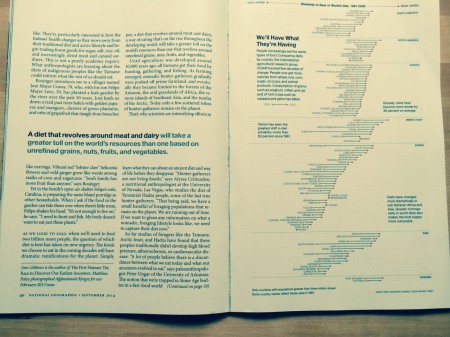
But it’s way cooler online.