- Yak farming. In Arizona?
- Sorghum farming. In Kenya?
- Jackfruit farming. Who’d do it?
- Cassava farming. With all those nasty viruses?
- Fish farming. By Bangladeshi women?
- Global farming. What will the G20 do?
- Farming research. Have you heard of the CGIAR? From the horse’s mouth?
Nibbles: Agave pollination, Sanjaya Rajaram, PGR policy history, Ex situ conifers, Botanic garden theft, Kyrgyz forests, Home nurseries, American chestnut, South Pacific action
- Tequila and bats. Two of my favourite things.
- Continuing the Mexican theme, we have a World Food Prize 2014 winner.
- I wonder what he thinks of the changes he’s seen during his illustrious career in the international system for PGR conservation and use.
- I bet there’s a few endangered conifers, and maybe some ex situ collections, in Mexico.
- I hope there weren’t any among the plants stolen from the RBG Edinburgh recently.
- But perhaps there were some fruits and nuts from Kyrgyzstan?
- Well, the way to go is home nurseries, clearly.
- Maybe even with the GM chestnut, why not?
- Meanwhile, in the South Pacific, CePaCT has been really busy.
Nibbles: GM bananas, Passenger pigeons, Conference, Diet, Perennial grains, Ugandan mushrooms, Adopting diversity, Indian history
- “Genetically modified bananas grown in far north Queensland and bound for Africa are about to undergo human trials in the United States.” Because … GM!
- More on those passenger pigeons.
- A big old conference on Agriculture and climate change, February 2015.
- Then again, we could all change what we eat to combat climate change.
- Or change what we grow. Report on some perennial grain experiments.
- Mushrooms for Uganda, a new project sees the light of day.
- “The determinants and extent of crop diversification among smallholder farmers” in Zambia. It’s IFPRI, Jake.
- I really just wanted a reason to link to this site, so I searched for millet. I’ll bet there’s more there of more direct interest.
Food policy ignores genebanks, so what else is new?
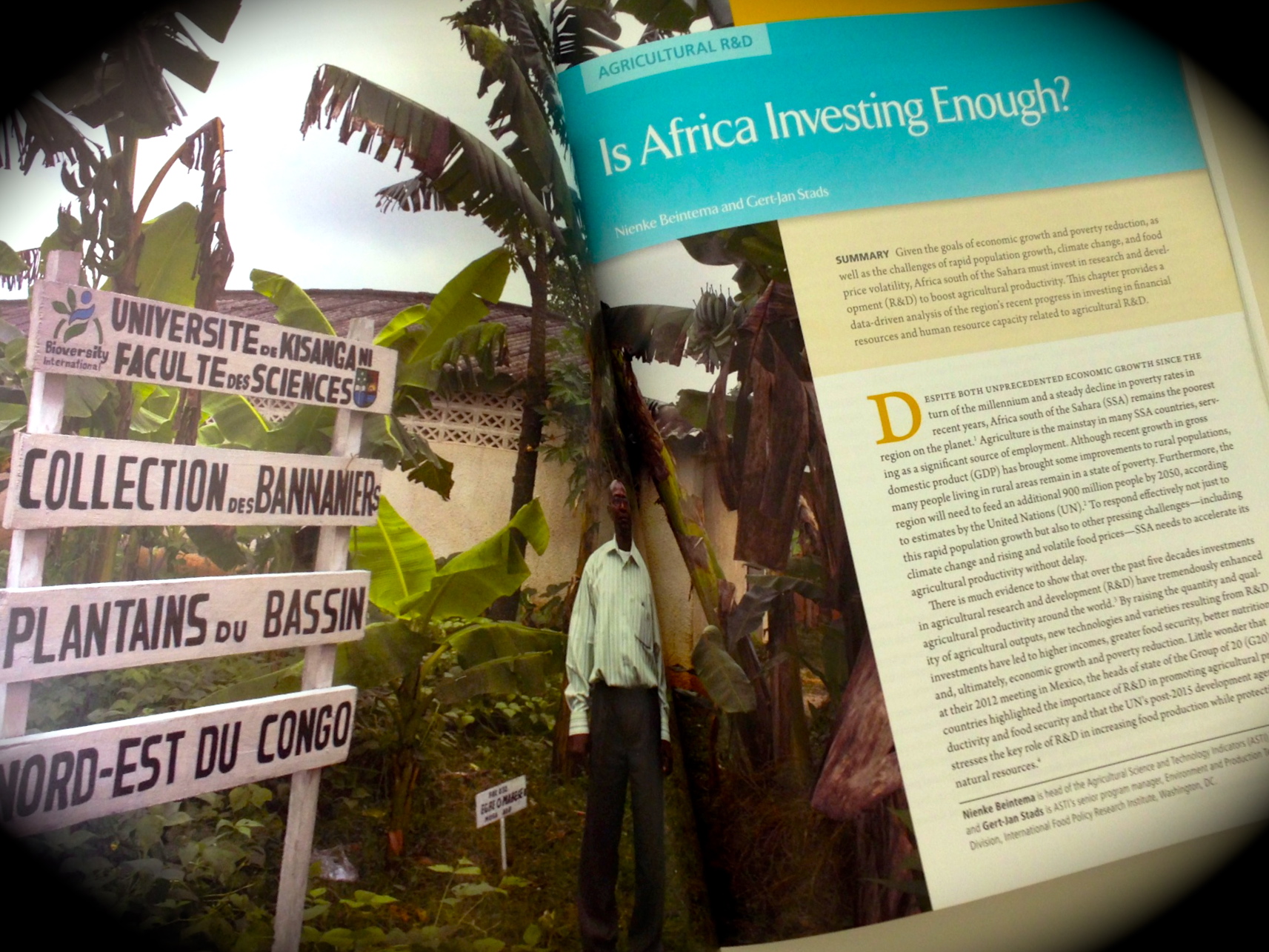 IFPRI’s latest Global Food Policy Report is out. I know because I was at the launch a couple of days ago in Berlin. Leafing through the hard copy while listening to IFPRI’s DG summarize the main findings, I was heartened to see the photo reproduced here, at the start of the section entitled “Is Africa investing enough?”. It’s a banana genebank! In a publication on food policy? Will wonders never cease?
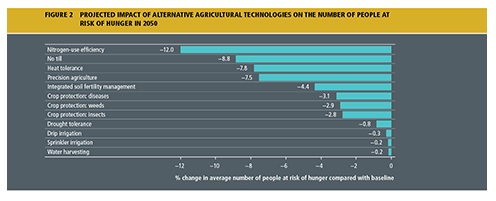
Unfortunately, they did. There’s nothing at all in the report about genebanks, apart from that photo. That’s despite the fact that another section, the one entitled “The promise of innovative farming practices,” did a great job of highlighting the importance of interventions that ultmately depend on the genetic diversity found in genebanks. IFPRI researchers used a geographically explicit modelling approach to predict the effect of 11 different agricultural technologies on yield, global harvested area and number of people at risk of hunger in 2050. They did this for three major staples: maize, rice and wheat.
It turned out that of the three breeding-based technologies included among the 11 — that is, new varieties that are more heat tolerant, N-efficient or drought-tolerant — the first two were consistently the ones resulting in the greatest impact. No-till agriculture was also up there. But really, if you were going to do just one thing to alleviate hunger, breeding for N-efficiency would probably be it, according to this analysis.
So why not mention the source of the raw materials for doing that? Especially as IFPRI’s fellow CGIAR centres manage global germplasm collections of these crops which have been formally recognized as fundamentally important to food security (check out Article 15 of the International Treaty for Food and Agriculture). It’s amazing how no opportunity is ever wasted of taking genebanks for granted.
Nibbles: Detecting diseases, Better bees, Millet milestone, Passenger pigeon, Land rights, Mongol mayhem, Jumping genes
- Sensors for volatile organic compounds will detect crop diseases for ya. Then a drone comes in and zaps them?
- Breeding better bees.
- “So why not simply replace the traditional variety with Dhanshakti?” Answers on a postcard, please.
- Bringing back the passenger pigeon.
- The impact of land rights around the world. Including on conservation of agricultural biodiversity?
- What the Mongols ate, and how we know it. Some millet. Maybe some passenger pigeons. Interesting concept of land rights.
- Sorry we’re one day late celebrating Barbara McClintock’s birthday.