- Canada invests $2.9m in “under-utilised Nigerian Vegetables,” report fails to say which ones.
- Where did all the diverse farms go? Katherine McDonald reveals all.
- Excellent argie-bargie over child nutrition in India.
What’s eating India?

Resources Research undertook a labour of love to produce this graph. It shows, for 20 Indian states, roughly how much of pulses and cereals each tenth of the population eats each month. I urge you to go and read the full post for the details.
Bottom line: Of the 200 populations, 43 are “severely deficient” in cereals and pulses required per month.
The graph is based on data from national surveys of “Consumer Expenditure,” so I don’t know whether it includes food people grow rather than buy, but I doubt that makes much difference overall.
Makanaka makes lots of interesting points about the data, comparing the 2009-2010 survey with a similar one done five years before. Overall, this is a terrific example of open data allowing people to offer alternative interpretations to the standard line.
Could plant diversity become free (as in speech)?
I’ve been tremendously privileged to be at the Seed Savers Exchange 33rd Annual Campout and Conference in Decorah, Iowa. It’s a wonderful gathering of people interested in saving and sharing seeds, with all sorts of workshops, practical classes, and speakers. One of this year’s speakers was Jack Kloppenburg, of the University of Wisconsin. Kloppenburg wrote First the Seed (now available in a second edition), which is the best analysis of the economic nexus that surrounds seeds and plant breeding. He told the audience he was “here to share an idea, just like you guys share seeds.” So I’m sharing his idea: the Open Source Seed Initiative.
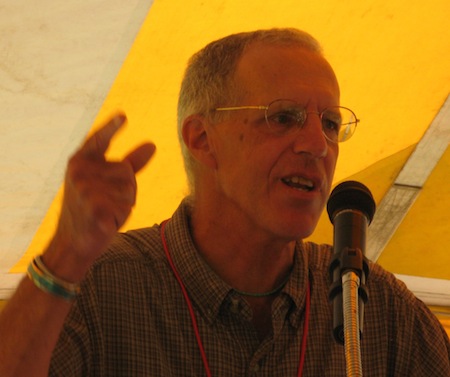
Kloppenburg set out his ideas in a 2010 paper in the Journal of Agrarian Change. In it, he rejects what he calls the “accomodationist” approach to patents and other efforts to restrict access to plant genetic resources. Accomodationists, he says, seek “market mechanisms for compensating those from whom germplasm is being collected”. Instead, he proposes a more radical approach derived directly from the open source software movement. The Open Source Seed Initiative prevents the privatisation of plant genetic resources and, in Kloppenburg’s view, also “might actually facilitate the repossession of ‘seed sovereignty’”.
Open source software is accompanied by a licence that encourages people to share it and create new programs with it, and at the same time prevents anyone from releasing a program that uses the code under any other form of licence. The creativity embedded in the code cannot be privatised. Kloppenburg and a group of like-minded seed companies, plant breeders and academics want to apply similar licences to plant genetic resources.
Kloppenburg is at pains to point out that actually he has nothing against plant patents, other intellectual property rights, contractual “bag-tags” or any of the other mechanisms that commercial breeders use to enforce ownership of their products.
“The problem isn’t the tool,” he told the conference. “The problem is who is using the tool and why.”
There have been three meetings so far to discuss the Open Source Seed Initiative, and although the details have yet to be worked out the underlying concept is simple. An OSSI licence allows me to give you seed (or any other form of plant genetic resources) with only one condition: that you have to share it, and anything you create with it, with exactly the same condition attached.
“It becomes viral,” Kloppenburg explained. “Now ‘viral’ is kind of problematical for people in agriculture,” he conceded, “but it is. It propagates.” As it does so, it creates a protected commons, as opposed to an open commons, of things that can be freely shared but not privatised. That is OSSI’s great potential strength, according to Kloppenburg.
“People who will share are unrestricted. People who won’t share aren’t interested.”
The general idea of a protected commons for plant genetic resources bubbles up from time to time, Kloppenburg told the audience, citing Richard Jefferson’s CAMBIA initiative as one manifestation. He credits the germ of OSSI to Tom Michaels, a bean breeder then at the University of Guelph in Canada, who in 1999 proposed the idea of a general public licence for plant germplasm, or GPLPG.
Kloppenburg stressed that the lack of a monopoly does not mean a lack of payments. As with open source software, there are many ways in which plant breeders and others can seek payment for their services. There could be different forms of OSSI licence, allowing royalty payments to the breeder on the first transfer. And seed companies would be free to charge for OSSI-protected varieties.
Many details remain to be worked out. Who will police the licences, and how? Will it be possible to discover traits shared under OSSI and then incorporated into privatised varieties? How could that be proved? And the global plant genetic resources community has yet to start a serious discussion of the idea. That may prove a hard sell after the long struggle to obtain the current International Treaty on Plant Genetic Resources for Food and Agriculture, which Kloppenburg doesn’t think is working.
The really radical route to establishing a just and agronomically productive regime for managing flows of crop germplasm is not to arrange payment for access to genetic resources, but to create a mechanism for germplasm exchange that allows sharing among those who will reciprocally share, but excludes those who will not.
The current material transfer agreement that accompanies plant germplasm under the International Treaty has some elements of an open source licence about it – but could go much further. Is there any chance CGIAR genebanks, whose holdings constitute the bulk of germplasm available under the International Treaty, could actually lead the way to the just and productive regime that OSSI is looking for, or are they too beholden to the private sector?
Brainfood: Apples, Solanaceous breeding, AnGR valuation, Seed systems, IPR, Chestnut cryo, C4 exploitation, CC adaptation in China
- Crop-to-wild gene flow and spatial genetic structure in the closest wild relatives of the cultivated apple. Some evidence of genetic differentiation within species, but not as much as you’d think. Probably because of the significant gene flow in all directions.
- Biosynthesis of Antinutritional Alkaloids in Solanaceous Crops Is Mediated by Clustered Genes. Which means they can be fairly easily silenced.
- Assessing the total economic value of threatened livestock breeds in Italy: Implications for conservation policy. It’s worth it, but farmers will need incentives.
- Strengthening informal seed systems to enhance food security in Southeast Asia. Including through identifying potential commercial species and also the odd seed fair and bank.
- Can Certain Intellectual Property Rights both Protect and Promote Unique Traditional Products and Cultural Heritage from Developing Countries for Economic Benefit? The Case of Georgia. Maybe.
- In vitro conservation of chestnut (Castanea sativa) by slow growth. Ok, now what?
- Getting the most out of natural variation in C4 photosynthesis. Through sequencing of a couple of key species and lots of RNA profiling.
- Coping with climate-induced water stresses through time and space in the mountains of Southwest China. Including by changing crops, changing crop varieties and changing cropping patterns. But other ways as well.
Brainfood: Crop genomics, Phenotyping, Smallholders and markets, Yacon diversity, Indian rice HYVs, Sustainable landscapes, Climate models, Food prices
- Genomics reveals new landscapes for crop improvement. Which are dominated by the looming presence of Mount Phenotyping.
- Where Have All the Crop Phenotypes Gone? Someone mention phenotyping?
- Smallholder agricultural commercialization for income growth and poverty alleviation in southern Africa: A review. On balance, it’s a good thing.
- Genetic diversity of yacon (Smallanthus sonchifolius (Poepp. & Endl.) H. Robinson) and its wild relatives as revealed by ISSR markers. Low diversity among the cultivated stuff, which is quite distinct from the wilds. All due to clonal propagation. No concrete recommendations apart from conserving all you can find. Pity.
- Molecular Genetic Diversity of Major Indian Rice Cultivars over Decadal Periods. Genetic diversity among high yielding varieties released in India went up between 1970 and 2010.
- Ten principles for a landscape approach to reconciling agriculture, conservation, and other competing land uses. Adapt, involve, multitask. And more, much more, from Mongbay.
- Uncertainty, ignorance and ambiguity in crop modelling for African agricultural adaptation. Be open about assumptions, communicate with and involve diverse stakeholders in appropriate ways, accept feedback from policy-makers. Could be talking about GMOs. Or the above.
- The effect of rising food prices on food consumption: systematic review with meta-regression. Worse for poorer countries, and worse for poorer households in all countries.