- Britain gets a tree seed bank. Wait, it didn’t already have one? St Helena seems to, sort of. And Cameroon. And why they’re needed more than ever; and more. Although in Brazil trees can be the bad guys.
- Bill Gates praises CIMMYT, and the CGIAR as a whole.
- A Renaissance garden recreated in NYC.
- A survey on moringa. And one on achocha and oca.
- And speaking of deconstructing weird crops, how about saffron?
- Yet another one of those GMOs-are-not-as-bad-as-you-think pieces. Is any of this getting through, I wonder?
- Free range pigs in Kenya and the USA.
- Speaking of free range livestock… Well, a species distantly related to livestock anyway. Oh, and here’s another restoration story, from another continent.
- Free range glass eels too. And salmon, after a fashion.
- Traditional potatoes in fancy Lima restaurants. Maybe with pork or fish?
Nibbles: SRI in Indonesia, SRI in Nepal, Diversity in GMO review, Climate change fears, Ancient grind in China
- System of Rice Intensification increases yields, not incomes, because it takes time away from other jobs. Caveats apply.
- Which does not deter Rajendra Uprety, an SRI activist, in Nepal, where rice farmers “hydridize technology”.
- In reviewing the global march of GMOs, a plea for policies to promote “much more crop diversity”. Well of course we agree.
- US food company executives fear “weather extremes” more than anything else in 2013.
- The same fears may have driven Chinese people to food processing 23,000 years ago. A grind not being able to access the PNAS paper.
Wheat diversity collections seen and unseen
A couple of things on wheat today, thanks to Tom Payne at CIMMYT, our go-to guy for all things triticaceous. First, Kew’s new page on Bread Wheat, which has a lot of useful information, including this:
About 250,000 samples of bread wheat are held in agricultural gene banks around the world, so the plant is far from being threatened. However, there is cause for concern in terms of bread wheat landraces, which are being replaced by modern cultivars and under threat of extinction if not already conserved in ex-situ collections.
The figure is I suspect from Genesys, from which the map below is taken. WIEWS, which covers many more genebanks, gives 546,797, but there’s probably much more duplication in that number than in the Genesys one.
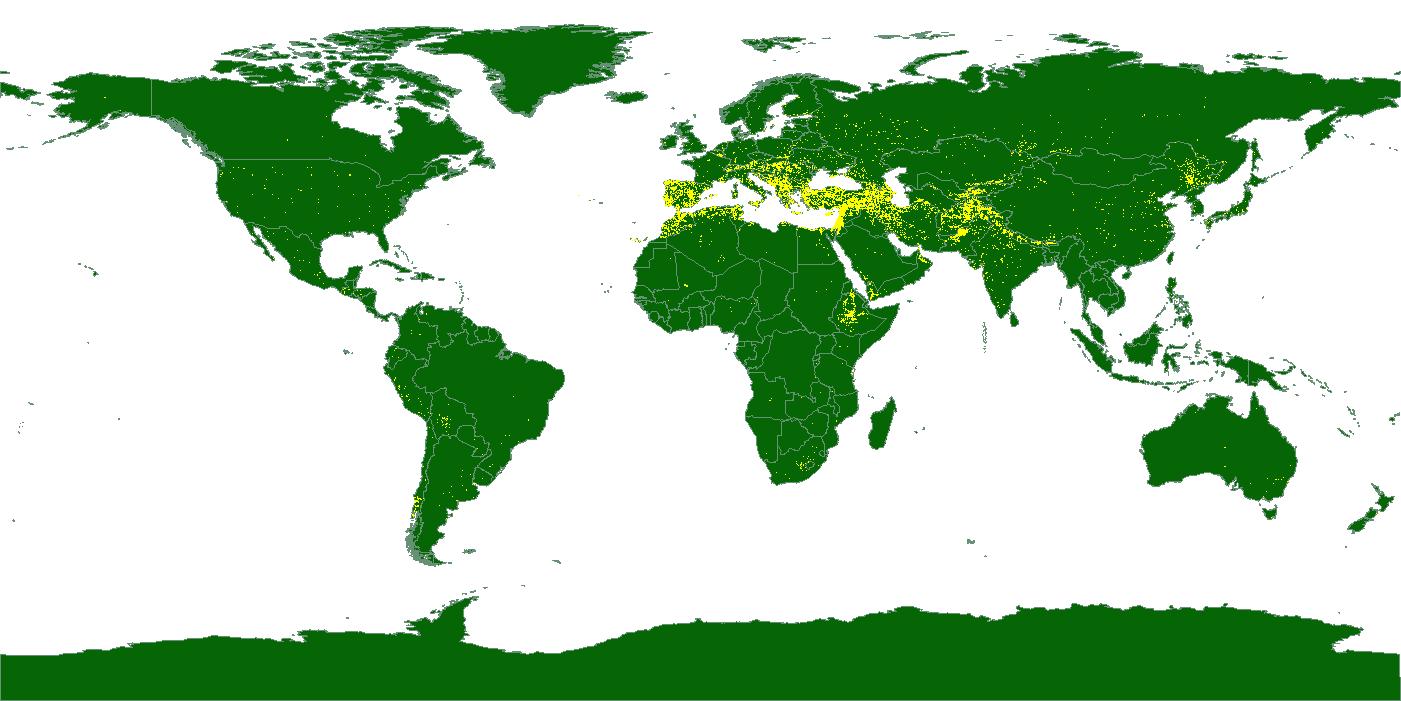
And second, from the just published study “Agricultural Innovation: The United States in a Changing Global Reality,” a wide-ranging analysis of the benefits to the US of investment in international agricultural research, a discussion of the pedigree of the hard red winter wheat variety Jagger, the most widely planted wheat variety in the United States:
The breeders who developed Jagger drew on genetic material from all over the world and throughout the United States. Jagger was formed by crossing the breeding line KS82W418 (developed by the Kansas agricultural experimental station) with the variety Stephens (developed jointly by the Oregon agricultural experiment station and USDA-ARS). In turn, these two varieties stand firmly on the shoulders of the investments in scientific crop breeding over the past century and the eons of selection and seed-saving efforts of farmers since wheat was first domesticated around 10,000 years ago. Jagger’s ancestry includes varieties like Turkey Red from Russia, Noe from France, Federation and Purplestraw from Australia, Yaqui from Mexico, and Etawah from India.
Too bad that the closest the authors come to saying where those ancestors of Jagger, along with their 250,000 or 500,000 or whatever cousins, may be found, despite numerous references in the text to CIMMYT and USDA, is this laconic sentence:
In addition to the efforts of private citizens, the US Department of Agriculture (USDA) sent its scientists to the far corners of the globe in search of better plant varieties.
Maybe I’ll send them that Kew link.
Nibbles: Alcohol, Cannabis, Pollination tool, EU seed law, Fruit cloning
- I need a drink.
- Or maybe some Viking ganja.
- I know I don’t need a VegiBee. But maybe you do.
- I guess we all need to write to the EU about the new seed law.
- Nobody needs another discussion of whether cloning is good or bad.
Nibbles: Fertilizer taxes, Sustainable brewing, Naked oats, New potatoes, White veggies, EU seed law, CGIAR policy, Grassland connectivity, Llama meat, Seed eating, Agroecology
- Intriguing: how about a sliding scale for fertilizer taxes?
- Dubious: sustainable brewing in Bogota.
- Surprising: naked oat seeds in Canada.
- Challenging: new coloured potato varieties are nutritious and pest-resistant.
- Illuminating: white veggies are nutritious too.
- Important: EU seed vote coming up.
- Belated: CGIAR goes open access.
- Intoxicating: Japanese drink fermented hydrangea leaves.
- Obvious: Cars move grassland seeds.
- Freaky: interspecific grass hybrid for flood prevention.
- Tasty: Fine carnivorous dining in Bolivia.
- Metaphysical: granivory is murder.
- Political: UK government supports agroecology.