- Dogs were first domesticated animal. But the love affair is cooling off, at least for some breeds.
- Building capacity for animal genetic resources use, and for conservation and sustainable use under the ITPGRFA. And tree domestication. Is someone keeping track?
- BGI continues to take over DNA world.
- And the Worst Plant Virus Oscar goes to…
- How PNG farmers cope with drought. From what is developing into a really useful blog.
- I wish I had time to read 200 pages on ancient Athenian food. But maybe you do?
- Learn about the USDA potato collection, including lots of wild relatives.
- The tree that thinks it’s a supermarket: Moringa in the limelight again.
Contract farming is good for you — official
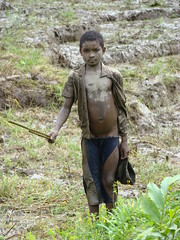 Many people say that giving smallholder farmers a stronger position in market chains is one of the best methods of helping them out of poverty, and that applies particularly to the neglected, orphaned, underused etc crops that are our bread and butter. Is it true? A new study in World Development says it is. 1 The article is behind a paywall, and even if it weren’t I am pretty confident that I wouldn’t understand the details. So how do I know that “participation in agricultural value chains make[s] smallholders better off”?
Because the author says so.
Which of course he would, although in this case he does so with a blog post explaining just why his study is so much more conclusive than anything that has gone before. And that I could understand. Not the details of how he got there, which is still a long way outside my expertise. But where he got to, which was here:
At the end of the day, I find that contract farming significantly increases the income of participants. Perhaps more importantly, I find that contract farming increases the income net of contract farming revenue of participants. In other words, there are positive spillovers on other sources of income (here, income from from sales of livestock and income from other agricultural sources such as the sales of non-contracted crops and animal byproducts).
More broadly, I’m seeing, and liking, more of these blog posts from scientists about their science. And while not all scientists are capable, not by a long shot, those who can are, I am sure, adding to their reach and impact. Just sayin’
EU seed law in turmoil?
Good reasons to take the weekend off include the fact that by not being too keen, one avoids certain errors. So I’m glad I didn’t see Patrick’s original post on an opinion delivered by an EU Advocate General in the matter of Association Kokopelli vs Graines Baumaux SAS. 2 At least, not until after he had got things straighter. Here is Patrick’s view of the Advocate General’s views:
First of all the Advocate-General said it is not legal to interpret EU or French Seed Laws as meaning you cannot sell unlisted varieties. YOU ARE ALLOWED TO SELL UNLISTED VARIETIES.
Secondly, the provisions of EU Seed Law that refer to the DUS standard are NOT VALID.
Don’t get your hopes too high for a legal seed supply revolution in Europe. As Patrick explains, there’s a lot more that still needs to happen. But the possibility is that it just might happen, and then Europeans will be in the happy state enjoyed by the entire rest of world, able to buy, sell and grow whatsoever varieties they choose.
Nibbles: Rice breeding, West African agriculture, Asian AnGR, Wheat breeding, Chinese semiotics, Neglected plant at NordGen, Fledermaus, PPB
- Norwich boffins save the world. To get the real story, you need to deconstruct the piece using this.
- “Results indicate that the greatest agriculture-led growth opportunities in West Africa reside in staple crops (cereals and roots and tubers) and livestock production.” Minor crops get the shaft again?
- Project tackles conservation of Asian farm animal diversity. I’ve always wondered whether there might be a role for ecotourism. I’d pay to see weird cocks. And hens.
- Pakistani boffins return home with skills to improve wheat P efficiency. And the resources? We shall see.
- Chinese food and plant semiotics. Can’t wait for LanguageLog to get to grips with this.
- NordGen characterizes a weirdly-named exotic Cinderella crop. Can you guess which?
- And can you guess what the “best kept secret of agricultural success” might be? Clue: nothing to do with those East Anglian boffins of the first item.
- Participatory plant breeding and gender analysis. They’re not giving much away at the source site.
Brainfood: Ag vs biodiversity, Bioinformatics, Genomic association, Diversity and productivity in forests, Increasing diversity
- Land, Food, and Biodiversity. Agriculture will expand, but that is bad for biodiversity. It probably must expand, actually, but this can be kept to a minimum by addressing land-use planning, governance and law enforcement, productivity, and market drivers. Oil palm as an example.
- Time to change how we describe biodiversity. By finally tackling the digitization of phenome annotations, apparently. NiM 3
- Genomic and metabolic prediction of complex heterotic traits in hybrid maize. Amazingly, genotype (SNP) can predict phenotype (biomass traits) pretty well. But in a population where a bunch of dents were crossed with a couple of testers. Will it work with a diverse genebank collection of landraces?
- Forest productivity increases with evenness, species richness and trait variation: a global meta-analysis. In over 50 studies, polycultures come out about 24% better than monocultures, with evenness having more of an effect than richness. Much more commentary and context at ConservationBytes.com. Compare with that recent drylands diversity and ecosystem function paper.
- All Is Not Loss: Plant Biodiversity in the Anthropocene. A model says there have been “gains in exotics caused by species invasions and the introduction of agricultural domesticates and ornamental exotic plants”. Oooh! Contrarian!