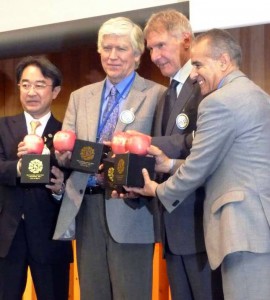
 So word has it that the Convention on Biological Diversity people will be handing out apples (or models of apples) with the logo of the Decade of Biodiversity on them during the 66th session of the UN General Assembly in New York City this September. Including to President Obama. The only photograph I’ve been able to find of these fruits comes from Nagoya last year, but they don’t look like heirloom varieties to me. An opportunity missed?
Nibbles: Aberdeen, Sahelian agroforestry, Seed companies, Haiti seed donation, Seaweed, Taste, Books, Logging, Cheese boycott
- 100 years of agricultural research in Idaho. Includes genebank since 1988.
- A Great Green Wall to go with Africa’s Green Revolution.
- Selling seed from the back of a car. Jacob unavailable for comment.
- Latest on that Haitian seed story.
- Seaweed farming in Zanzibar. Nice gig if you can get it.
- Taste is a complicated thing.
- Gorge on brainfood. Lots of botanical science books made available by Smithsonian.
- DNA fingerprinting to identify illegal logs?
- Cottage cheese isn’t “just” cottage cheese, say Israeli activists.
Africa’s Green Revolution: A report from the barricades
Jacob van Etten has sent in this post, with the following disclaimer: I contributed one of the articles to the issue and participated in a preparatory workshop. My own addition to this issue highlights the role of ICT technologies to create new networks of collaboration around technological innovation, creating new links between scientists and farmers. Luigi will give his own critical assessment of that piece in a separate post.
The Alliance for a Green Revolution in Africa, the Milennium Villages Program and the new Feed the Future program are all busy to make a new Green Revolution happen in Sub-Saharan Africa. These initiatives promote similar combinations of better access to inputs such as fertilizers and improved varieties, including the development of input markets so that the inputs keep getting to the farms in the future, too.
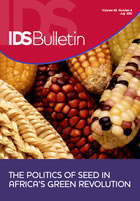 The latest issue of the IDS Bulletin reports from the ground on these African Green Revolution initiatives. The issue contains interesting field studies from Malawi, Ethiopia, Kenya, Zimbabwe and Ghana. The focus is not that of traditional impact evaluation, though. The studies look at how the different projects take shape through an institutional, political lens. How are local alliances shaped to realize the objectives of these programs? And whose interests are being served anyway?
The stories that emerge are tremendously diverse and well worth reading. For instance, Kenya, with its strong but unevenly developed private seed sector, versus Ethiopia‘s still largely state-controlled system give very different contexts to work in. Especially fascinating is the study on Malawi. Malawi has been a poster child for its input subsidy programme. Blessings Chinsinga investigates how this plays out on the ground.
One of the lessons is that seed market development, as promoted by the different African Green Revolution initiatives, is supply-driven rather than demand-driven. For agrobiodiversity, this means that the supply often becomes reduced to a few modern varieties, even though there might be demand for a more diverse set of seeds.
There is very little evidence that the different projects were designed explicitly taking the political-economic diversity on the ground into account. As a consequence, the different interventions seem to do little to change local power balances or place agricultural innovation on a more democratic footing. Therefore, Ian Scoones and John Thompson, in the introductory article, call for more democratic deliberation on these issues, so that more diverse perspectives come to the table.
To me it seems that we need fairly radical new ways to make the voices of farmers heard and to prevent certain elites from undermining the process. Even supposedly democratic deliberations are often hijacked by elite opinions as a result of cultural conventions, verbal assertiveness and so on. Perhaps we should promote less a “talking” democracy and more a “doing” democracy. 1 Democratic processes that tap into the expert knowledge of farmers may be less easy to hijack by non-experts, such as business elites. Vote with your seed.
Nibbles: Parliamentary buzz, Weeds, Malthus, Suceava genebank, Fukushima farmers, Mangifera, Fermentation, Macaws, Biodiversity banks, Asses
- EU parliament, and others, urged “to improve conditions for pollinators in Europe”.
- Weeds. A book from Richard Mabey, now published and reviewed in the US.
- Ismail Serageldin will present the 2nd annual Malthus Lecture on 14 July at IFPRI. I’ll be staying late to follow the webcast.
- The Romanian genebank at Suceava seems to have a kind of progress report.
- They’re making a film about the organic farmers of Fukushima.
- Mango diversity picture goodness.
- Turns out making ginger beer doesn’t involve ginger. What it does involve is a weird agrobiodiversity symbiosis, but you had me at beer.
- Ancient Chacoans bred macaws. And why not.
- Biodiversity offsets are a huge market. What I want to know is if any of than money could go to genebanks.
- Ethiopian donkey power.
Nibbles: Qat, Neolithic, Indian nutrition, Indian fish resources, San Diego zoo genebank, Oats, food Security
- Tax qat? Rather you than me, dude.
- ” …non-domesticated animals and plants may give hints on the direction and timing of early human expansion routes.”
- ” The question is why hunger is prevalent when the nature has blessed India with 20 agro-ecological regions and 60 sub-regions to produce the widest variety of food grains, fruits and vegetables in the world?” And it’s a good question.
- “We have sent a report regarding the occurrence of exotic fishes in such a huge quantity to the National Bureau of Fish Genetic Resources (NBFGR), Lucknow.” In other news, India has a National Bureau of Fish Genetic Resources.
- San Diego Zoo works to conserve Africa apes. Fine. But did you know it has a Native Seed Gene Bank?
- Swedes and oats; recipe for cold-tolerant varieties.
- Empowering Farmers to Achieve Food Security. The Head of Food Security at Syngenta International explains how.