- See what WWF thinks will make agriculture sustainable.
- Americans are dying younger. Obesity partly to blame.
- Study shows how scientists can get farmers to innovate. And vice versa?
- Iron-age beer in France. “Beer … might have resembled modern home brews.” Which might have created a nation of wine-drinkers.
- Voice of America ♥ Nourishing the Planet. (African farmers also important.)
- Bacteria in mosses on tree branches fertilize forest soils. How long before the whole thing is available in a packet?
- Bioengineering the prairie. Together with, presumably, its crop wild relatives.
Nibbles: Bramleys, FAO vs Big AG, Biofuels, Honduras, Indigenous food
- Awesome apple tree awes impressionable TV reporter shock.
- Food fight!
- Food fight referee?
- Recent developments in the world of biofuels; CABI sorts the good, the bad and the indifferent.
- A blogger asks: “What is the appropriate mix of policies regarding agriculture in Honduras?“
- Watch a video on an indigenous food festival in Thailand by following instructions here. Note to film-makers: there are simpler ways to share a video.
Where will the protein come from?
As everyone and her dog ventures an opinion of how much more food will be needed to properly feed how many more mouths by when, it is worth bearing in mind an idea that was a little bit hidden in Oliver Morton’s wonderful introduction to The Anthropocene, in The Economist a couple of weeks ago.
Although nitrogen fixation is not just a gift of life — it has been estimated that 100m people were killed by explosives made with industrially fixed nitrogen in the 20th century’s wars — its net effect has been to allow a huge growth in population. About 40% of the nitrogen in the protein that humans eat today got into that food by way of artificial fertiliser. There would be nowhere near as many people doing all sorts of other things to the planet if humans had not sped the nitrogen cycle up.
There’s a chart, too.
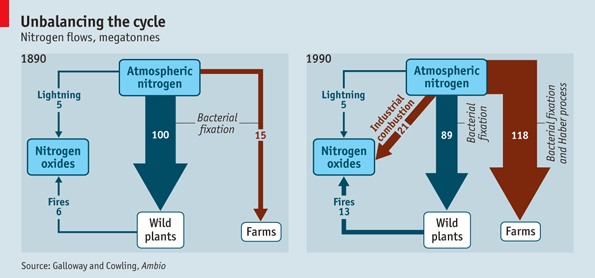
Industrial nitrogen fixation does not, of course, require oil, but it does require lots of cleaner, cheaper energy, and there’s still no sign of that just around the corner.
Nibbles: Food security, Food carts, Cotton, Ritual, C4 C3 CC, American Indian diets, Community genebanks in India, Fowler, Dark earth soil, Domestication
- German donor examines food and security, notes “the fast loss of biodiversity”.
- Food carts are successful oases in at least one food “desert”.
- Yesterday’s Botany Photo of the Day was American cotton.
- Good news, everyone: “Hardcore farmers prefer lowkey rituals.” Obviously the memo didn’t reach the children of the corn.
- Photosynthesis and climate change: it’s complicated.
- Native Americans try to reclaim control of their foodways. And their waists.
- “…every district should have a community-controlled seed centre with a gene bank for traditional seeds.” Of course it should. “The local available seed diversity needs to be protected and conserved at any cost.” Of course it must.
- “Right now, all over the world, projects are underway to store seeds…“
- Dark earths not just in Amazon, Africa too.
- Presentation on IFAD project on cultivating wild aromatic etc. species for money in Morocco.
Food and Security: diverse views agree
The timing on the E. coli outbreak in Europe is perfect: right on the heels of the "periphery" debt crises, you’ve got the same countries (Spain, etc.) squared off against the same "victims" (Germany foots the bailout bill disproportionally and now suffers disproportionally on this tainted food outbreak). Bottom line: you – Mr. Terrorist – have created tons of enmity, economic loss, and discombobulating fear. If I’m al Qaeda, I’m claiming this one on principle.
Thomas Barnett’s take on the ways in which food impacts our future security are disconcerting, interesting, scary, and in a warped way rather entertaining.
And then there’s this, from a commentary on the G8‘s recent meeting in Deauville:
[T]he world is now better able to feed itself. But the same economic stimuli that underpin higher food output also lead to supply problems, a decline in living standards, and massive social strains, especially in urban centers.
This is important to bear in mind, because rising food prices have historically been the trigger for political revolutions. The three revolutions that made the modern world, in France, Russia, and China, all had their immediate origins in food shortages, fear of hunger, and disputes about food pricing.
Luckily I know better than to quote ancient Chinese proverbs.