- See what WWF thinks will make agriculture sustainable.
- Americans are dying younger. Obesity partly to blame.
- Study shows how scientists can get farmers to innovate. And vice versa?
- Iron-age beer in France. “Beer … might have resembled modern home brews.” Which might have created a nation of wine-drinkers.
- Voice of America ♥ Nourishing the Planet. (African farmers also important.)
- Bacteria in mosses on tree branches fertilize forest soils. How long before the whole thing is available in a packet?
- Bioengineering the prairie. Together with, presumably, its crop wild relatives.
Brainfood: Cabbages, Crops in Darfur, Sowing dates, People and biodiversity, Honeybees, Rhizobium, Figs, Urban ag, Wild olives, Ancient textiles, Ducks, Wheat introgression, Food citizenship, Crop models, Trifolium, Variety choice
- Genetic diversity of Brassica oleracea var. capitata gene bank accessions assessed by AFLP. Czech genebank; subgroups reflected place of origin.
- Optimizing the cropping mix in North Darfur State, Sudan. A study of Umkdada district. “…the results of the model were different from the real practices of the farmers.” Oh dear. To improve the fit, schoolboys should work in the fields more. And crops should fetch more. The dismal science indeed.
- Climate-driven simulation of global crop sowing dates. Ok, this model works. You can predict sowing dates under rainfed conditions for various annual crops from climatic conditions. Not entirely sure why you would want to, though.
- Exploring some of the myths of land use change: Can rural to urban migration drive declines in biodiversity? Yes, counter-intuitively, at least in the forests of Mexico’s southwestern highlands. More from Conservation Magazine.
- Pollination services in the UK: How important are honeybees? Quite a bit, but maybe not as much as previously thought. It’s the wild bees, stupid!
- Genetic diversity and symbiotic effectiveness of rhizobia isolated from root nodules of Phaseolus vulgaris L. grown in soils of Iran. It is high, and it varies, respectively.
- Interspecific hybridization of fig (Ficus carica L.) and Ficus erecta Thunb., a source of Ceratocystis canker resistance. It’s a breakthrough!
- Exploring the diversity of urban and peri-urban agricultural systems in Sudano-Sahelian West Africa: An attempt towards a regional typology. There are 6 types. Not 5; not 7. On this one, the journey is more interesting than the destination.
- Variability of wild olives (Olea europaea subsp. europaea var. sylvestris) analyzed by agro-morphological traits and SSR markers. There’s a lot of variabzzzzzzzzzz…
- Hemp in ancient rope and fabric from the Christmas Cave in Israel: Talmudic background and DNA sequence identification. Mainly flax, but some hemp, from both Roman and Chalcolithic periods. But can you smoke it?
- Modelling the distribution of domestic ducks in Monsoon Asia. Low resolution data, plus fancy modelling, can be used to get pretty good high resolution predictions.
- Gene flow between wheat and wild relatives: empirical evidence from Aegilops geniculata, Ae. neglecta and Ae. triuncialis. It happens, a lot.
- Toward food system sustainability through school food system change: Think&EatGreen@School and the making of a community-university research alliance. Food citizenship?
- Simulation of winter wheat yield and its variability in different climates of Europe: A comparison of eight crop growth models. Big differences among models, so best thing to do is to use the mean of all of them.
- The potential of plant viruses to promote genotypic diversity via genotype × environment interactions. The negative effect of White Clover Mosaic Virus (WCMV) infection on performance differs from white clover genotype to genotypes, which means differential selection, which means negative frequency-dependent selection in host populations, which means diversity. Via.
- Amplifying the benefits of agroecology by using the right cultivars. Why should we summarize, when an author has already done so?
Keeping bees in Hong Kong
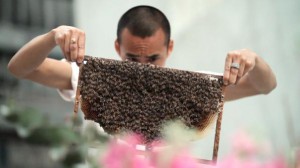 I can’t resist sharing this wonderful video about a guy I found, well, inspirational is the only way I can describe him. And believe me, I don’t often use that word, at least about people. Clicking on the photo will take you to Vimeo. Thanks, Grist.
Nibbles: Spatial data, poverty, Livestock diseases, Romania, Cultural diversity, Iraqi marshes, Citizen science , Biohappiness, Beer!
- The CGIAR spatial crowd get it together? Not holding my breath.
- So tell me about that biodiversity-poverty link. Well, more research is, ahem, needed. Wet, for want of a better word.
- All the different kinds of “spots” for livestock diseases. How did they cope with the poor data? And have the various hotspots and coldspots been considered in drawing up the new research priorities for livestock?
- UNDP stumps up $4 million to plan biodiversity management in Romania. Including agrobiodiversity? Not holding my breath.
- A socio-economic impact analysis of cultural diversity in cities does not consider agriculture at all. There’s a PhD there for someone.
- IUCN’s plans for the Iraqi marshes. Thesiger unavailable for comment.
- If it can be done with amphibians, why the hell can’t it be done with agricultural biodiversity?
- Biojoy swamps Bioversity as Biohappiness book is launched.
- Yeah but was there any of this? And if not, why not? Via NWFP-Digest-L.
Nibbles: Coffee, British orchards, Wild foraging, African agriculture, Sesame, Taro wine, African beer, Brazilian pastures, Hemp
- First of all, I need a cup of coffee.
- Stop Press: Britain’s orchards neglected. Prince Charles to be called in to help?
- Eating the wild, in San Francisco and San Diego.
- IFAD on what African farmers need: infrastructure, insurance, investment. Apparently.
- Harvesting sesame in Greece: The video.
- Filipinos make wine from Hawaiian traditional food. Strange the Hawaiians hadn’t thought of that. But perhaps they did.
- And while we’re on the subject of booze…
- Destroying the Pantanal and Cerrado in a sustainable manner.
- Hey, it’s Hemp History Week! And you know how to celebrate that, don’t you.