Timbuktu Chronicles pointed me to an interesting allAfrica feature on the organic vegetable revolution sweeping around the edges of Cape Town under the leadership of some formidable grandmothers. Great that such a community-based movement is taking off and making a difference, of course. But it was a bit disappointing for me not to see much evidence in the text and photos that indigenous African vegetables are included in the mix. I know there are dedicated people promoting this neglected agrobiodiversity in South Africa. I’ve worked with some of them. Local leafy greens have become mainstream in countries like Kenya in the past few years: you can buy them nicely packaged in supermarkets now, which was certainly not the case when I lived there in the mid-90s. Is that not happening in South Africa? If not, why not? I hope someone out there can tell us.
Floral glory
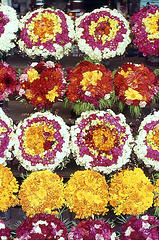 A fascinating post over at Human Flower Project takes as its starting point the different cultural aesthetics associated with different styles of flower-arranging, from the all-encompassing European “one of everything” to the zen simplicity of Japanese ikebana. But that’s really all just throat-clearing prior to Julie’s rhapsodizing on flower bouquets in Afghanistan. She wonders what inspired the Afghan style, and whether it has survived. “[W]ith all that’s happened in the past three decades, do flowers in Afghanistan today look anything like Ard’s picture from the early 1970s? Can an aesthetic this original and strong survive thirty years of war?” good question. I have no idea.
Flickr photo by Ard Hesselink, used under a Creative Commons Licence.
Community-based gardening for yoofs
How to interest children in gardening: weeding doesn’t cut it.
Turning market waste into meat and milk
A recent paper in Animal Feed Science and Technology 1 did a number on three different kinds of waste from the markets of Kampala, Uganda. Waste from banana, sweet potatoes and Solanum aethiopicum (African eggplant) were chemically analyzed and fed to sheep and goats. That way, the scientists could measure what the wastes contain and how much of that the animals could make use of. Turns out — surprise — that there are differences among the wastes and differences between wet and dry season wastes. Banana leaves and pseudostems were not all that nutritious, and African eggplant leaves were very watery. But sweet potato leaves were just right: “sufficient to provide the CP (crude protein) and ME (metabolizable energy) required by growing goats under tropical conditions”.
Which is nice to know, but not all that surprising, given that about half the sweet potato crop in China is fed to livestock. Of course, pigs are monogastric, while sheep and goats are ruminants, so it was worth checking.
Will this see the market people of Kampala bundling sweet potato waste for sale? Or maybe the farmers will grow the leafy varieties specifically for animal fodder.
Garden Mosaics
Garden Mosaics is “a science education and outreach program based at Cornell University that has been thriving in more than two dozen cities” in the US and has recently spread to South Africa. Marianne Krasny, a professor at Cornell, kept a blog of her 2006 trip to southern Africa. I wonder what they think about urban fruit gleaning…