How can we ever expect to be healthy when we’re shunning the foods our bodies are built for?
Modern Forager gets on a soapbox.
Crops, livestock, microbes, pollinators, wild relatives, agroecosystems, foodways …
How can we ever expect to be healthy when we’re shunning the foods our bodies are built for?
Modern Forager gets on a soapbox.
Sue Branford writes in The Guardian that:
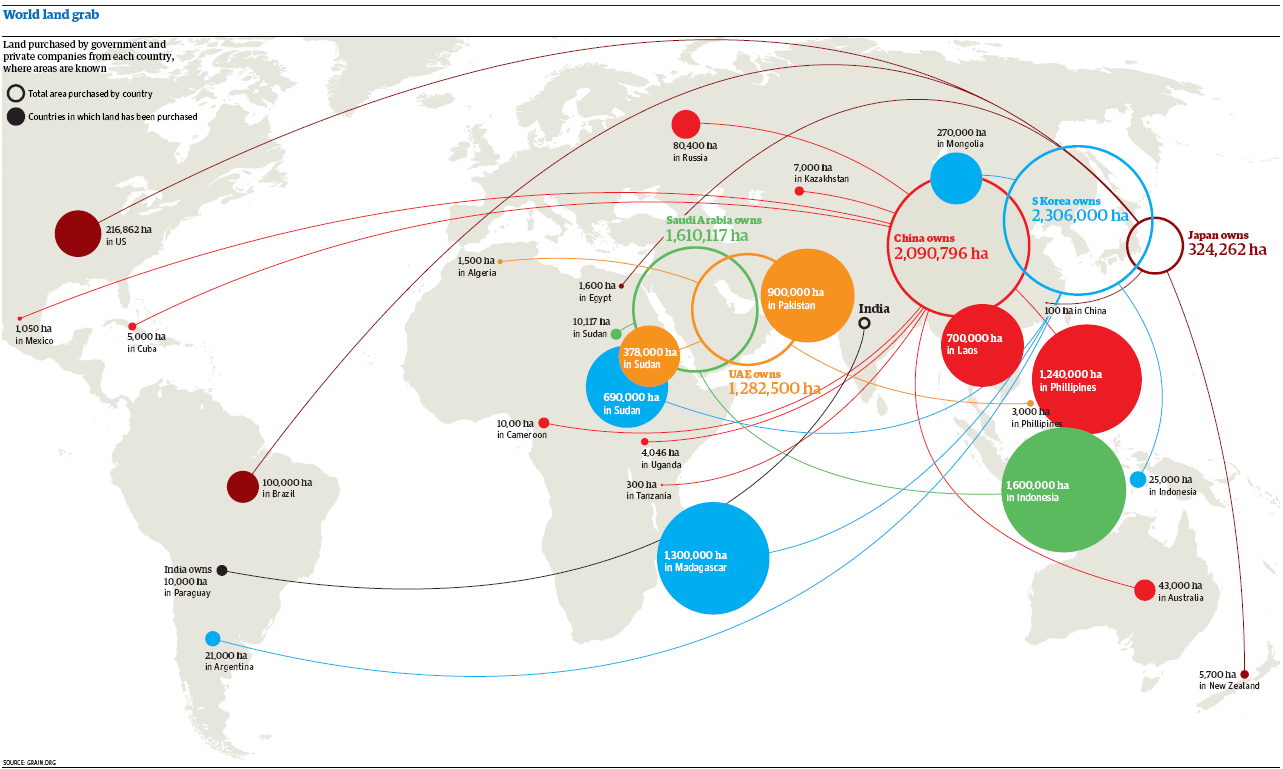
China, South Korea, Japan, Saudi Arabia, Kuwait and other nations have been buying and leasing huge quantities of foreign land for the production of food or biofuels.
A couple of days ago, Luigi mentioned in a footnote of a post on Malagasy coffee, that Daewoo is to lease 1.3 million ha in Madagascar. Apparently to produce maize. The Financial Times reported:
“It is totally undeveloped land which has been left untouched. And we will provide jobs for them by farming it, which is good for Madagascar,” said Mr Hong [of Dawoo]. The 1.3m hectares of leased land is almost half the African country’s current arable land of 2.5m hectares.
There might be some scope for agricultural expansion on the Malagasy high plateau, but 1.3 million ha of good arable land that is untouched? Except by the local population, of course.
Not quite, and not so fast, responded the government:
The contract (…) concerns only the facilitation of a land search. We are talking about a search for 100,000 hectares … It is only after this stage that the rest of the process will continue.
Grain has a report, and a Google notebook with clippings.
FAO’s Jacques Diouf talks about neo-colonialism. There is also this Guardian article on resentment in Laos. Expect more of that to come.
You may remember the obsession we developed here last summer about diversity among crop varieties in nutritional composition in general and glycemic index in particular:
Good measurements of characteristics such as GI for specific, named and recognizable varieties, whether the products of modern breeding or traditional farmer varieties, would be really valuable for lots of reasons, not least to add substance to claims that diversity of diet in and of itself is good for one.
Well, our prayers are being answered. Foodnavigator has a news item about the “Healthgrain diversity screen.” Researchers
grew, harvested and milled 150 wheat varieties used for bread making and 50 other grain varieties — oats, barley and rye — over a one-year period in Hungary. The grains originated worldwide…
They then measured “the components known to play a role in prevention of cardiovascular disease and type-2 diabetes,” including tocols, sterols, phenolic acids, folates, alkylresorcinols and fiber components.
Only one site and one year, and 150 are not that many compared to the tens of thousands of wheat landraces and varieties in the world’s genebanks, but you have to start somewhere, and “the Healthgrain diversity screen has generated the most extensive database currently available on bioactive components in wheat and other smallgrain cereals.” Should be a great breeding resource.
According to John Ioannidis, most published research findings are false 1. This is because of the Winner’s Curse: scientists need to oversell to get heard, published and funded 2.
Does this affect agrobiodiversity research?
Yes, it does.
Take this press release that came in today: “Research finds way to double rice crops in drought-stricken areas.” Right. Perhaps there were some extreme experimental conditions where this is true, but I find it hard to believe there is a magic set of markers that will let you select for double rice yield under normal drought conditions relevant for farmers. I think that’s a bit much. Perhaps the typical benefit might be as high as 10%, but that does not make for a good headline (even though it would be a staggering result, really) 3 .
If only, then we could also throw in the Hardy gene, for another 50% boost.
Here’s another example of overselling, say Stuart Orr and colleagues 4 in a recent review article on NERICA — “New Rice for Africa”.
NERICA is a group of rice varieties produced at the Africa Rice Center (WARDA). They have been produced after a breakthrough in rice genetics, the use of embryo rescue to cross Asian (Oryza sativa) with West African (O. glaberrima) rice. The offspring of these crosses has been back-crossed a number of times with sativa parents such as IR64.
NERICA varieties have been referred to as “miracle rice” and are said to be higher yielding, have higher quality, compete better with weeds, be more stress resistant, etc. etc. etc. This has created a lot of interest, enthusiasm and funding for their continued development and dissemination. Orr says that all the hoopla about NERICA is not backed up by the (published) facts. This perhaps explains why adoption of NERICA varieties is not what was hoped for.
Wopereis and colleagues 5 defend WARDA and NERICA saying that NERICAs perform well, that there are new published data, that the outlandish claims were made by others, and that there is nothing wrong with enthusiasm.
I do not know how good NERICAs are, but some farmers like them, which is good. And WARDA definitely has created a renewed interest in breeding rice varieties for Africa, where many, it seems, had given up. That’s good too. Better still would be to move beyond the NERICA brand, and try and disseminate a broad and diverse set of varieties. Let the farmers decide.
Jean-Christophe Glaszmann, an agronomist and expert in genetics, has just been awarded the prix Jean Dufrenoy, the French Academy of Agriculture’s highest distinction. The award was made in recognition of his work on the genetics and genomics of plant species of interest for the tropics.