The more eagle-eyed among you may have noticed, looking at the byline of the previous post, that we have a new regular contributor. He’s Robert Hijmans, and he has in fact written for us before, most memorably his tour-de-force liveblogging from the recent Harlan II Symposium. Welcome to the team, Robert.
Single gene looking for water
Drought tolerance is the holy grail in crop improvement these days. We are running out of water; cannot easily expand irrigation; poorer farmers are affected most by it; and climate change will make things worse (etc.).
Breeding for drought tolerance has not been very successful. For lack of trying? Many years of work at CIMMYT seem to be paying off. Or is it just too damn difficult because of the multiple genes involved (from stomatal regulation to root growth), and the multiple droughts (when, how long, how much) to deal with.
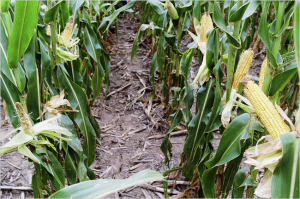 Can biotech come to the rescue? This New York times article suggests that big companies and single genes may do the trick. I have to see it before I believe it, something like this picture, which shows drought-resistant corn on the right, tested next to “traditional” corn plants in Nebraska, USA. I want to see that picture in the fields of African farmers.
Or should farmers who cannot grow maize because of drought start thinking of another crop? Why not grow sorghum?
Water hyacinth not so bad after all
Sure, the water hyacinth is a terrible weed on Lake Victoria. But, as I blogged last year, it does have some redeeming features, for example it can be used to make furniture. Now comes news that it can also be fed to animals, and that it shelters catfish fingerlings. 1 One man’s invasive weed is another woman’s income-earning opportunity. How long before it is officially classed as agrobiodiversity?
LATER: Ok, apologies. A comment alerted me to the fact that I had misread the article, and that hippo grass is not water hyacinth, but rather (probably) Echinochloa stagnina. The perils of common names. But the fact remains that people are making use of a plant that to many is a pest. The dividing line between useful agrobiodiversity and noxious weed can be hard to define. Thank you, Inoculated Mind.
American farmers got stoned a lot
Two articles this morning both point to the widespread use of hallucinogenic plants in ancient South America. National Geographic reports that traces of the mind-altering substance harmine have been found in the hair of Tiwanaku mummies from the coastal Chilean desert dating back to 800-1200 AD. Harmine comes from the Amazonian vine Banisteriopsis caapi, which suggests that an extensive trade network linked the rainforest to the desert. Elaborate sniffing kits have been found in many Tiwanaku tombs and also, as a Times article points out, at the other end of the continent in the Caribbean. Archaeologists have found ceramic bowls and inhaling tubes on the island of Carriacou and have identified them as originating in South America between 100-400 BC. The drug of choice in this case may have been cohoba.
So why was everyone getting high?
Richard Davenport-Hines, a former history lecturer at the London School of Economics and author of The Pursuit of Oblivion, a global history of narcotics, believes humans have been using drugs for thousands of years. “Drug use became widespread in many early agriculture-based societies simply because it was the only way people could cope with spending long hours working in the fields, often in horrible conditions like baking sun,” he said.
What is a landrace anyway?
When plant genetic resources people are tired and emotional, and sometimes when they’re not, talk can turn to landraces. What are they? Can they be identified unequivocally? Can they be associated with a geographical location? Are names anything other than a convenient fiction? Whole chapters, if not entire books, have been written on the subject. 2 There are definitions aplenty, of course, but that’s not the same as an answer.
Wrapped up in the definitions, and the answers, are notions of genetic variability within the landrace population and an element of selection being needed to maintain the landrace’s properties and maybe guide it in new directions. But that, of course, is crucially affected by the breeding biology of the species concerned. Bluntly, species that are reproduced clonally, like figs, say, or potatoes, are unlikely to have any variability within the landrace while those that are obligate outbreeders, such as maize, are going to be much more variable within the population and likely to change over time too. And then there are inbreeders — beans like Phaseolus vulgaris — in which the landrace is probably a mixture of different genetically pretty uniform types, each of which may well breed true, although the proportions of each may vary from season to season and from place to place.
All of which is a long and roundabout introduction to three recent papers in Theoretical and Applied Genetics that tackle the problem of landrace identity, all of them using molecular markers.
Oat (Avena sativa) is normally self-pollinating, but occasional crossing does occur. So we would not expect much variation within a population. Good thing that, because Hermann Buerstmayr and his colleagues sampled DNA from only three individuals in each of 114 oat varieties gathered from around the world. 3