Sure, we live in a globalized world, a global village. Recent events in the financial markets are somewhat painful reminders of that. But that doesn’t mean things are the same everywhere, or even going in the same direction. High(er) altitude farming is alive and well in Nepal, as Jeremy just noted. But on its way to extinction in England. Better irrigation is boosting rice yields in Cambodia. While karez wells are being abandoned in Afghanistan. That’s one reason why I don’t believe the genetic erosion meta-narrative. There is always an exception. And although you can sometimes see the world in a grain of sand, it’s better to look at the beach.
Calling Colorado State University locals
Rebecca Nelson, who researches improving disease resistance in crops, will be the speaker at the ninth annual Thornton-Massa Lecture at Colorado State University at 7:30 p.m. Monday, Oct. 13, in the Lory Student Center Theatre. Her topic is “Science vs. Hunger: The Challenges of Funding Research in International Agriculture,” and it would be great to get a report here.
Reflections on Barcelona
Danny Hunter has some thoughts on whether IUCN takes agricultural biodiversity seriously over at his Rurality blog. Crop Wild Relative Global Portal. The money quote:
There still appears to be a massive disconnect between the global conservation and agrobiodiversity communities.
LATER: There is, of course, no consideration of agriculture in the latest work on Key Biodiversity Areas, apart, that is, from seeing it as a threat.
A landscape to marvel at
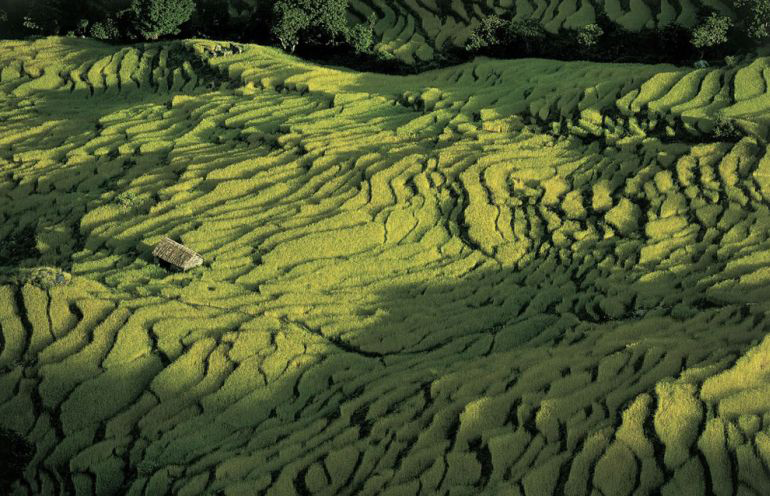
That image took my breath away when I saw it a couple of days ago. It shows rice terraces north of Pokhara, Nepal. The caption to the picture said that the economy of Nepal is based on agriculture,
“which employs 80 percent of the working population and accounts for 41 percent of the gross domestic product of one of the world’s poorest countries. Generations of farmers have tamed the mountainsides and prevented erosion by cutting terraces. Rice paddies thus rise in tiers as high as 9,800 feet (3,000 m) above sea level, covering 45 percent of Nepal’s cultivated land.”
The photo was one of almost 40 at a wonderful site called The Big Picture at boston.com. Two or three times a week Alan Taylor assembles a portfolio of outstanding photographs from around the world. This time they were by Yann Arthus-Bertrand, who has developed a wonderful technique of photographing nature and humanity from the air.
Many of the pictures that The Big Picture showcased depended for much of their impact on agriculture, and the patterns that human interference creates on the ground. This particular one caught my eye for two reasons. First off, it is very, very beautiful. Secondly, Pokhara is a famous name among some agrobiodiversity nuts (such as myself). I’ll explain in a minute. So, I made a note to come back and blog the story here when I had a moment. Imagine my horror, then, when I headed over to The Big Picture and found this note:
At the request of the coordinator of Yann Arthus-Bertrand’s upcoming exhibit, the number of photographs displayed here has been reduced to ten.
Pokhara had vanished. Yikes! That’ll teach me to procrastinate. But, knowing as I do the Dark Side of the Web, I simply assumed that someone, somewhere, would already have stolen it, and I was right. Lock, stock and barrel, the entire sequence of 38 images had been scraped by a nefarious site (to which I will naturally not link). They’d even had the gall to put their own credit on the image, a matter of minutes to excise. So, saved, by evil. 1
Which brings me to the importance of Pokhara. The farmers there have been working with a local NGO called LI-BIRD and with Bioversity International to develop a local landrace of rice. After a concerted effort to find and then assess hundreds of versions of the landrace, the farmers came up with an improved version that was eventually registered with the Nepalese authorities as a “proper” variety that can be sold. That may not sound like much of an achievement, but take it from me: it is. But I had never seen the agricultural landscape in which this work was undertaken. Now that I’ve seen Arthus-Bertrand’s picture, I’m even more impressed.
You can read about Pokhareli Jethobudho at the web site of Bioversity International and at the International Development Research Centre in Canada, one of the donors that supported the project.
The forest: back to the future
I’ve blogged before about the myth of the pristine forest, at least as it applies to the Amazon, and a long feature in the University of Chicago Magazine entitled Can’t See the Forest for the Trees does a good job of summarizing that argument. But it does a lot more by putting it in a global context. I hadn’t realized that researchers that see the Amazon as a “working landscape” are increasingly finding kindred thinkers in other parts of the world: in the “secret forests” of El Salvador, the greening Sahel, the tea forests of China. There’s a lot of talk nowadays in such circles of the “social life of forests” 2 and about local communities taking back control, and becoming “gardners of the forests,” in the words of Peter Crane, formerly Director at Kew. Says Chris Reij of the Centre for International Cooperation at the VU University Amsterdam:
“The foresters have the idea that they have to protect trees from farmers. Our own view is that forests have to be protected from foresters.â€