- Governing Agrobiodiversity by Regine Andersen. Anyone read it and want to review it for us?
- Louise Sperling on assessing the security of seed systems.
- Ike inflates Cohiba prices?
- Kibera slum goes very green. Via.
- “35 years ago, I was bringing seeds from France to California. Now I’m bringing seeds back to my friends in France.”
- John Innes Centre maps out a future for peas.
- Pictures from my recent trip to CATIE in Costa Rica, including some agrobiodiversity.
The value of pollination: euros 153 billion in 2005
INRA and CNRS French scientists and a UFZ German scientist found that the worldwide economic value of the pollination service provided by insect pollinators, bees mainly, was €153 billion in 2005 for the main crops that feed the world. This figure amounted to 9.5% of the total value of the world agricultural food production. The study also determined that pollinator disappearance would translate into a consumer surplus loss estimated between €190 to €310 billion.
My jaw dropped. Read the full study here.
Harlan II, day 1
From our man on the spot at Davis, Robert Hijmans.
It is only one day old, but the Harlan II symposium is the best I have been to for ages. That the subject is of some importance helps, of course. In his keynote speech, Jared Diamond called it nothing less than the most important event in the last million year of human history. Guess what, it has something to do with agrobiodiversity. It is plant and animal domestication, of course. Have a look at the program and you may understand that I am challenged to summarize the proceedings. But here are some impressions.
Domestication took a long time. Dorian Fuller summarized archaeological data to show that traits associated with domestication, such as non-shattering of grains, evolved slowly, over 1000s of years. Some speakers distinguished the initiation of cultivation from domestication. I had always thought of these two things as happening at the same time. But why not cultivate wild wheats, or rice? Benjamin Kilian showed data suggesting that wild einkorn was cultivated in Turkish parts of the Fertile Crescent. And Susan McCouch of Cornell University pointed out that, after 4000 years of cultivation, the common rice of West Africa, Oryza glaberrima is not domesticated yet: it still shatters. And I think there are many animal species that are not domesticated but that are nevertheless put to good use. Vicuña for example.
The question whether we domesticated plants or they domesticated us was not (yet) discussed, but there was reference to the self-domestication of dogs and cats. Robert Wayne showed that dogs were domesticated from Mediterranean grey wolves. But wolves are not very friendly to humans, how would you go about taming them? Wayne thinks that it was the wolves who approached our ancestors because they liked to eat the leftovers of their hunting parties. Over time, they may have lost some of their fear and aggression towards humans (obviously not realizing they would end up as chihuahuas). Likewise, cats may have approached ancient towns to catch some of the abundant mice in the granaries of the agricultural revolution.
Molecular biology rules. Remarkable progress is being made in analyzing the genetic make up of crops, the remains of ancient crops, and of crop wild relatives, to solve the puzzles of how our crops and domestic animals left their wild states. In some cases, this work leads to truly new insights in otherwise uncharted territory. In other cases, the molecular work confirms or refines insights that others had obtained from morphological, geographical, and archaeological data.
Even religion was invoked. John Burke explained that sunflower become a popular source of oil in Russia because it could be used during the Lent season, whereas all other sources of oil were on the black list of the Russian church. Gila Kahila Bar-Gal has put the insights from her ancient DNA work on archaeological remains of caprins (goat like creatures) to good use: she showed that the Dead Sea Scrolls were written on goat skin (not sheep). Unfortunately, there was also pieces of (wild) oryx skin — which is not kosher — but these were only used as wrapper; a relief.
Agrobiodiversity at the Ara Pacis
A sunday morning wander around the area surrounding the Piazza di Spagna ended with lunch at ‘Gusto and then our first chance to see the Ara Pacis, the Altar of Augustan Peace, in its fancy modernist cocoon. There is some controversy about the meaning of the left scene on the East wall — the so-called Tellus panel:
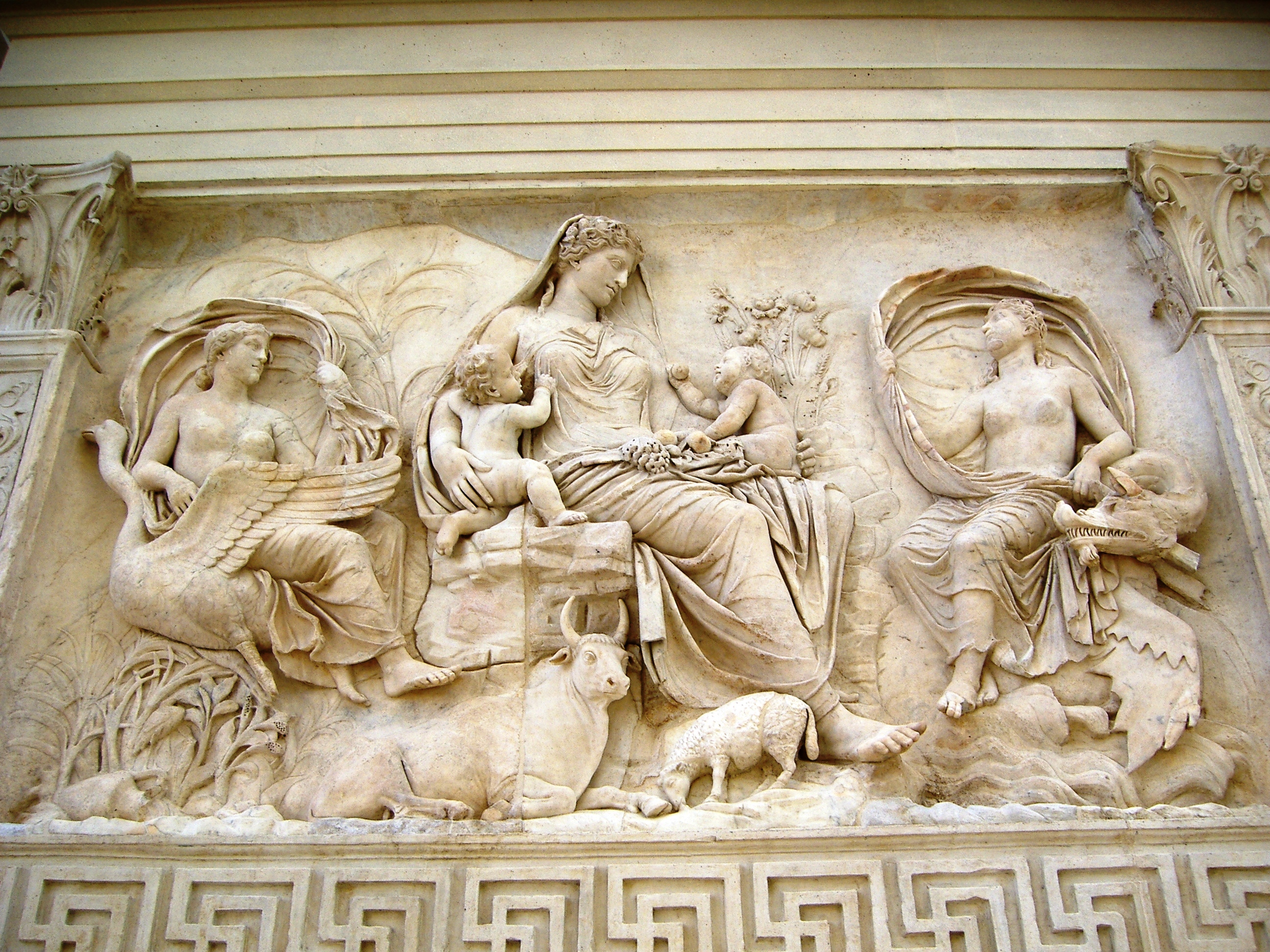
But there’s no doubting that it is a marvellous hymn to the bounty of agricultural biodiversity. You can see a cow and a sheep. wheat and poppies, grapes and pomegranates. Oh, and a sea serpent. No wonder one of the more solid interpretations identify this lady as Mother Earth.
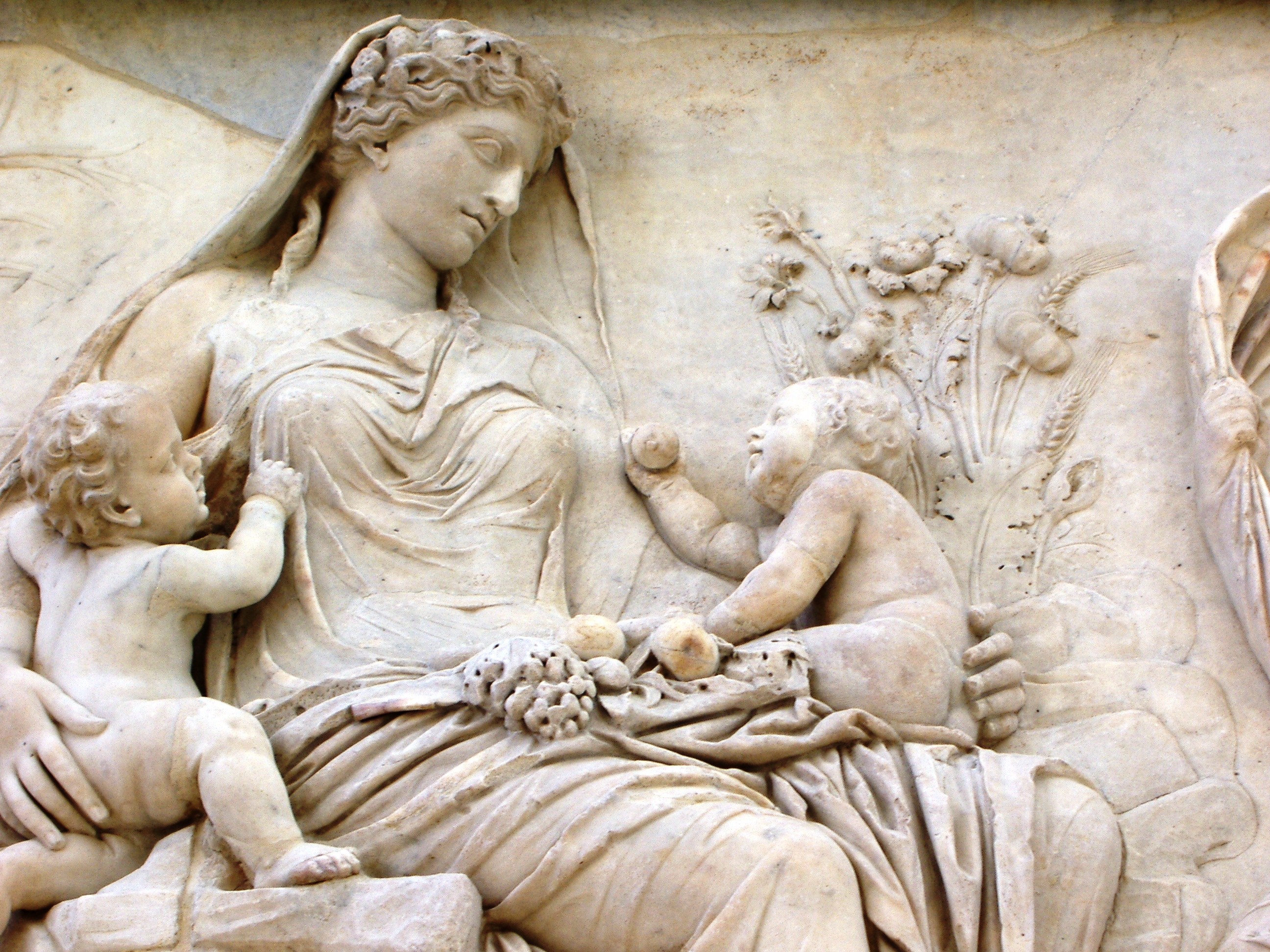
More details here.
I can’t believe it’s not meat/fish/eggs/a penis
Elizabeth Andoh, an American who has lived in Japan for 25 years, talks about “food that is not what it seems.” Modoki has nothing really to do with deception, it is all about having fun with your food. Links to Buddhist cuisine of China, vegetarian and vegan stuff, often made to resemble stuff that did have the potential for life.
There is an ancient Japanese book called “100 things to do with tofu.”
She shows a picture of real eel (I’m not getting the names, thanks to the PA) and then a fake (modoki) that is visually identical, down to the surface look of the “fish”. Gobo (burdock root) and lotus root help the whole thing to stick together.
“You have to have keen powers of observation and to take into consideration texture even more than taste. Truly, if you closed your eyes, you would think you were eating eel.”
Now we’re onto Ganmodoki, which is a version of goose meatballs, no goose meat.
“Soy milk skins sound like something even a dermatologist doesn’t want to know about.” They have a wonderful unctuous texture and a creamy feel in your mouth. They perish easily, and are dried, but can be resuscitated by wrapping in a damp cloth. Resemble a thin omelette, an impression that can be enhanced by adding the dried seeds (or buds?) of a gardenia, which “bleed an intense neon yellow”. The end result can be shredded and used as “eggs” in other dishes.
Pseudo-chestnuts made of fish and shellfish meat and fried noodles with a whole-roast chestnut poked inside, provoking a memory of the whole chestnut.
A teeny tiny persimmon made from a dyed quail’s egg with a piece of kombu stuck to the top.
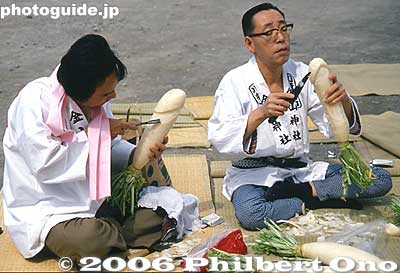
One of the elements in modoki is sheets of daikon radish, which take an amazing amount of skill to make: watch this.
A perfect segue into Michelle Toratani, who takes the floor to talk about a very particular individual daikon, “the fighting root”. A very bizarre story.
How did a vegetable root become a super-hero? Because it is such an important daily vegetable in Japanese life. People can really identify with it.
On to the proper stuff. Daikon originated in China, came to Japan about 1000 years ago. There are about 100 regional varieties of daikon. Don’t have to be white, can be red or deep purple.
Frankly, there’s so much here about the daikon in culture (some of which Luigi nibbled), that I really don’t want to get into here on a Sunday morning. See for yourself. Or Google Daikon Penis.