19 cities in the world with 20 million people in the 21st century is a slide show that sets out a jaw-dropping agenda to study the near future. The slide are wonderful, so is the concept. One can but hope that the results will be too. Just one little niggle: nowhere among the 14 “subjects of exploration” does the word “food” appear. Health, yes. Nutrition, no. Water sources, yes. Agriculture, no. Maybe sustenance will find its way into all the explorations, but somehow I doubt it. 1
Association Kokopelli fined (again?)
Over a year ago we reported that a French court had fined the Kokopelli Association €17,130 for putting unregistered seeds on the market. Today we learn that a fine of €35,000 has been levied, after Baumaux, a seed company, took the association to court. It isn’t clear whether these represent one case, with an increased fine, or two separate cases. What is clear is the lunacy of the argument:
Association Kokopelli were found guilty of selling traditional and rare seed varieties, which were not on the official EU-approved list. Such seeds are deemed illegal to sell on the grounds that it gives the seller an “unfair trading advantage”.
Right. Selling people what they want, rather than (or in addition to) what you want, is unfair. 2
In related news, the same article says that the European Commission either has met or will meet to consider the new seed marketing directives or regulations, which we have also discussed here before. Very hard to penetrate those mysteries, so nothing to report, but we’ll keep our ears open. And if any readers can shed any further light on the subject, share it with us, please.
Threatened livestock species?
Many thanks to Michael Kubisch for this contribution.
An interesting recent article in Molecular Ecology asks the provocative question of whether cattle, sheep and goats are endangered species. 3 Yes, that is species, not breeds. While nobody will question the fact that many livestock breeds all over the world are at risk of disappearing, the suggestion that whole species may be at risk would seem far-fetched.
Well, not if you’re a geneticist. The article nicely summarizes what’s been lost in terms of genetic variation and the overwhelming impression one gets is that it’s quite a bit. Even in breeds such as Holstein cattle where animals number in the millions, the effective population size, which is an indicator of the degree of genetic variation, would suggest that such populations tend to be relatively homogeneous. The primary reason for this is, as one might expect, mostly economic necessity. The selection pressure for increasing production of desired commodities has inevitably led to the loss of genetic diversity. What seems to have accelerated this loss is the use of modern technologies such as artificial insemination, which allows for rapid and widespread dispersal of the genetic attributes of relatively few males. And this may just be the beginning. The fact that advances in cloning technology now make it feasible to generate transgenic animals with added, deleted or altered genes means that such changes would by necessity depend on their dispersal on very few founder animals. So it is likely that this trend is not only continuing but may, in fact, be accelerating.
Adapting in the Andes
Climate change is leading to an increase in late blight and other diseases in Andean potato fields, and farmers are moving up the mountain in response. They’re also trying to figure out which of their dozens of varieties — plus others from genebanks, especially CIP’s — are going to do best, where. Hear all about it at NPR. There’s a great slideshow too.
Out and about: Smithfield Horse Market
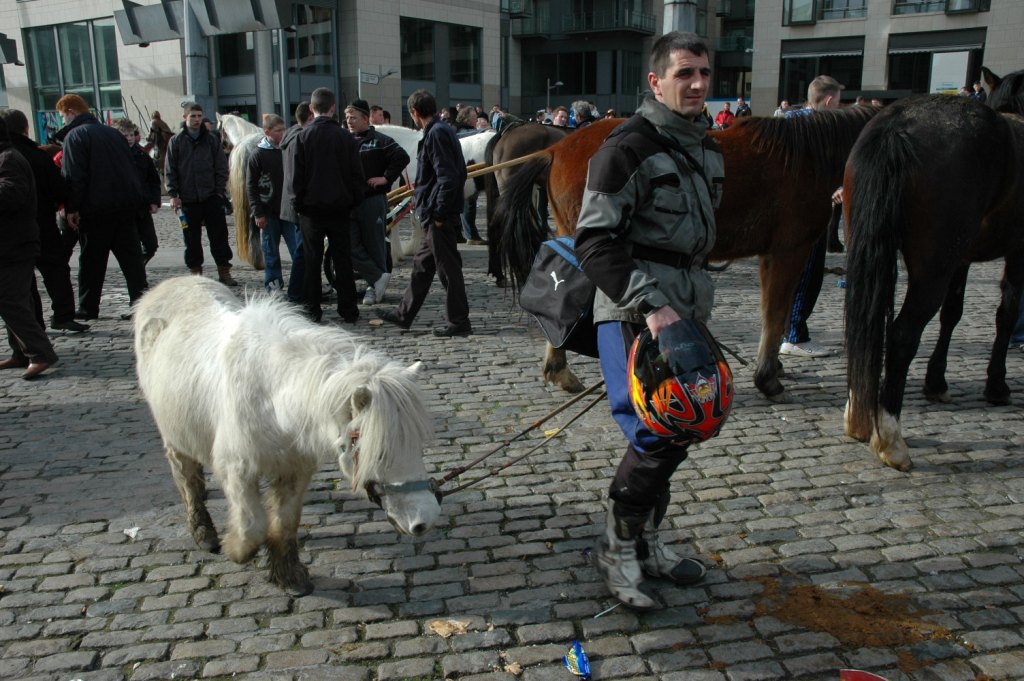
This just in from our friend and occasional contributor Danny Hunter out and about in Dublin admiring the agricultural biodiversity on show in a local market.
I walked one minute up the road to the Smithfield Horse Market and was surprised at how big a concern it was. There were horses, ponies and donkeys of all sorts. It was chaotic and pretty much unmanaged. Largely run by and catering for the Traveller community. At one stage there was a bare knuckle fist fight between two brothers apparently. If you missed that you could always go to the van selling videos which had a wide range of DVDs of all sorts of family members, friends and foes slugging it out (among the many road races the Travellers organise in various places). Kids as young as 12 years old were buying and selling! While it is always lovely to be around horses and get some nice shots it all seemed a bit brutal and sad. I liked the scene of the guy with crash helmet and shetland pony walking through the market. After a few hours of sweet fresh horse dung I set off on the Luas for the fresh lungs of Bray and did the 10km coast walk to Greystones.