- Medium-term seed storage of diverse genera of forage grasses, evidence-based genebank monitoring intervals, and regeneration standards. One size does not fit all.
- Sustainability gridlock in a global agricultural commodity chain: Reframing the soy–meat food system. Divide and conquer.
- Farm establishment, abandonment and agricultural practices during the last 1,300 years: a case study from southern Sweden based on pollen records and the LOVE model. Medieval Swedes got high.
- A review of breeding objectives, genomic resources, and marker-assisted methods in common bean (Phaseolus vulgaris L.). Oh dear, a worldwide catalogue of germplasm needed.
- Construction of genetic linkage map and genome dissection of domestication-related traits of moth bean (Vigna aconitifolia), a legume crop of arid areas. No word on whether a catalogue is needed.
- Resources and opportunities for re-establishing Lathyrus cicera L. as a multipurpose cultivated plant. I’d try it. But do a catalogue first.
- Ex situ seed banks and the IUCN Red List. When is extinct not extinct?
- Convergent seed color adaptation during repeated domestication of an ancient new world grain. Grain amaranth selected 3 times independently from same wild precursor, but always for the same colour.
- Modeling epidemics in seed systems and landscapes to guide management strategies: The case of sweetpotato in Northern Uganda. Spread of disease depends on where it starts. Watch out for places with lots of out-nodes.
- A Molecular View of Plant Local Adaptation: Incorporating Stress-Response Networks. Adaptation here does not necessarily mean no adaptation there. Interesting for breeders?
- Using social norms to encourage healthier eating. To get kids to eat broccoli, tell them their favourite youtuber does. Probably generalizable.
- Nutrition Transition and the Structure of Global Food Demand. Lower growth in overall food demand than in the past, but a doubling of demand for animal calories.
- Grass pea (Lathyrus sativus L.): orphan crop, nutraceutical or just plain food? Needs to shed its bad image.
- Origin and evolution of the octoploid strawberry genome. All four parents tracked down.
Brainfood: Australian pigs, EAHB breeding, Megafauna lunch, Women & agrotourism, Biodiversity & productivity, US beans, Potato ploidy, Phenotyping forests, Sudan cattle genomics, Botanic gardens, Pepper resources, Vanillin, CWR maintenance
- What does the ‘closed herd’ really mean for Australian breeding companies and their customers? Australia has enough pig diversity to be going on with.
- Crossbreeding East African Highland Bananas: Lessons Learnt Relevant to the Botany of the Crop After 21 Years of Genetic Enhancement. Not completely sterile, but hardly very fertile either. Hard row to hoe.
- Are we eating the world’s megafauna to extinction? Yes.
- A systematic map of evidence on the contribution of forests to poverty alleviation. Always like a map.
- Turismo Rural y Conservación Ambiental: La Participación de la Mujer Campesina en la Reserva de la Biosfera los Tuxtlas, Veracruz, Mexico. It would be a good idea.
- Not even wrong: The spurious measurement of biodiversity’s effects on ecosystem functioning. Biodiversity likely not as important for ecosystem productivity as previously thought, because maths.
- Evolution of SSR diversity from wild types to U.S. advanced cultivars in the Andean and Mesoamerican domestications of common bean (Phaseolus vulgaris). Some base-broadening may be called for.
- Comparison of Methods to Distinguish Diploid and Tetraploid Potato in Applied Diploid Breeding. Count chloroplasts.
- Phenotyping Whole Forests Will Help to Track Genetic Performance. You heard.
- Signatures of positive selection in African Butana and Kenana dairy zebu cattle. Adapted to marginal environments, but with potential for higher milk production.
- How cultivating wild plants in botanic gardens can change their genetic and phenotypic status and what it means for their conservation value. In the end, it’s a numbers game.
- Genetic Resources of Capsicum. Could use more wild relatives, more.
- Vanilla bahiana, a contribution from the Atlantic Forest biodiversity for the production of vanilla: A proteomic approach through high-definition nanoLC/MS. But does it taste the same?
- Spontaneous hybridisation within Aegilops collection and biobanking of crop wild relatives (CWR). I guess that’s bad. But could it be useful?
A survey on genebank learning materials
A request from Gayle Volk (USDA-ARS) and Pat Byrne (Colorado State University). Please respond by 15 March.
The plant genetic resources conserved by genebanks around the world are the essential raw materials for increasing crop genetic diversity and improving the global supply of food and other agricultural products. Colorado State University and USDA-ARS have developed a short survey (5-10 minutes) to assess the needs for various types of learning materials to educate the next generation of plant genebank managers, as well as to inform students about the value and use of plant genetic resources in breeding and research programs. The survey link can be found here.
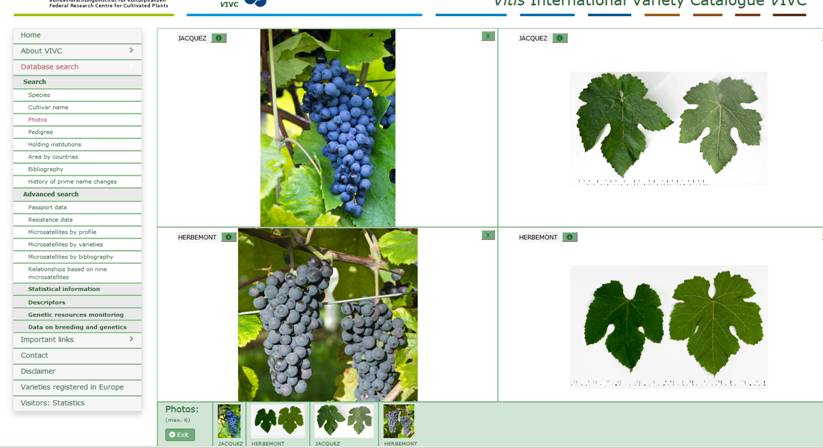
Featured: Herbemont
It seems I may have inadvertently walked into a little bit of a controversy with that post on Herbemont. Dr Jerry Rodrigues of the University of Cape Town hopes for a resolution in a comment on the post:
Let’s hope that sooner rather than later, researchers in the Department of Viticulture and Enology or at the National Clonal Germplasm Repository (University of California, Davis) or the Plant Genetic Resources Unit (PGRU) at Geneva, New York will not be afraid to make public the microsatellite DNA markers for the true Herbemont.
Whereas Erika Maul from the Julius Kühn-Institut, which maintains the Vitis International Variety Catalogue (VIVC), has this to say in an email:
Herbemont and Jacquez are maintained in European collections and seem not to be endangered. These photos from VIVC could assist to confirm identification.
What is the State of the World’s Biodiversity for Food and Agriculture?
Spoiler alert: It’s not good.