There’s a new set of weekly information nibbles in town:
Food Bytes is a weekly blog post of “nibbles” of information on all things food and nutrition science, policy and culture.
It’s a bit tricky to work it out, but the person behind this welcome addition to the discussion of nutrition and related issues is none other than Dr Jess Fanzo, co-chair of the Independent Expert Group of the Global Nutrition Report. Which gives me the opportunity to remind everyone in the words of Jess herself that said report came out a couple of months back :
The Global Nutrition Report was released this November. The news is not great. The report revealed that the global burden of malnutrition is unacceptably high and now affects every country in the world. But it also highlighted that if we act now, it is not too late to end malnutrition in all its forms. In fact, we have an unprecedented opportunity to do so. Steps have been taken in understanding and addressing malnutrition in all its forms, yet, the uncomfortable question is not so much why are things so bad, but why are things not better when we know so much more than before? Check it out and read all the deets.
This recommendation from the report is particularly relevant to us here:
Healthy diet policies and programmes are proving effective in countries, cities and communities but overall there is inadequate delivery of a holistic package of actions. The World Health Organization Global database on the Implementation of Nutrition Action (GINA) includes more than 1,000 national policies in 191 countries in support of healthy diets. For example, many countries have adopted sugar-sweetened beverage taxes in recent years, and these are proving effective, as are product reformulation policies. Large-scale food fortification is another area where there has been progress – but also exemplifies that there remain many barriers to change. A growing number of community and city-level initiatives are being implemented to improve diets and nutrition. New evidence is showing that intensive multi-level action can improve infant diets and reduce childhood obesity. Lessons could be scaled up from city to national level and shared through newly emerging international city networks. To date, however, few countries have implemented the comprehensive package of actions needed to significantly improve diets at the population level.
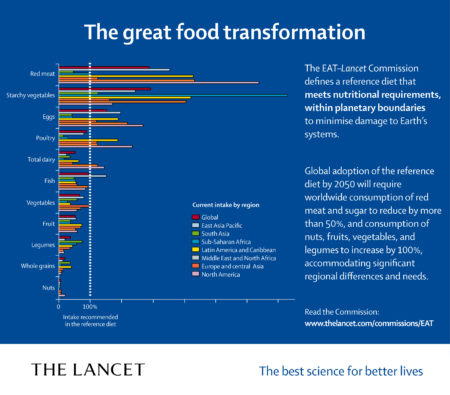
And since we’re on the subject, the EAT-Lancet Commission on Food, Planet, Health, which is attempting to reach a scientific consensus on what constitutes a healthy and sustainable diet, is delivering its first scientific review tomorrow. No doubt Jess will have something to say about it in due course.
But if this commentary from Frédéric Leroy is anything to go by, that consensus may be elusive, at least with regards to meat.
…the campaign, that will be launched in Oslo on January 17th, sounds like a powerful push to shift global diets by discouraging animal products. It is fuelled by large budgets and will be mediatised for a long time to come, scheduling more than 30 events around the world. But a closer look into its background reveals some perturbing elements. The danger is that the overstatement of certain concerns will result in an anti-livestock narrative, create a false impression of scientific consensus, and do more harm than good in a world in need of nutrient-rich meals and sustainable food systems.