USDA just announced an update to their instance of GRIN-Global, the genebank data management system, where you can explore the holdings of the U.S. National Plant Germplasm System at your leisure. From there the data finds its way to Genesys, where you can compare US holdings with those of other contributing genebanks. Perhaps the most significant change is the resurrection of the Crop Wild Relatives search page, a monumental resource.
ITPGRFA Benefit-Sharing Fund sharing funds again
From an FAO press release:
The Call for Proposals under the fourth cycle of projects to be funded through the Benefit-sharing Fund of the FAO International Treaty on Plant Genetic Resources for Food and Agriculture is now open. All developing countries that are Contracting Parties to the International Treaty are eligible to apply for funding under the Benefit-sharing Fund (BSF), which will invest at least USD 5 million in projects over the next four years.
All the details are on the Treaty website. Good luck, everyone!
Jobs available
Fancy blasting plants with mutation-inducing atomic rays? Good news just in from our friend Norman Warthmann, who recently joined the Plant Breeding and Genetics Laboratory of the FAO/IAEA joint Division in Vienna, Austria. They have two fairly high-level job openings. I can’t actually find the vacancy notices on the site, but I’m sure if you email Norman, he’ll send them to you.
Good luck.
LATER: One of the jobs is as a plant breeder.
Veggiexit
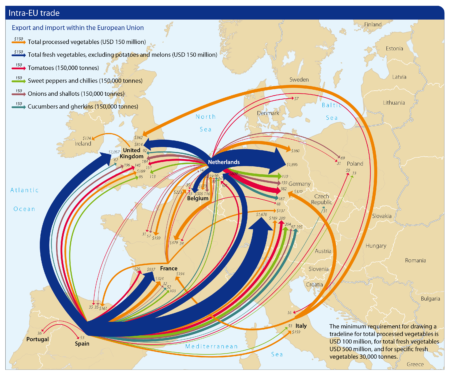
Gosh, I hope the Brits make a trade deal on vegetables.
Back to the future for the forests of Central Africa
Two of the authors, Jean Maley and Alex Chepstow-Lusty, summarize a recent paper in Quaternary Research for us.
A recent article in Quaternary Research 1 by Jean Maley at the University of Montpellier and colleagues, which focuses on the scale of natural contraction and fragmentation of the rainforests across Central Africa 2500-2000 years ago, may have major implications for agriculture in this vulnerable region today. During this period, linked to global climate change, dry seasons became longer, and, combined with intensified storm activity, resulted in widespread erosion.
It has been proposed that this fragmentation 2500 years ago allowed the second and major phase of migration of Bantu-speaking peoples through the forests 2, who were able to exploit pioneering trees, such as energy rich oil palms that had colonized the gaps created, as well as cultivate for the first time cereals in this newly created agricultural zone, including pearl millet (Pennisetum glaucum), for which archaeological evidence has been found.
This map in the paper indicates the extent of the forest refuges 2500 years ago, which were more resilient to climate change and hopefully shall remain so. The longer dry season, between 2500-2000 years ago, eliminated previous rainforests, and provided space for pioneer forests and savanna. Subsequently, after 2000 years ago, the rainforests grew back. In some regions, from south-eastern Cameroon to the northeast and east of the Congo Basin, a new forest formation developed, characterized by Gilbertiodendron dewevrei (‘Limbali’), a shade tolerant tree belonging to the Fabaceae-Caesalpinioideae. This canopy tree forms very dense, practically monospecific, evergreen stands in which the species regenerates well under its own shade. Nevertheless, some fragments of savanna have survived to this day as islands within the rainforest.
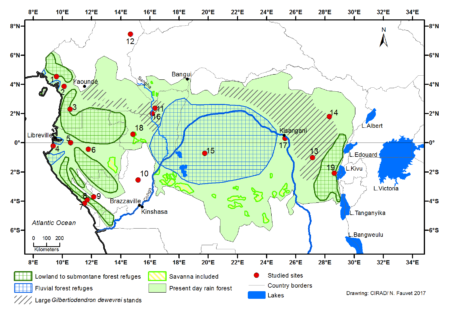
Recent meteorological data, including increased thunder and lightning activity, may already be suggesting that the climatic patterns leading to forest contraction and major erosion are starting again. Hence, the interval 2500-2000 years ago could provide a model for the future, with the savannas re-expanding (i.e. especially in the areas outside of the forest refuges). Previously, this occurred when human populations were negligible. That’s not the case now.
If predictions of an extended dry season become a reality, agriculturally a greater emphasis should probably be placed on the cultivation of African native cereals 3, which maintain the characteristics of their wild savanna ancestors. Besides pearl millet, these include sorghum (Sorghum bicolor), finger millet (Eleusine coracana), fonio (Digitalis exilis and D. iburua) and African rice (Oryza glaberrima), and there should be less dependence on the relatively recent introductions and more demanding global cereals: wheat, rice and maize. Indeed, this approach could be essential for maintaining the production of arable lands in much of Central Africa and providing food security for an ever-growing population.
This paper brings together a range of data across a wide-geographical area, and should act as a wake-up call, with the implications for climate change, human activities and conservation already being experienced.