- The Use of Crop Wild Relatives in Maize and Sunflower Breeding. In maize, unlike sunflower, it just hasn’t been worth it. Yet.
- Securing sustainable and nutritious food systems through mainstreaming agricultural biodiversity: an interdisciplinary study. What works in Brazil won’t necessarily fly in India.
- Duplication assessments in Brassica vegetable accessions. Half of 13 accession pairs/triplets with identical names from VIR and NordGen turned out to be morphologically identical.
- Beans (Phaseolus ssp.) as a Model for Understanding Crop Evolution. 7 independent domestication “events” spread across 5 species and 2 continents makes for some interesting natural experiments.
- A Mesoamerican origin of cherimoya (Annona cherimola Mill.). Implications for the conservation of plant genetic resources. Compare and contrast with above.
- Highly productive forage legume stands show no positive biodiversity effect on yield and N2-fixation. Sometimes diversity doesn’t add much.
- Genetic Resources of Pearl Millet: Status and Utilization. 22,888 accessions from 51 countries. Indian landraces: earliness, high tillering, high harvest index and local adaptation; African: bigger panicles, large seed size, and disease resistance.
- Use of natural diversity and biotechnology to increase the quality and nutritional content of tomato and grape. Both are needed.
- Rhubarb (Rheum species): the role of Edinburgh in its cultivation and development. From China, via Russia, with love.
- Will phenotypic plasticity affecting flowering phenology keep pace with climate change? If the change is smaller than about 13 days.
- Seed dispersers help plants to escape global warming. Because they move seed >35 m per decade uphill.
Alright already

You see a grumpy plant biologist. Ask them what stomata? #PlantDay @RoyalSocBio pic.twitter.com/hM7MRyx9my
— Mr C (@mintchemistry) May 17, 2017
Indian nutrition and crop diversity link ready to be explored
Is there a relationship between levels of stunting in Indian districts…
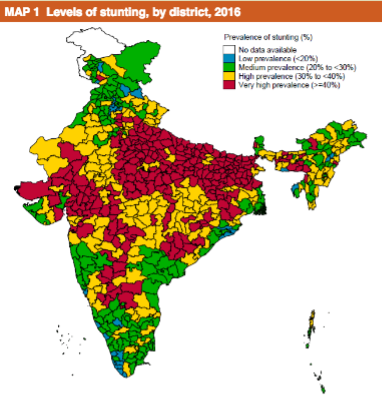
…and crop diversity in their farming systems (blue low, green high)?
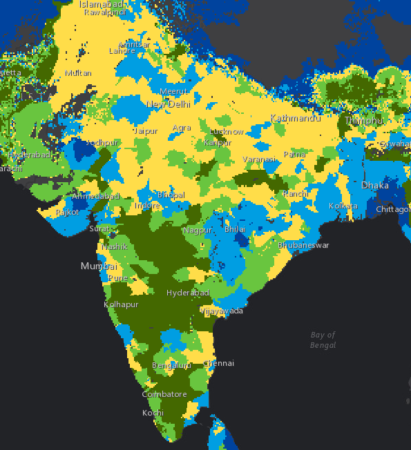
I have no idea. But I think we should be told.
New CGIAR portfolio off and running
CGIAR launched its new portfolio yesterday, there was a Twitter chat thing, and I wrote a blog post about the Genebanks Platform. Not many people hurt.
How genetic improvement and crop intensification improve wellbeing
Featured: Mapping crops
Glenn is ready to take up our challenge on crop distribution mapping:
I suppose that you could use “big data” & machine learning to find individual crop patterns in all that data. I think that some people are doing this kind of thing, but it’s private sector stuff. The global crop maps rely too heavily on data from surveys and censuses, and all the problems that come with those in terms of standardizing across countries.
Kinda. Sorta.