- Genetic diversity of Bolivian wild potato germplasm: changes during ex situ conservation management and comparisons with resampled in situ populations. It’s all a bit of a lottery.
- Traditional preparations of kava (Piper methysticum) inhibit the growth of human colon cancer cells in vitro. Still tastes like crap, though.
- Multiple horizontal transfers of nuclear ribosomal genes between phylogenetically distinct grass lineages. 9 independent instances of non-sexual panicoid introgression into wild barley species.
- Who is sowing our seeds? A systematic review of the use of plant genetic resources in research. Ahem, researchers? Study of the UK Vegetable Genebank.
- Evaluation of Lotus corniculatus L. accessions from different locations at different altitudes reveals phenotypic and genetic diversity. Phenotype could be the same, and genotype still be different.
- De novo hybrid assembly of the rubber tree genome reveals evidence of paleotetraploidy in Hevea species. Which happened before Hevea and Manihot diverged.
- Potential Uses of Wild Germplasms of Grain Legumes for Crop Improvement. “A big international effort is underway with the aim to adapt agriculture to climate change, which includes collecting, protecting and preparing crop wild relatives. Several pulses are among the major targets: common bean, adzuki bean, chickpea, cowpea, faba bean, groundnut, lentil, lima bean, mung bean, pea, pigeonpea, soybean, urd bean and vetch [197,198]. The information generated and systematized from this project certainly will be a unique source of information and materials facing the current and futures challenges for agriculture in the context of crop wild relatives use.” How sweet.
- Assessing the Benefits of Andean Crop Diversity on Farmers’ Livelihood: Insights from a Development Programme in Bolivia and Peru. Private benefits can incentivize public ones.
- Modelling of species distributions, range dynamics and communities under imperfect detection: advances, challenges and opportunities. Beyond mere presence.
Everybody’s a comedian
.@AgroBioDiverse complicating the job for critical discourse analysts https://t.co/IPK934QIH1
— Ola Westengen (@OlaWestengen) February 17, 2017
All things tropical forages
Great article on improved tropical pastures by Dan Charles on NPR’s The Salt yesterday. Here’s the money quote:
According to Michael Peters, who leads CIAT’s research on tropical grazing, pastures made up of these grasses can support three times more cattle, compared to typical tropical pastures today. The animals also gain weight twice as quickly. It translates into a six-fold increase in production per acre, and a dramatic cut in greenhouse emissions.
“These grasses” are Brachiaria species, but of course there’s much more than just those in CIAT’s forages genebank. And then there’s ILRI’s forages genebank too. And a global strategy to rule them all. And a newsletter to subscribe to if you want to keep up to date.
Mapping pests the old fashioned way
The collaborative project “Predicting climate change-induced vulnerability of African agricultural systems to major insect pests through advanced insect phenology modeling and decision aid development for adaptation planning” was led by CIP and implemented in collaboration with the International Centre of Insect Physiology and Ecology (icipe) and the International Institute for Tropical Agriculture (IITA). In the project, pest risk assessments under potential future climates were conducted for a number of important insect pests of agricultural and horticultural crops in Africa (i.e., potato, sweetpotato, vegetables, maize, cassava, and fruit). Results of these assessments are presented in the Pest Distribution and Risk Atlas for Africa (Pest Risk Atlas for Africa, for short).
And here it is, covering 3 potato pests, 5 for sweetpotato, 4 for vegetables and 5 for maize. For each pest, there’s a lot of information on detection and identification, biology, impact, and control, as well as a detailed geographic analysis of distribution and severity, now and in the future, at various scales.
Check out, for example, what’s going to happen to sweetpotato whitefly (Bemisia tabaci) in Africa (there are also global and country maps, in this case).
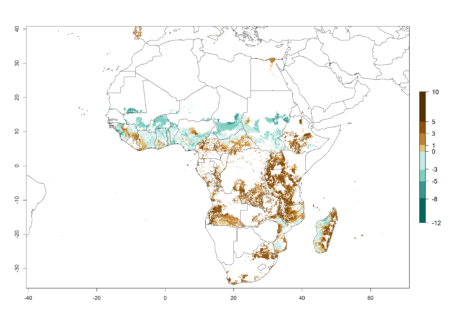
This shows the absolute change in potential population growth between 2000 and 2050. Note the bad news for Central Kenya, which will be interest the mother-in-law, who rents out some bottomland for sweetpotato. And she’ll have plenty of Chinese company, by the looks of the global maps.
At least, I guess so. It’s difficult to be sure when all you have are maps in the form of images. I do hope they’ll be available on Google Earth in due course, for researchers (and indeed farmers) who want to drill down a bit.
Brainfood: Cotton domestication, Niche modelling, Finger millet double, Bird flu, Lake Chad millet, USDA Ethiopian sorghum, Phast phenotyping, Corchorus genomes
- Genome-wide divergence, haplotype distribution and population demographic histories for Gossypium hirsutum and Gossypium barbadense as revealed by genome-anchored SNPs. Parallel domestication.
- Integrating species distribution modelling into decision-making to inform conservation actions. You need really nice maps.
- Establishing a core collection of finger millet (Eleusine coracana [L.] Gaertn.) ex situ holdings of the Ethiopian genebank. Particularly interesting for the discussion of what to do with the core, now that it exists.
- Characterization of Some Ex Situ Conserved Finger Millet (Eleusine coracana (L.[/efn_note] Germplasm Accessions in Sri Lanka. Unlike this one.
- Global mapping of highly pathogenic avian influenza H5N1 and H5Nx clade 2.3.4.4 viruses with spatial cross-validation. It’s the intensively raised chickens.
- Unexpected pattern of pearl millet genetic diversity among ethno-linguistic groups in the Lake Chad Basin. Different linguistic groups have genetically distinct pearl millet, but only on the western side of the lake.
- Genomic characterization of a core set of the USDA-NPGS Ethiopian sorghum germplasm collection: implications for germplasm conservation, evaluation, and utilization in crop improvement. 7,217 accessions from Ethiopia, 374 in the core subset, representing 11 highly admixed and very diverse populations.
- High-throughput phenotyping and QTL mapping reveals the genetic architecture of maize plant growth. Brave new world.
- Comparative genomics of two jute species and insight into fibre biogenesis. There are a few but interesting genetic differences between the 2 species of Corchorus cultivated for fibre. No word on the differences between fibre and vegetable varieties, if any.