- EURISCO: The European search catalogue for plant genetic resources. 43 countries, 400 institutes, 1.8 million accessions, and a vital part of Genesys!
- Yield-related salinity tolerance traits identified in a nested association mapping (NAM) population of wild barley. Salinity allele found in wild barley.
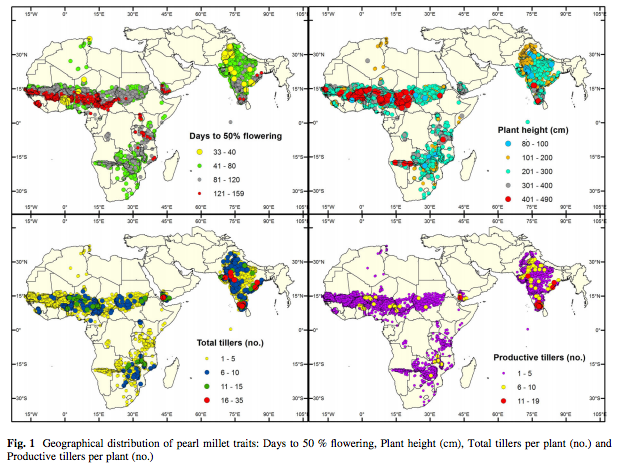
- Geographical distribution of traits and diversity in the world collection of pearl millet [Pennisetum glaucum (L.) R. Br., synonym: Cenchrus americanus (L.) Morrone] landraces conserved at the ICRISAT genebank. Plant height in Burkina Faso ranges from 80 to 490cm.
- Hardy Kiwifruit Genetic Resources. They’re wild.
- Deciphering Genetic Diversity in the Origins of Pepper (Capsicum spp.) and Comparison with Worldwide Variability. Diversity is decreasing in Ecuador.
- Simple Sequence Repeat (SSR) markers show greater similarity among morphologically diverse Date palm (Phoenix dactylifera L.) cultivars grown in Pakistan. Morphologically diverse varieties show little genetic diversity.
- Assessing climate adaptation options and uncertainties for cereal systems in West Africa. About the only thing that’s going to work is increased temperature resilience during flowering.
Dissecting pearl millet diversity
 Our friends at ICRISAT have been busy describing their pearl millet collection, and their latest offering is a thorough analysis of the geographic distribution of morphological traits. That follows, among other things, a general review of the collection, and an analysis of latitudinal patterns in morphological diversity.
That last paper showed that although pearl millet landraces reach basically similar latitudes in both the N and S hemispheres (about 34°), there is much more cultivation north of the equator than south, as one would perhaps expect from the relative distribution of landmasses, except perhaps for the 15°–20° range, from which there is more cultivation south of the equator than north. Mid-latitude regions (15°–20°) in both hemispheres have proved the most useful as sources of material for developing high-yielding cultivars (they are early-maturing, producing long and thick panicles with large seeds). So it seems that southern hemisphere germplasm has a greater chance of being useful in breeding, although most cultivation is in the north. Another example of interdependence.
The latest paper 1 goes in a lot more detail for individual traits. It’s very difficult to summarize patterns in 8 quantitative traits (days to 50% flowering, plant height, total and productive tillers per plant, panicle exsertion, length and thickness and 1000 seed weight) and 8 qualitative traits (panicle shape and density, bristle length, seed shape and color, endosperm texture, green fodder yield potential and seed yield potential) from 15,969 accessions from 30 countries. So I’ll limit myself to one recommendation. If you want to see huge variation in pearl millet height, go to Burkina Faso.
Reports galore
It’s clearly the season for major reports. Hot on the heels of AGRA’s status report on African agriculture, and IFPRI’s look at agricultural reasearch in Africa, both of which we Nibbled recently, there’s an IDS-Oxfam study into the effects of the global food crisis and, from the Global Alliance for the Future of Food, the aptly named The Future of Food: Seeds of Resilience, A Compendium of Perspectives on Agricultural Agrobiodiversity from Around the World. I hope someone is joining up the dots.
The deep history of barley breeding
A recent paper reported on the discovery of a bit of the barley genome where an allele from the wild relative, when homozygous, confers a 30% yield advantage over a popular German variety under saline conditions. 2 That of course is very interesting in its own right, but I want here to delve a bit into the methods, rather than the results.
The main tool used by the researchers at the King Abdullah University of Science and Technology in Saudi Arabia was a “nested association mapping population” of barley called HEB-25. That stands for ‘Halle Exotic Barley 25’. The Halle bit refers to the site of the German plant breeding institute where the population was made. Following the trail of references from the KAST paper takes you to a 2015 paper which describes the history of HEB-25:
The population results from initial crosses between the spring barley elite cultivar Barke (Hordeum vulgare ssp. vulgare, Hv) and 25 highly divergent exotic barley accessions, contributing an ideal instrument to study biodiversity. The exotic donors comprise 24 wild barley accessions of H. vulgare ssp. spontaneum (Hsp), the progenitor of domesticated barley, and one Tibetian H. vulgare ssp. agriocrithon (Hag) accession. Barke was selected since it was also used as a parent of a barley high-resolution mapping population and as a genetic stock for mutation screening.
To generate HB-25, F1 plants between Barke and those 25 diverse barley samples were backcrossed to Barke and then selfed three times to make a total of 1,420 lines, each with a mainly Barke background, but different bits of genome from the 25 other samples. The researchers in Saudi Arabia then “simply” identified which bits of whose genome are associated with increased tolerance to salinity.
A lot of work. But we can take the story even further back. How were those 25 diverse barleys chosen? Again, following the trail of references takes you to a 1999 paper:
The exotic donors were selected from Badr et al. to represent a substantial part of the genetic diversity that is present across the Fertile Crescent, where barley domestication occurred.
Badr et al. (1999) was a very academic study of the origins of barley using molecular markers that would now be sneered at, but were all the rage back then:
The monophyletic nature of barley domestication is demonstrated based on allelic frequencies at 400 AFLP polymorphic loci studied in 317 wild and 57 cultivated lines.
So there you have it, 17 years from basic work on the geographic distribution and history of wild barley diversity to the identification of a particular, tiny bit of that diversity that confers a yield advantage to the crop under salinity stress. It would probably be a lot faster now, but you can see why using crop wild relatives in breeding is a bit of an acquired taste. And also that basic diversity research is needed for successful applied breeding.
A warty problem
By now, of course, you know the difference between a true zucchini and a cocozelle. In the course of researching that little gem, I came across one of the stranger byways in the annals of pumpkin science.
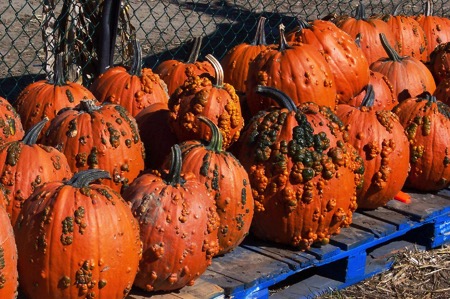
In December 2007, Siegers Seed Co., of Holland Michigan, applied for a US patent for “warted pumpkin”. The patent helpfully tells us that such a pumpkin has an “at least one wart associated with the outer shell of the body”. And, while IANAPL, it seem to me that the patent attempts to cover any warted pumpkin whatsoever, no matter how large, prominent or numerous said warts may be.
Which is very odd because warted pumpkins are nothing new. And again, IANAPL, but I thought that a patent had to include some sort of novelty.
As Hank Will, then as now Editor in Chief at Grit magazine wrote:
My ancestors grew warted gourds, pumpkins and squashes long before Siegers was even in business, and they received the seed from Native American gardeners who had warted cucurbits in their patches for who knows how long.
Will listed five examples of “prior art,” including a description from the granddaddy of cucurbit taxonomy, Antoine Nicholas Duchesne. The lack of novelty was one of the factors that led the US Patent & Trademark Office to reject the application in quick time. The rejection even cited images from our friends at Seed Savers Exchange to show that warty pumpkins had long been in existence. The patent rejection, however, was “non-final” and I have not been able to find out what happened after that. 3
How did Siegers come to invent the warty pumpkin that everyone else seems to have known about forever? The “inventor” (who was a director of marketing at Siegers) was both very observant and very inexperienced.
In a large commercial field of multiple unknown pumpkin varieties, a single fruit was discovered displaying a greater degree of warting than has ever been observed in prior experience by the inventor.
The brilliant marketing idea was that these warty pumpkins would make extra ghoulish Jack-o-lanterns, and Siegers even went so far as to register the trade name Super Freak, with varieties called Knucklehead and Goose Bumps, and one called Gremlins that I swear is a repackaged version of the “ornamental gourds” that were all the rage dried, varnished and gathering dust a while back.
One independent trial concluded:
We had both of these in our trials and thought they were sort of ugly, but nonetheless, they appeared to be a hot item at a garden center where we test-marketed them. These varieties will not be easy to use as carving pumpkins because of the hard shell associated with the warty character.
So maybe it was a good marketing idea, even if it was a terrible idea to claim novelty and a patent.
Thanks Lori Holder-Webb for making your picture of warty pumpkins available.
P.S. A website the company apparently created, “dedicated to the Superfreak™ Series,” and designed to give “growers and consumers alike … valuable information about all of Siegers Seed Company’s unique pumpkins, gourds and fall specialty items” 4 has been overrun by spam. That seems kinda fitting.