- Genetic and root phenotype diversity in Sri Lankan rice landraces may be related to drought resistance. Fancy genotyping and phenotyping picks out landrace whose name in Sinhalese means “drought rice.”
- The relationship between agricultural biodiversity, dietary diversity, household food security, and stunting of children in rural Kenya. Increasing dietary diversity could increase household food security.
- Biodiversity and origin of the microbial populations isolated from Masske, a traditional Iranian dairy product made from fermented Ewe’s milk. Streptococcus thermophilus doesn’t sound like a safe thing to be drinking, but I still want to try it.
- Well, what can I tell ya, that’s all that caught my eye last week. Send me your favourite paper that I missed, and I’ll summarize it in a sentence by next Monday.
Potatoes at the Chelsea Flower Show, again
Nice to see agricultural biodiversity on display at the Chelsea Flower Show, in the form of potatoes, of all things. Scroll down past the very boring flowers to the very exciting tuber display. A similar — maybe the same? — display actually won a prize last year, which I can’t think how we missed.
The Adam and Eve of apples?
It was 1993 and US Department of Agriculture (USDA) horticulturist Phil Forsline flew over the magnificent mountain ranges of south-eastern Kazakhstan in a helicopter. Forsline had not been to the huge Central Asian country before; with the recent fall of the Soviet Union, this was his first chance to visit its wild forests. It was here, scientists now believe, that the ancestors of the apples sold in supermarkets around the globe originally evolved. Forsline was on a quest to find out what was really out there, in those mountain gardens.
The appearance on the BBC website of a long piece on the remarkable apple diversity of Kazakhstan and USDA’s efforts to conserve it, which leads with that mouth-watering paragraph above, reminded me that there was a much weirder little article a few weeks ago on much the same subject that I also wanted to point to. If only for the rhetorical flourishes it unleashes:
There are currently 7,500 varieties of apples in the world today — incredibly though, basically every single one of these can be traced back to a Mother and Father tree in a mysterious Kazakhstan forest.
…
In these Kazakh forests, bears, being the picky buggers that they are, would only pick and eat the sweetest apples.Then they’d go and wander around poop everywhere and the seeds of these sweet, delicious apples were spread around.
Then humans cottoned on and were all “hey, sick apples, bears – we’re gonna eat and grow these to stuff in our mouths as well.”
Then we started only growing these apples which is why out of the thousands of apple varieties that originated from these forests, only 15 of them end up in our grocery stores.
So now, thanks to a group of scientists’ gene sequencing magic, we know that 90% of all apples can be traced back to a Mama and Papa tree thousands of years ago – that was most likely eaten by a bear and then pooped out all over the place.
Very cool.
Incidentally, those bear-filled apple forests have recently been formally recognized with the International Carlo Scarpa Prize for Gardens. And of course they’re not new to the attentions of the popular scientific press. And the not so popular, all due respect to Steppe magazine.
But what you really want to know is where that assertion that all apple varieties can be traced to two trees comes from. Well, so did I, and I asked around, including the apple people at USDA. Nearest I can figure it, it may be based on the fact that an oldish paper looking at the taxonomy of apples found a wild accession in the USDA collection that shared a bit of chloroplast genome with many domesticated varieties. According to the abstract:
Two matK duplications were found, one in series Malus and the other in most M. domestica cultivars and one Central Asian M. sieversii accession.
Here’s what that looks like, from a different paper by the same authors with fancier graphics.
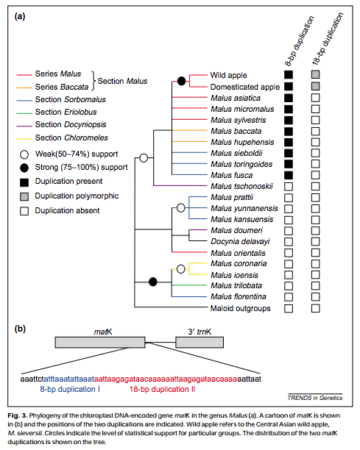
It’s all true about the bears though.
Over millions of years, millions of bears just prior to hibernation slowly and unconsciously selected the larger and sweeter fruits of the neo-apples. Bears do have a sweet tooth, as A. A. Milne noted in Winnie the Pooh. The relative inefficiency of a bear’s jaw in crushing fruit has another unintended consequence. As we have seen above, seeds that remain within the tissue (placenta) of the apple do not germinate. Herb Aldwinckle of Cornell University told me he has noticed that very small apples pass intact and uncrushed through a bear’s jaws and gut and, in one or two cases, were seen intact in the fecal mass. The seeds in the small intact fruits would not have germinated. It does not pay, in a genetic sense, to be a very small apple in the Tian Shan.
LATER: Oh, man, I forgot to link to Jeremy’s podcast.
Brainfood: Italian chickens, Maca genome, Ordonomics, AnGR, Stuffed potato, Biological control, Wild pea, Rice landraces
- Genetic variability of two Italian indigenous chicken breeds inferred from microsatellite marker analysis. Two Piedmontese breeds are closer to British breeds than other Italian or continental chickens. And poorly managed to boot.
- Genome of plant maca (Lepidium meyenii) illuminates genomic basis for high altitude adaptation in the central Andes. It’s the whole genome duplications, stupid.
- Rationalizing the GMO Debate: The Ordonomic Approach to Addressing Agricultural Myths. Yeah that’ll work.
- Factors and determinants of animal genetic resources management activities across the world. Capacity, says fancy maths.
- Accumulation of Genetic Diversity in the US Potato Genebank. The collection may need to double.
- Structure, function and management of semi-natural habitats for conservation biological control: A review of European studies. There is plenty of information on natural enemies in natural habitats (though not in woodlands, surprisingly), but not much on whether they make it to adjacent fields and actually have an effect on pests.
- Prospects of the use of wild relatives for pea breeding. More work needed. Starting with translating this thing from the Russian.
- Genetic Diversity Analysis Reveals Importance of Green Revolution Gene (Sd1 Locus) for Drought Tolerance in Rice. Back to the landraces.
Featured: Plant patents
Åsmund Bjørnstad is not at all daunted by the doubters on the need to reform patents:
First, I entirely agree that “global legal harmonization” is a daunting task… [But] [g]iven that four countries has passed breeding exceptions for patents, that Switzerland adds compulsory licensing to this, and the emergence of private licensing consortia, changes need not be dramatic.
Read the whole thing.