Rowan is incensed about an NPR article denigrating tiger nuts that we Nibbled.
The article does this delicious food no justice and a bit more research would have gone a long way.
Read the whole thing, and have your say.
Crops, livestock, microbes, pollinators, wild relatives, agroecosystems, foodways …
Rowan is incensed about an NPR article denigrating tiger nuts that we Nibbled.
The article does this delicious food no justice and a bit more research would have gone a long way.
Read the whole thing, and have your say.
Announcements such as this from UC Davis, of the launch of the Global Tea Initiative, make me wish there was a market for roving agrobiodiversity bloggers and tweeters. Alas, I’m reduced to the usual ploy of asking participants if they’d like to blog the thing for us.

Will genebanks be discussed? There aren’t that many collections around the world, and one of them, in Japan, accounts for 7,500 of the 11,700 accessions WIEWS knows about. And where’s China? Can’t help thinking that’s not altogether healthy. Lots to talk about…
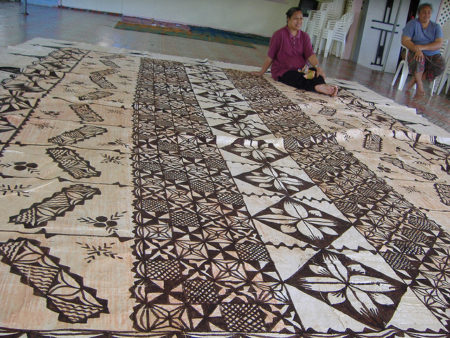
The announcement of a fascinating new project on Kew’s tapa cloth collection from the Pacific is a great opportunity to remind myself about this wonderful specimen I encountered on Tonga a few years ago. Yes, everything is about me in the end.
More from our friend Lex Thomson on the Pacific Hibiscus saga:
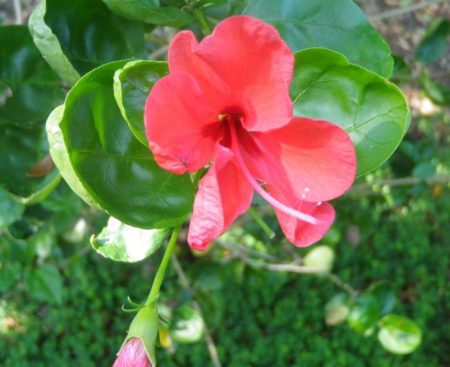
Excited to report on the finding of a presumed new Hibiscus species in Solomon Islands. This Hibiscus has several distinctive features including round, saucer-shaped leaves with an entire or shallowly crenulated margin and very small, bright red flowers with a windmill arrangement of petals. The serrated dark red eye may indicate a relationship with the Fijian Hibiscus storckii but other features suggest affinities with Indian Ocean islands Hibiscus such as Hibiscus liliiflorus. The new species appears of ancient origins and may represent a ‘missing link’ between Pacific Islands and Mascarene Islands Hibiscus. Am looking forward to working with Solomon Islands botanist Myknee Sirikolo to describe this new species, which is thus far known only from a 1970’s collection from Santa Cruz Islands and the photographed plant in Mrs Bronwyn Lilo’s garden (Gosi Anikisina) near Honiara.
This from the Facebook page of Savurua Botanical Gardens in Fiji.
Lots more work to be done, clearly.