- In the Footsteps of Vavilov: Plant Diversity Then and Now. The Pamiri Highlands of Tajikistan, the Ethiopian Highlands, and the Colorado Plateau of Southwestern North America compared at time of Vavilov and now: “Localities that have retained diversity have suffered the least.”
- Vavilovian Centers of Plant Diversity: Implications and Impacts. “His concept of specific centers of origin for crop plants was not an isolated aphorism but has directed breeders, on their study and reflection, to the continued improvement and economic development of plants for humanity.”
- Mitochondrial DNA variation of Nigerian domestic helmeted guinea fowl. Recent domestication, and lots of intermixing mean not much diversity, and what there is doesn’t have structure.
- Genome-wide association and genomic prediction of resistance to maize lethal necrosis disease in tropical maize germplasm. That’s when two viruses attack synergistically. Resistance is from multiple loci with smallish effects, and there are some promising markers.
- Genome-environment associations in sorghum landraces predict adaptive traits. Genotype predicts drought tolerance.
- Facilitation and sustainable agriculture: a mechanistic approach to reconciling crop production and conservation. Understanding facilitative plant–plant interactions (intercropping, varietal mixtures) in crops leads to more sustainable farming practices. Or it could.
- The relative contribution of climate and cultivar renewal to shaping rice yields in China since 1981. Mainly new varieties. Climate change has actually helped, but for how long?
- Biodiversity inhibits parasites: Broad evidence for the dilution effect. Meta-analysis shows biodiversity decreases parasitism and herbivory.
- Using genomic repeats for phylogenomics: a case study in wild tomatoes (Solanum section Lycopersicon: Solanaceae). Data that are usually thrown away turn out to be useful for something after all.
- Genetic structure of the date palm (Phoenix dactylifera) in the Old World reveals a strong differentiation between eastern and western populations. Asian and African genepools, with geneflow E to W.
EU springs into action on olive plague
That whole Xylella fastidiosa attacking olives in Puglia story? Shit just got real. The French are burning trees in Corsica. And the European Commission has come out with a factsheet. This explains that
…there are four different subspecies of Xylella fastidiosa and that the strain identified in Apulia is a new genetic variant which has so far only attacked olive and plum trees. The bacterium is spread by spittlebugs, cicadas and sharpshooters which feed on the infected plant tissue.
Could get really nasty. Is anyone looking for resistant material?
New seeds for India, but from where?
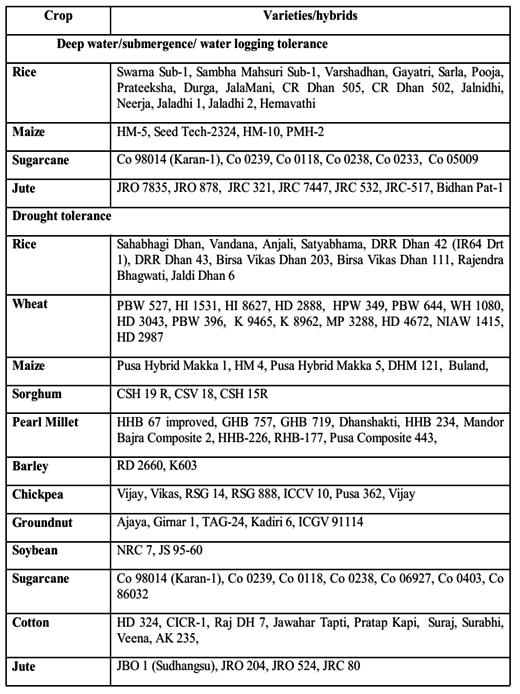 Surprising, though in a good way, to see a Government of India press release listing newly-released flood and drought resistant varieties of a number of staple and cash crops. What I’d like to know is how many of them owe their existence to material that breeders sourced from genebanks, either India’s own national system or the international genebanks of CGIAR. I see the famous flood-resistant Swarna Sub-1 rice is there, which was developed at IRRI. Maybe there are others.
ICRAF in forage shrub germplasm giveaway
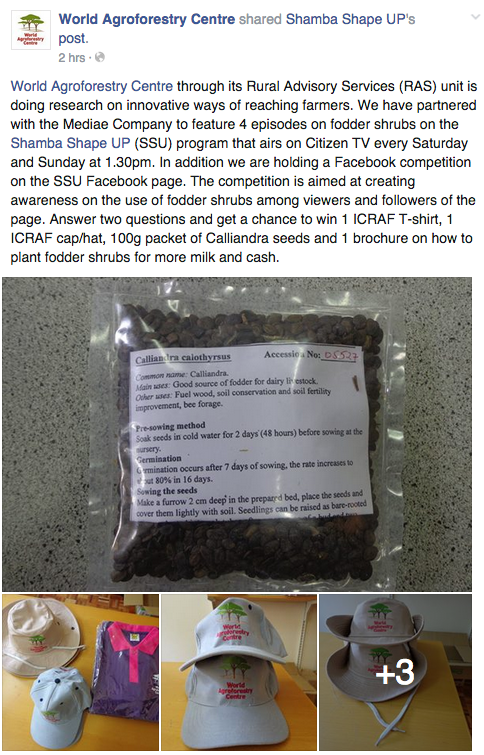 I liked this idea from the World Agroforestry Centre’s Facebook page:
World Agroforestry Centre through its Rural Advisory Services (RAS) unit is doing research on innovative ways of reaching farmers. We have partnered with the Mediae Company to feature 4 episodes on fodder shrubs on the Shamba Shape UP (SSU) program that airs on Citizen TV every Saturday and Sunday at 1.30pm. In addition we are holding a Facebook competition on the SSU Facebook page. The competition is aimed at creating awareness on the use of fodder shrubs among viewers and followers of the page. Answer two questions and get a chance to win 1 ICRAF T-shirt, 1 ICRAF cap/hat, 100g packet of Calliandra seeds and 1 brochure on how to plant fodder shrubs for more milk and cash.
That’s one way of getting germplasm out the genebank door! But I think it shouldn’t be just Calliandra. Let’s get those farmers playing around with lots of different species. And what, incidentally, is second prize?
Mapping responsible soy irresponsibly
Good thinking by the Round Table on Responsible Soy (RTRS) to map where it is most — and least — environmentally responsible to extend soy cultivation in South America.
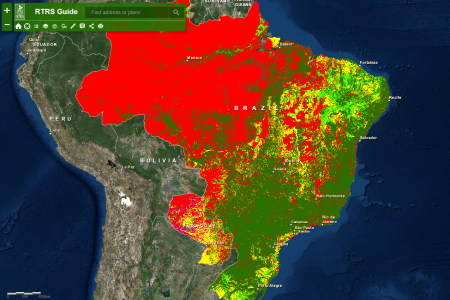
“An interesting exercise, isn’t it?” they ask. No doubt it was meant rhetorically, but I’ll answer anyway: definitely, you bet! But how much more interesting if there had been a way of adding your own data to theirs. I’d really like to know, for example, about any crop wild relatives found in those light green areas in particular: “Areas where existing legislation is adequate to control responsible expansion (usually areas with importance for agriculture and lower conservation importance).” I know where to get the CWR data. 1 But how do I mash them up with this?