Our readers have known for some years now that HRH Prince Charles has taken over a collection of apple varieties. Not so readers of the Sunday Times, apparently. Unfortunately, the article describing the Prince’s efforts to save the British apple is behind a paywall, so we cannot for now say whether it adds anything to the story we already knew. Maybe someone out there with a subscription can help us.
SDGs recognize agrobiodiversity and genebanks
The final version (pdf) of the Post-2015 Development Agenda was posted online about a day or so back after an all-nighter in New York.
For those who are just waking up, read the final version of the Post-2015 Development Agenda here http://t.co/c9PHgLvHCE #SDGs #Post2015
— UN DESA Sustainable Development (@SustDev) August 1, 2015
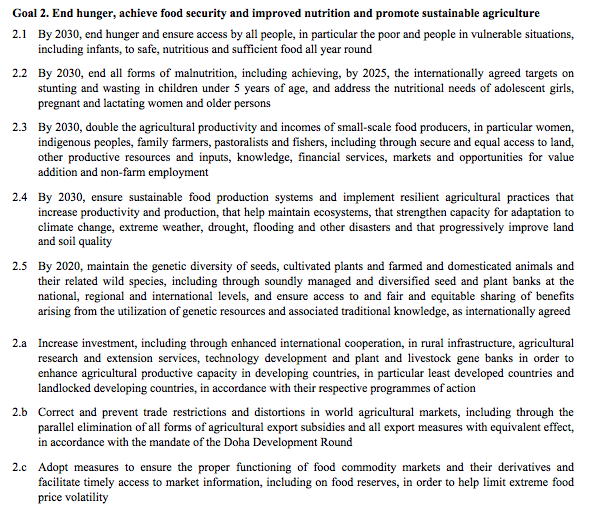
I’m glad to say Target 2.5, which highlights the importance of agricultural biodiversity, has survived intact. This includes a specific reference to genebanks, as also does an additional target (2.a) on funding. Here is the full text:
2.5 By 2020, maintain the genetic diversity of seeds, cultivated plants and farmed and domesticated animals and their related wild species, including through soundly managed and diversified seed and plant banks at the national, regional and international levels, and ensure access to and fair and equitable sharing of benefits arising from the utilization of genetic resources and associated traditional knowledge, as internationally agreed
2.a Increase investment, including through enhanced international cooperation, in rural infrastructure, agricultural research and extension services, technology development and plant and livestock gene banks in order to enhance agricultural productive capacity in developing countries, in particular least developed countries and landlocked developing countries, in accordance with their respective programmes of action
This should make it a lot easier to raise money for genebanks in the future. To see how these particular targets relate to the overall goal of ending hunger and improving nutrition, here’s the full set of targets agreed under Goal 2:
Ghana to develop vegetables, but which ones?
A new regional laboratory in Ghana is seeking to develop the vegetable industry through research, development and innovation to improve food and nutritional security in West Africa. It will do this through increased use of indigenous vegetables…
Well, that’s interesting. But which indigenous vegetables? Garden egg? Bitterleaf? There are plenty, and they’re really important in the preparation of Ghanaian dishes.
Eric Yirenkyi Danquah, director of WACCI, says the laboratory will develop framework for accelerating the development of the tomato and vegetable industry in Ghana and West African sub-region.
Ah, ok. As you were.
Prize for plants programme
It’s not clear whether it was due to her magisterial BBC programme Plants: From Roots to Riches, but Prof. Kathy Willis has won the Royal Society’s prestigious Michael Faraday Prize for excellence in communicating science to UK audiences. You’ll remember the programme features genebanks quite prominently. Well worth listening to. Congratulations to Prof. Willis, who is Director of Science at the Royal Botanic Gardens, Kew.
Brainfood: Vavilov then & now & always, Helmeted fowl diversity, MLND resistance, Sorghum diversity, Facilitation, Rice yields, Biodiversity services, Wild tomato diversity, Date diversity
- In the Footsteps of Vavilov: Plant Diversity Then and Now. The Pamiri Highlands of Tajikistan, the Ethiopian Highlands, and the Colorado Plateau of Southwestern North America compared at time of Vavilov and now: “Localities that have retained diversity have suffered the least.”
- Vavilovian Centers of Plant Diversity: Implications and Impacts. “His concept of specific centers of origin for crop plants was not an isolated aphorism but has directed breeders, on their study and reflection, to the continued improvement and economic development of plants for humanity.”
- Mitochondrial DNA variation of Nigerian domestic helmeted guinea fowl. Recent domestication, and lots of intermixing mean not much diversity, and what there is doesn’t have structure.
- Genome-wide association and genomic prediction of resistance to maize lethal necrosis disease in tropical maize germplasm. That’s when two viruses attack synergistically. Resistance is from multiple loci with smallish effects, and there are some promising markers.
- Genome-environment associations in sorghum landraces predict adaptive traits. Genotype predicts drought tolerance.
- Facilitation and sustainable agriculture: a mechanistic approach to reconciling crop production and conservation. Understanding facilitative plant–plant interactions (intercropping, varietal mixtures) in crops leads to more sustainable farming practices. Or it could.
- The relative contribution of climate and cultivar renewal to shaping rice yields in China since 1981. Mainly new varieties. Climate change has actually helped, but for how long?
- Biodiversity inhibits parasites: Broad evidence for the dilution effect. Meta-analysis shows biodiversity decreases parasitism and herbivory.
- Using genomic repeats for phylogenomics: a case study in wild tomatoes (Solanum section Lycopersicon: Solanaceae). Data that are usually thrown away turn out to be useful for something after all.
- Genetic structure of the date palm (Phoenix dactylifera) in the Old World reveals a strong differentiation between eastern and western populations. Asian and African genepools, with geneflow E to W.