- The biodiversity and genetic structure of Balearic sheep breeds. 5 types, pretty well differentiated among themselves, and very different to the mainland breeds.
- Exploration of genetic diversity within Cichorium endivia and Cichorium intybus with focus on the gene pool of industrial chicory. Species reasonably, though not completely, differentiated. C. intybus division into 3 phenotypic cultivar groups (Witloof, root chicory and leaf chicory) confirmed. Leaf chicory division into 3 phenotypic subgroups confirmed (Radicchio, Sugarloaf and Catalogne cultivars). Modern industrial root cultivars have high phenotypic and genetic variability.
- The genome of cultivated sweet potato contains Agrobacterium T-DNAs with expressed genes: An example of a naturally transgenic food crop. No doubt it will soon be banned in Europe.
- Distributions, ex situ conservation priorities, and genetic resource potential of crop wild relatives of sweetpotato [Ipomoea batatas (L.) Lam., I. series Batatas]. 79% of species identified as high priority for further collecting. None of them GMOs. Yucatan is the place to go to get bang for buck.
- Complementary effects of species and genetic diversity on productivity and stability of sown grasslands. Species diversity increased productivity under drought, regardless of number of genotypes per species present. Genotypic diversity increased temporal stability of production under both drought and non-drought conditions, regardless of number of species.
- Exploiting Nutritional Value of Staple Foods in the World’s Semi-Arid Areas: Risks, Benefits, Challenges and Opportunities of Sorghum. Unbalanced amino acid composition, cyanogenic glycosides and antinutrients are obstacles to increased consumption, but can be overcome by: reduction of worrisome components (or their activity), good practices to minimise contamination and compensation by varied diet.
- Nutritional and Health Implications of Conventional Agriculture — A review. Only agricultural biodiversity can save us.
- Pollination services from field-scale agricultural diversification may be context-dependent. Hedgerows may not always be good for both crop pollination and wild bee conservation.
- Morphological, Physiological and Molecular studies on wildly collected Cordyceps militaris from North West Himalayas, India. You can cultivate it.
- Olive biodiversity in Colombia. A molecular study of local germplasm. 5 of the genotypes could not be identified with known varieties.
- A phylogenetic analysis of 34 chloroplast genomes elucidates the relationships between wild and domestic species within the genus Citrus. 3 main clades: citron/Australian species, pummelo/micrantha and papeda/mandarins. Lots of heteroplasy. 4 genes showing positive selection.
Dr Solh on the ICARDA genebank
“Even when the war was going on, they were managing to take seeds out of Syria…”
In memory of Mitsuaki Tanabe
Sad news from our friend Ruaraidh Sackville Hamilton, IRRI’s genebank manager.
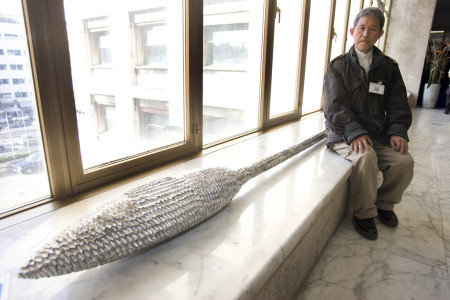
With sadness I [share] this news about the death of Mitsuaki Tanabe, famed for his lifetime of work promoting the conservation of rice diversity through sculpting and drawing huge grains of wild rice. Many of you frequently, perhaps daily, see the works that he donated to IRRI, FAO, the Crop Trust, the Svalbard Global Seed Vault and others. He is surely unique in the way he used his artistic talents to further the cause of rice conservation, and the dedication he showed to both.
My own strongest memory of him is his enthusiastic participation in a scientific meeting organized by the Green Energy Mission in Nepal in 2002 on the conservation of wild rice. He donated a 10 metre long drawing of a wild rice grain, which all participants signed. An exceptional person.
Mr Tanabe was 76. He established a museum for his work last year in Yokohama. This is him seated by the sculpture he donated to the Crop Trust in 2006. It’s on the second floor of the FAO building in Rome, facing the Viale Aventino.
ILRI@40 puts down some agricultural biodiversity markers
Last year was a big one for the International Livestock Research Institute, marking as it did its 40th anniversary. There was a whole series of events, the results of which were summarized last week by Nadine Sanginga, the ILRI@40 Coordinator, in an email to stakeholders.
At each event, we asked participants to comment on two questions: Looking to 2054, what are the two most critical livestock-related challenges we must answer through research? What is the most promising ‘best bet’ opportunity we should invest in to achieve better lives though livestock by 2054?
You can see what they had to say nicely pulled together in a Powerpoint. Securing livestock genetic diversity featured as a challenge, as did developing sustainable feeds and forages, which will depend on likewise securing forage genetic diversity. Some interesting stuff among the “best bets” too, such as paying more attention to insects and to multi-purpose crops (grain and forage). Plenty of work there for ILRI’s forage genebank, as well as for its animal genetic resources conservation people.
Saving the banana. Again
Australian banana farming changed forever last month. That’s because TR4 was detected on two farms in north Queensland, representing probably the greatest ever threat to the A$ 400 million industry.
Tropical race 4 (TR4) is the name given to the fungal strains of Fusarium oxysporum f. sp. cubense (Foc) that cause Fusarium wilt (popularly known as Panama disease) in Cavendish cultivars grown in tropical conditions.
Remember that Cavendish dominates the international banana trade. The spread of TR4 is seriously bad news, as recognized even by FAO.
Following the Australian report, someone asked on the ProMusa mailing list 1 whether the wild species might be a source of resistance. While admitting that he wasn’t fully up to date on developments, and pointing to some very recent literature, 2 Australian expert Dr David Jones had this to say:
As far as I am aware, wild Musa species have not been included in tropical race 4 screening trials except in the Northern Territory of Australia and then it was limited to six accessions of M. acuminata subspecies malaccensis. Of these six accessions, three were resistant and three susceptible. M. a. malaccensis grows wild in areas of Malaysia and Indonesia where it is believed Foc TR4 evolved.
More wild M. acuminata subspecies, other Musa species and pollen-producing, banana cultivars need to be screened as part of the global programme that is being developed to combat TR4. Germplasm with resistance could then be incorporated into conventional breeding projects. Others may have more information on proposed or active screening trials not available to me.
On the local front here in Australia, TR4 has been detected on another farm in North Queensland. The big worry is that it is on the Atherton Tableland in a completely different banana-growing district some 180 km by road from the Tully Valley, the scene of the first outbreak. The prognosis is not as good as it was, but we will have to wait and see what happens next.
Those involved with genetic engineering now have a golden opportunity to push their breeding techniques as the only way to save the global banana industry based on TR4 susceptible cultivars, notably Cavendish, even though no gene ready for insertion is guaranteed to work. If by some lucky chance a banana could be developed that has resistance, I have grave doubts about whether discerning consumers would be willing to eat the fruit. I think the big export fruit companies know this.
It has also often been said by proponents of GM bananas that there is no possibility of genes engineered into GM bananas ‘escaping’ into the environment because commercial cultivars are propagated asexually. I am wondering what would happen if GM bananas were grown in countries with wild bananas present in the adjacent bush, like Malaysia, Indonesia, PNG etc.? Isn’t there a risk that if pollen were released from GM plants it could fertilise nearby wild species?
So anyway, the wild might be a source of resistance, but so also are the Eastern African Highland bananas and plantains, apparently. Some will ask whether the Cavendish is worth saving at all, whether by biotechnological or conventional means, whether using wild or domesticated sources. But that’s another story.