- European Gene Bank Network for Animal Genetic Resources (EUGENA). Compare and contrast with crops situation.
- Oil content, fatty acid composition and tocopherol concentration in the Spanish almond genebank collection. A couple of varieties have very high levels. But only a couple.
- Variability in almond oil chemical traits from traditional cultivars and native genetic resources from Argentina. Local cultivars are best. No word on how they relate to the above.
- Development of interspecific and intergeneric hybrids among jatropha-related species and verification of the hybrids using EST–SSR markers. Even biofuels need wild relatives.
- Evolution of wild emmer wheat and crop improvement. “…arguably best source for wheat improvement and future food production…” Largely untapped, though, as yet.
- Genomewide Association Studies for 50 Agronomic Traits in Peanut Using the ‘Reference Set’ Comprising 300 Genotypes from 48 Countries of the Semi-Arid Tropics of the World. Ok, can we start using these now, please?
- Genome wide SNP identification in chickpea for use in development of a high density genetic map and improvement of chickpea reference genome assembly. Ok, can we start using these now, please?
- Aibika (Abelmoschus manihot L.): genetic variation, morphology and relationships to micronutrient composition. DNA, morphology and chemical composition give different groupings for this PNG veg. In general, environment seems to be more important than genetics as far as micronutrients are concerned.
- Broadening the Gene Pool of Cocoa (Theobroma cacao L.) Progenies with Guiana Clones: Establishment and Precocity Traits. That would be the “…recently identified genetic groups with high resistance to black pod diseases.” Progenies with tester clones did really well in Ghana.
- Characterization of Gene Expression Associated with Drought Avoidance and Tolerance Traits in a Perennial Grass Species. 36 genes involved in drought tolerance in Bermudagrass and relative, including for stuff like cuticle wax accumulation, antioxidant defense and dehydration-protective protein accumulation.
Ethereal botany
Lots of botany in the ether today from #Bot21C #globalplants @JSTORPlants @UNESCO good to feel the inspiring and positive vibes
— Sandra Knapp (@SandyKnapp) September 23, 2014
Indeed. And thanks Sandy Knapp for keeping us all informed.
Brainfood: Ethiopian landuse history, Linum diversity, Chinese melons, Organic cauliflower, Mexican mission citrus, Saline mungbeans, Saving the elm, Future Fusarium, Wheat biofortification, PPB and public value
- Dynamics and driving forces of agricultural landscapes in Southern Ethiopia – a case study of the Chencha and Arbaminch areas. It’s the population pressure, stupid. No word on what expansion of agriculture and decrease in holding size is doing to agricultural biodiversity. Or wild relatives, for that matter.
- The potential of pale flax as a source of useful genetic variation for cultivated flax revealed through molecular diversity and association analyses. Levels of diversity similar in wild and cultivated, but strong differentiation between the two.
- Microsatellite analysis of genetic relationships between wild and cultivated melons in Northwest and Central China. For the true wild melons, go to the NW. Others may be escapes and introgressions.
- Evaluation of cauliflower genebank accessions under organic and conventional cultivation in Southern Germany. Genotype performance differs depending on cultivation method. But if you want to breed specifically for organic conditions, here’s what to use.
- Mission and Modern Citrus Species Diversity of Baja California Peninsula Oases. Lots of unique types in the mission oases and surrounding ranches. For how long? Well, here’s the baseline. I’d like to know about the agritourism potential.
- Evaluation of mungbean genotypes for salt tolerance at early seedling growth stage. From the Indian core collection. Some good stuff found.
- Implementing the dynamic conservation of elm genetic resources in Europe: case studies and perspectives. Genebanks are not enough. But then again, nobody ever said they were.
- Future distributions of Fusarium oxysporum f. spp. in European, Middle Eastern and North African agricultural regions under climate change. Some countries are in big trouble.
- Use of wheat genetic resources to develop biofortified wheat with enhanced grain zinc and iron concentrations and desirable processing quality. CIMMYT has used a range of wild species to increase the Zn and Fe content of high-yielding, high-quality bread wheat lines.
- Expressing the public value of plant genetic resources by organising novel relationships: The contribution of selected participatory plant breeding and market-based arrangements. PPB can help smallholders manage the indirect and option value of agrobiodiversity, but it needs new types of property rights and networked governance. Whatever that is, it can take a variety of forms. All this from China, of all places.
On sorghums and cultures
Our friend Dr Ola Westengen just sent us this post on a paper that he’s just had published. Keep it up, Ola, and thanks.
In a new study published in PNAS this week we stand on the shoulders of Jack R. Harlan et al. and take a molecular approach to test some interesting hypotheses on the factors shaping diversity in sorghum. In the book Origins of African Plant Domestication, from 1976, Harlan and Stemler summarized findings from their Crop Evolution Laboratory at Illinois University and proposed that the five basic “races” of sorghum identified were associated with language distribution in Africa: “Guinea is a sorghum of the Niger-Congo family, kafir a Bantu sorghum. Durra follows the Afro-Asian family fairly closely, and caudatum seems to be associated with the Chari-Nile family of languages” (p. 476). This kind of crop-language co-distribution would be in support of the contested farming-language co-dispersal hypothesis (by Diamond and Bellwood). Genetic studies have hitherto not directly explored the molecular support for this sorghum-language co-distribution hypothesis — maybe because such studies have found “little correspondence between races and marker-based groups” (Billot et al.).
We let go of the race concept and based on molecular markers we modelled the population structure in a panel of 200 ICRISAT accessions with a broad geographic origin. We identified a pattern that is in strong support of the notion that sorghum diversity and ethnolinguistic groups are associated in Africa. We identified three major sorghum populations: a Central population co-distributed with the Nilo-Saharan language family; a Southern population co-distributed with the Bantu languages; and a Northern population distributed across northern Niger-Congo and Afro-Asiatic language family areas.
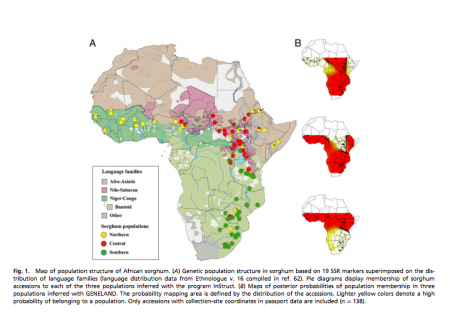
A case study of the seed system of the Pari people, a group descending from the proposed first Nilo-Saharan sorghum cultivators, living in today’s South Sudan, provides a window into the social and cultural factors involved in generating and maintaining the pattern seen at the continental scale. We show that the age-grade system, a cultural institution important for the expansive success of this group in the past, governs the traditional sorghum seed system in a way that maintains the Pari sorghum landraces as a metapopulation. Thus, we can make Harlan and Stemler’s words as ours: “It has been our observation that the races of sorghum are intimately associated with the cultivators who grow them.”
So Harlan et al. are our main references, but how did we start thinking along these ethnolinguistic lines in the first place? Well, like many others in the community we regularly read this excellent blog.