- Are species’ range limits simply niche limits writ large? A review of transplant experiments beyond the range. Meta-analysis shows dispersal constrains geographic distribution but extends altitudinal. Biotic interactions important at low elevations and latitudes.
- Herbivores and nutrients control grassland plant diversity via light limitation. Nutrients bad, herbivores good for grassland diversity.
- Economic and ecological implications of geographic bias in pollinator ecology in the light of pollinator declines. Half the data come from 5 countries. Nuff said.
- Integrated crop and livestock systems in Western Europe and South America: A review. Market logic has driven crops and livestock apart, but it should drive them back together again.
- ARABIDOPSIS THALIANA HOMEOBOX25 Uncovers a Role for Gibberellins in Seed Longevity. Seed longevity gene found. No word on whether giberellin treatment can prolong seed life in genebanks. Yet.
- Molecular-level and trait-level differentiation between the cultivated apple (Malus×domestica Borkh.) and its main progenitor Malus sieversii. Status of M. sieversii as main progenitor confirmed. Always good to have more data.
- Adaptation of Cultivated Amaranth (Amaranthus spp.) and Their Wild Relatives in Mexico. One of the wild species could be a source of adaptation for the cultivated under climate change.
- Eat your orchid and have it too: a potentially new conservation formula for Chinese epiphytic medicinal orchids. Nature reserves and cultivation on farms not enough. What you need is “restoration-friendly cultivation.”
- A continental-scale study of seed lifespan in experimental storage examining seed, plant, and environmental traits associated with longevity. Australian seeds are somewhat longer-lived than those from other regions. But there’s plenty of variation, some of which can be explained by different features of the seeds, plants and the specific environment where they grow.
- Inclusive fitness in agriculture. Plants and their root symbionts can get along even better together, with a little help from human selection.
- Genetic diversity analysis for quantitative traits in lentil (Lens culinaris medik.) germplasm. NBPGR seem to be on an evaluation blitz. More power to them. Hope to see the data online soon.
More Gadam lessons
I think that post on Kenya’s beer-brewing Gadam sorghum could do with a follow-up. Quite apart from the mystery of the origin of the variety, which in any case I’m sure is a mystery only to us sorghum illiterates, there are interesting lessons to be learned from the history of Gadam which could be relevant more generally to that group of crops we sometimes call neglected and underutilized. These are nicely illustrated by a couple of papers I found online while researching the previous post. And, yes, I know that we don’t usually consider sorghum a neglected or underutilized species (NUS); but it does have, in some places, at some times, some of the characteristics more commonly associated with crops like finger millet or quinoa: a bad reputation, chronic underinvestment, no markets, you know the kind of thing.
Anyway, it seems, for a start, that Gadam, along with other modern sorghum varieties, has actually been around for a while in Kenya, but was just not getting adopted. Why? Here’s an excerpt from the first paper, “The Role of the market in addressing climate change in the arid and semi-arid lands of Kenya: the case of Gadam Sorghum” (PDF):
Over the years research institutions including the KARI [Kenya Agricultural Research Institute] and the International Centre for Research in Semi-arid and Arid Tropics (ICRISAT) have been working to produce suitable dryland crops. This has resulted in the development of genetically superior cereal and legume crops in terms of yields, early maturity, drought tolerance or drought escaping and higher water use efficiency. Among the cereals, several varieties of sorghum have been developed and released including KARI Mtama 1, Seredo and Gadam among others but the adoption and utilization of the same has been generally poor. The adoption of a technology is affected by many factors but this paper explores two factors (changing dietary habits and lack of markets) and the efforts made by the Kenya Arid and Semi-Arid Lands Research Programme (KASAL) to overcome them and improve the adoption of Gadam Sorghum.
Markets proved key in the case of Gadam. Kenyans prefer maize to sorghum for food, but Gadam was found to have good beer-making properties.
Although KARI had developed several sorghum varieties over time none of these had been targeted to the brewing industry as the main focus was to provide a higher yielding variety for food. As the varieties produced were targeting semi-arid areas with their associated climatic conditions they had to be early maturing and drought tolerant. In association with EABL [East African Breweries Ltd.] several KARI sorghum varieties were tested and Gadam variety was found suitable for making malt beer. Gadam is a short (Figure 4), early maturing sorghum variety (flowers in about 45-52 days and matures in 85-95 days depending on altitude.) The variety matures earlier than the other sorghum varieties and any of the maize varieties making it an ideal variety for areas receiving low and unreliable rainfall. It has been reported to survive and produce grain with approximately 200 mm of rainfall in Machakos area. The grain is high in starch, low in protein and tannin making it suitable for malting. Gadan grain has 75% carbohydrate compared to 67% in barley and 66% in maize making it a good alternative source of starch. Further analysis showed that Gadam had low levels of oil and proteins which makes it good for industrial processing. Through tests for enzymatic digestion of starch, Gadam was found to have high levels of fermentable sugars.
Once the right variety had been found, a model of smallholder production had to be developed that would allow EABL to abandon its predictable preference for being supplied by large-scale contracted farmers. That was found in a private-public partnership based on commercial production clusters of 20-30 members, each with a collection centre serviced by a private company that did the bulking and shipping to EABL; but with certified seed, training and quality control provided by different government agencies, and micro-finance by various banks.
It seems to have worked. Gadam farmers keep lower quality grain back to eat themselves or feed to chickens (leading to a bit of a poultry industry), and buy maize for food and other stuff with the profits they make from selling the good stuff to EABL. Everybody wins.
So is it all sweetness and light? Another paper, “The potential role of sorghum in enhancing food security in semi-arid eastern Kenya: A review” (PDF), hints at further opportunities:
Due to increased health concerns and awareness, the use of sorghum products has seen a gradual increase as reflected by the quantity and range of processed sorghum products sold in local supermarkets (Kilambya and Witwer, 2013).
But it also notes that increased interest in sorghum by both brewers and the consumer has not yet been matched by public investment in research, breeding and seed production:
The agricultural sector development strategy, 2010-2020 also noted that the decline in productivity of orphaned crops was partly arising from low use of improved seeds due to poor distribution systems and the monopoly of the Kenya seed company which concentrates its operations in high rainfall areas (GoK, 2010). The other major problem facing the sorghum subsector is the dominant position of the single market provided by East African breweries for the Gadam sorghum which is widely grown by farmers in the semi-arid eastern Kenya. Although EABL has helped to address the problem of marketing, it has led to a situation where farmers do not have an alternative market to sell their surplus produce or grains that do not meet the standards set by EABL. Cases of grains below standard have been encountered due to seed impurities especially mixing of varieties common with commercially supplied seed lots (Miano et al., 2010). The other problem facing the sorghum sub-sector is an image problem where it is considered to be a food crop for the poor and vulnerable communities in the ASALs. As such its consumption in the urban areas is extremely low and many urban dwellers prefer maize thus lowering the to expand the market and increase acceptance of sorghum among the more financially endowed middle class residing in urban areas.
So, one could truthfully say that there is now in Kenya renewed interest in a traditional crop, but that would be only part of a much more complex story. There is really only increased interest in one, exotic variety of that crop; we know that local landraces persist alongside Gadam, but for how long? That interest depends on a single commercial company, and could end tomorrow. And although there are encouraging signs of wider public acceptance of some of its benefits, sorghum still has an image problem in the cities.
I mentioned some general lessons for NUS at the top of this piece. What are they? I’d say the main one is the obvious one: diversify your risk. Promote diversity of the crop, rather that just one or two varieties. Preferably by improving local varieties rather than parachuting new stuff in. Make sure the private and public sectors are working together. And don’t rely on a single value chain. Even if it is beer.
Iraqi agricultural atlas ready for prime time
Nice to see the first National Atlas of Food and Development launched in Iraq, courtesy of the Ministry of Agriculture and ICARDA. You can find it here. You can map various agricultural and development indicators (although some of them don’t seem to work), including harvested area and yield of a number of crops. Here’s barley yield:
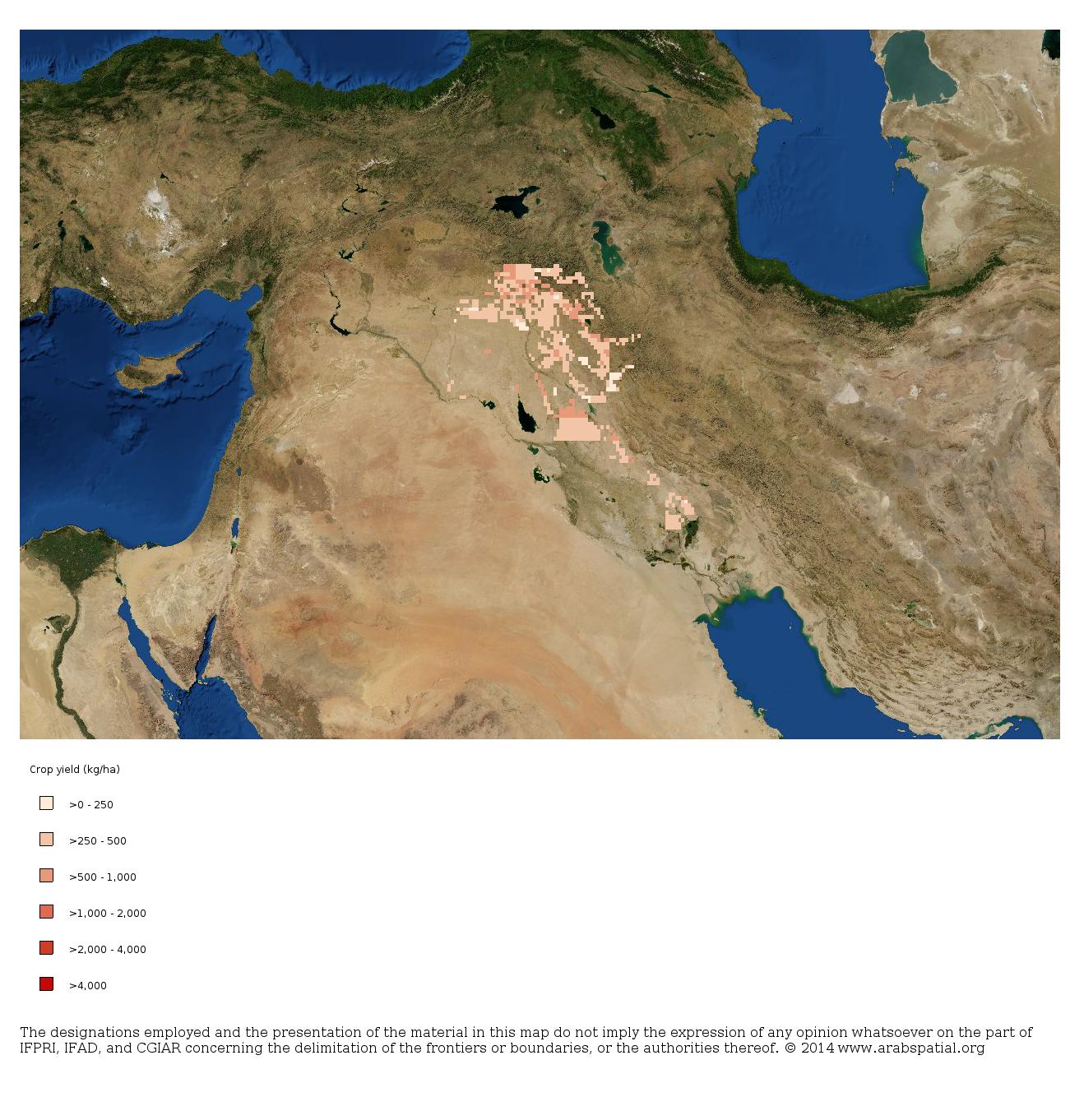
You can export the map as an image (as above) or as a URL, which is good but insufficient. Because one would like to mash it up with other datasets, like for example germplasm holdings, right? You know what’s coming next, and here it is, the locations of Iraqi barley material in Genesys:
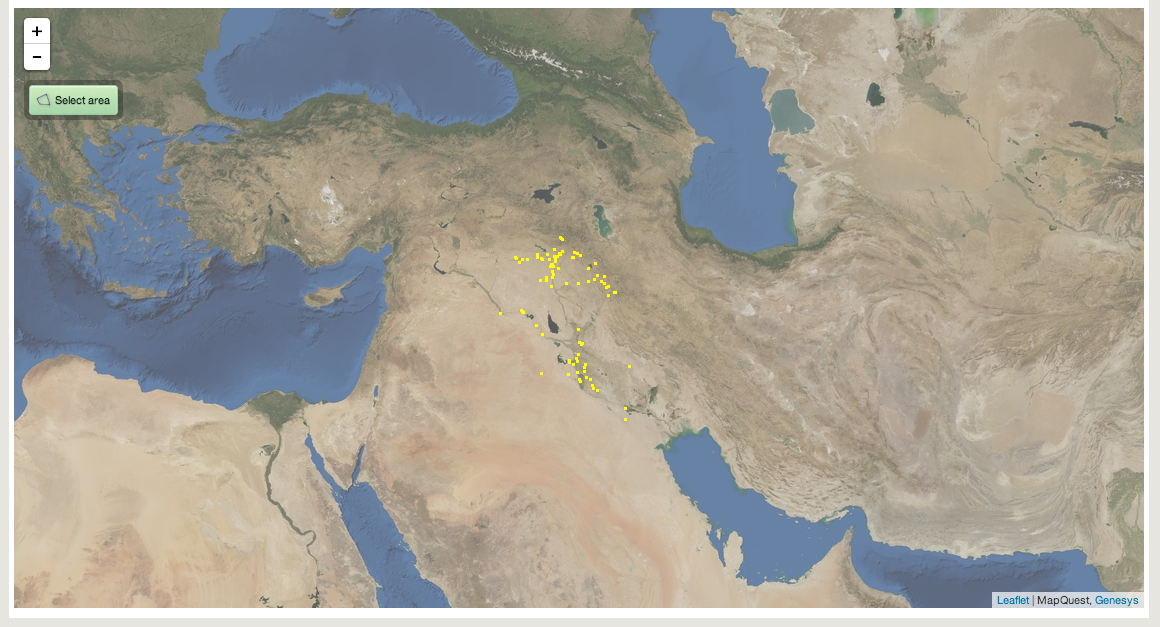
And yeah, I know, it takes two to tango, and it’s not exactly easy to share that Genesys data either, less easy than sharing the Iraqi atlas map if we are honest. We’re working on that…
But in the meantime, my colleague Matija and I spent the best part of a day hacking both tools and were eventually able to import image files from the Iraqi atlas and from Genesys into Google Earth. It’s not perfect, not even close, but here’s our first attempt at mashing up barley yield in Iraq (the pinkish squares) with the location of germplasm samples from that country in the world’s genebanks (in yellow).
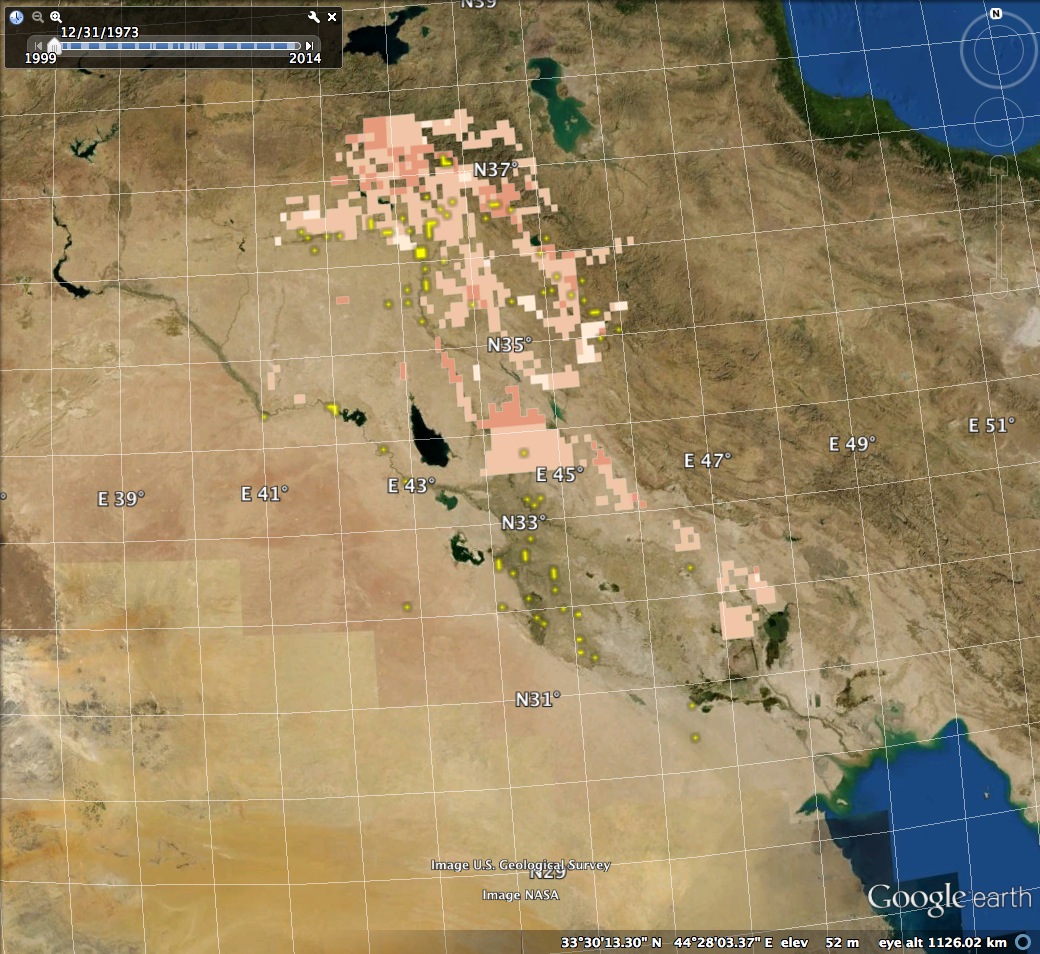
So, possibly some areas where further collecting might be warranted, conditions permitting. But is there an issue with the barley data in the atlas? You see that horizontal line right in the middle of the image, where barley apparently abruptly disappears south of latitude 33.5°N? That looks a bit suspicious, especially as the Genesys data seems to suggest that barley cultivation extends southwards along the Euphrates.
Game of Strawberries

As one generation of campus strawberry breeders prepares to pass the torch to another, the commission in October filed a lawsuit against the university, expressing concern that the campus would end its breeding program.
UC Davis’ reply was as loud and clear as a dragon crying out for its Mother:
“UC Davis is committed to a long-term, positive relationship with the Strawberry Commission, for the benefit of California strawberry growers and the public,“ said Helene Dillard, dean of the College of Agricultural and Environmental Sciences. “We are eager to resolve the legal issues and move on to address the many challenges facing the strawberry industry.”
She noted that the college has begun the recruitment process for a new breeder and plant geneticist to join the strawberry program.
To further demonstrate its commitment to maintaining a strong, secure breeding program, the college has made sure that it has two copies of the strawberry plant collection — one for use by the breeders and one to serve as a backup. Each contains patented varieties, advanced selection lines, breeding stock and historical plants.
So is it all a big misunderstanding? Time to return Oathkeeper to its scabbard? Well, there may be a bit more to it than UC Davis allows in its news article. This from an article in The Packer (tag line: Everything Produce) back in January:
The lawsuit alleges that UC-Davis breached its contract with the commission. Among the allegations, the commission says growers are no longer receiving strawberry germplasm specifically developed for them.
The commission wants a judge to stop UC-Davis from allowing two scientists to control and profit from research and cultivars commission members paid for already.
The two scientists have been working on strawberries since the commission’s formal arrangement with the school began in 1980. They are not named as defendants in the case.
According to the commission’s complaint, in early 2012 researchers Doug Shaw and Kirk Larson announced intentions to resign and take the germplasm and research to establish a private company to research and breed strawberries. The university then notified the strawberry commission it planned to terminate the breeding and research program and said it will no longer sell new strawberry varieties to the growers, according to the civil lawsuit.
So it may not be so much about the commitment of UC Davis to the breeding programme, as about the nature of control over its products. We hope the court proceedings — should it go that far — won’t turn into a Red Wedding.
Getting down with Gadam sorghum
Kirinyaga County government will this week start distributing free Gadam sorghum seeds to residents of South Ngariama settlement scheme as way of fighting poverty in the area. The exercise which will see the residents receive 2,000 kg of the free seeds is expected to be flagged off by Governor Joseph Ndathi.
Interesting enough, but a month-old Kenya News Agency press release about the distribution of some sorghum seed, even free sorghum seed, wouldn’t normally exercise me unduly. Except, that is, when the above is followed by this:
The Gadam sorghum is best suited for industrial production of beer and farmers are expected to rake thousands of shillings from sale of the produce which will be marketed to the Kenya Breweries Limited (KBL).
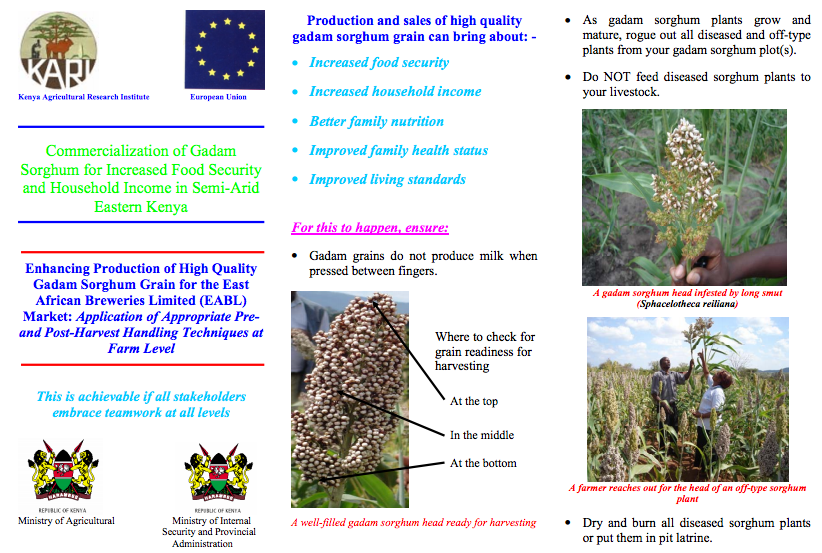
Ah, well, now you’re talking. I did know that sorghum is increasingly being used in beer brewing in Kenya, but I didn’t realise that there was a specific variety involved, I thought any old sorghum, including landraces, would do. You can get extension leaflets on Gaudam, such as this:
Which is just as well, because there are clearly some problems with it, as well as undoubted advantages, in particular earliness. The value chain for sorghum beer in Kenya has been well documented, and from that study comes this admittedly sketchy description of the Gadam variety and its history:
Sorghum beer is made from Gadam, a semi-dwarf sorghum variety with specific market traits, including white colour, low tannin and a high starch content. Originating in Sudan, Gadam was officially introduced in Kenya as a food crop in 1972 but then re-launched as an industrial crop in eastern Kenya in 2004. The KARI Seed Unit, located at Katumani, was established to grow and market seed of open-pollinated varieties (OPVs) that were unprofitable for private seed companies. It is the biggest producer of sorghum seed in Kenya. The Seed Unit sub-contracts seed production to 3000 growers who are advanced seed and repay in kind after harvest. The minimum acreage for a contract farmer is five acres. The Seed Unit buys whatever quantity farmers want to sell, provided it passes seed inspection by KEPHIS. Sales are made to large buyers but not to stockists because of risk of adulteration
Gadam is widespread and common enough to have been included as a sort of control in a recent survey of sorghum diversity in Kenya, which includes this passage:
In contrast to the case of some landraces, improved varieties were uniformly distributed and their frequencies did not differ between ethnic groups. The recently introduced Gadam variety was genetically distinct from the landraces and showed limited introgression from the other genetic clusters. It was genetically uniform and complied with certified control. However, farmers also gave the names of local and already known variety to individuals that have the same genetic profile as Gadam, an improved variety. This can be explained by a morphological similarity. Yet it raises the question of the consequences this will have for the on-farm evolution of the improved variety. Kaguru, for instance, which was introduced in the area 10–15 years ago, seems to have evolved differently across ethnic groups.
So Gadam‘s genetic future is uncertain. It may well change significantly, and in different ways in different places, and that will be interesting to follow, though those brewers may perhaps object. But what about its past? Can we trace Gadam back in time to its source? Unfortunately, I was not able to find anything online about its pedigree or breeding history, beyond hints at the involvement of ICRISAT, and vague references to an ultimate origin in Sudan. I’ll have to ask some sorghum experts, I suppose. Or look harder. However, my searches did produce one lead. There are 5 entries in GRIN that feature the word Gadam, including two from Sudan, a 1945 introduction called Gadam El Haman, PI152664, and a much later introduction called Gadam El Hamam, PI571389.
Note the slight difference in the last word of the name — hamaN versus hamaM. I think the first version may perhaps be a typo. I can’t find an Arabic word that can plausibly be transliterated as hamaN; hamaM, on the other hand, may mean “bath,” or perhaps “dove.” Gadam is even trickier, because that initial G could equally be a ق (leading to the noun “foot”, or possibly to a verb which may mean “to present”), or a خ (leading to the verb “to serve”). Bringing my mighty Arabic resources to bear on the problem, I conclude that the full name could well be translated as “footbath.” Or perhaps “serving the dove.” The perils of a little knowledge. Whichever it is (and I can’t for the life of me think why a sorghum variety should be called either), I’m no closer to knowing whether either, or neither, of those PI numbers is the ultimate source of Kenya’s Gadam, tout court. But I’m going there next week. Maybe I’ll ask around. If I find anything, I’ll let you know. And have a sorghum beer in celebration.