- Improvement in wild endangered Persian sturgeon, Acipenser persicus (Borodin, 1897) semen cryopreservation by 2-hydroxypropyl-beta-cyclodextrin (HβCD). Hey, stop sniggering, it’s good to know there’s an ex situ option.
- Biofortification of wheat grain with iron and zinc: integrating novel genomic resources and knowledge from model crops. Your jetpack is here, sir.
- Genetic Diversity and Ecological Niche Modelling of Wild Barley: Refugia, Large-Scale Post-LGM Range Expansion and Limited Mid-Future Climate Threats? As ever, the answer is yes.
- Economic and physical determinants of the global distributions of crop pests and pathogens. More crops, more pests, but not as many as there would be if more money were available for observation.
- Wild potato species (Solanum section Petota Solanaceae) in the Tunari National Park, Andean Region of Cochabamba, Bolivia. Four species, but not very morphologically variable.
- Impact of Genetic Drift on Access and Benefit Sharing Under the Nagoya Protocol: The Case of the Meishan Pig. Current Meishan pigs in the US have become differentiated from the ones originally imported from China in the 1980s.
- Investment into the future of microbial resources: culture collection funding models and BRC business plans for biological resource centres. Services must include capacity building and the promotion of links to research collections and users. That can’t be done on basis of full cost recovery from sales. Will need a combination of government, commercial and project support. Can crop collections learn anything from this?
- Gene Discovery and Molecular Marker Development, Based on High-Throughput Transcript Sequencing of Paspalum dilatatum Poir. Important forage grown in apomictic monoculture now has genomic resources that should allow better breeding. And perhaps some diversification.
- Genetic Diversity and Population Structure of the Major Peanut (Arachis hypogaea L.) Cultivars Grown in China by SSR Markers. The northern cultivars are different to the southern.
Grapes or rootstocks
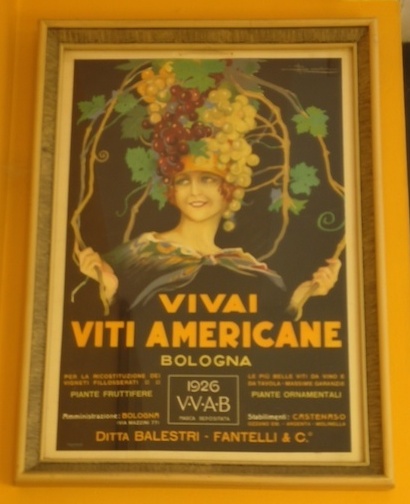
One item of agricultural biodiversity interest from my visit to Bologna last weekend, this rather charming 1926 poster. 1 It offers, as you can see, American vines. And here’s my question: varieties, or Phylloxera-resistant rootstocks?
Livestock are how much?
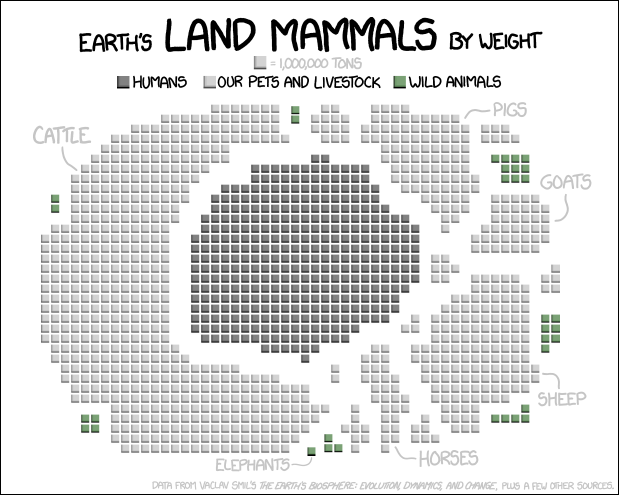
I just think you should see this, from my favourite comic on the web.
Featured: Similarity groups
An item in Monday’s Brainfood prompted Brian Ford-Lloyd to revisit the concept of core collections. The paper looked at “similarity groups” in genebank holdings.
One important question they addressed was ‘why identify similarity groups?’ (not to be confused with duplicates), and only time will tell whether their expectations will be met.
However, there are other issues that occurred to me. One is the relationship with ‘core collections’ (which are not mentioned in the article) of which there are now many, even for a single crop such as rice, and which are proven to be of considerable use (see: Genetic resources and conservation challenges under the threat of climate change, Ford-Lloyd, Engels and Jackson – in Plant genetic resources and climate change – Jackson, Ford-Lloyd and Parry, 2014) (sorry for the plug!). So, having identified similarity groups, is it now necessary to go back and redesign core collections? This seems unlikely, but it would perhaps be worthwhile checking core collections to see the extent of occurrence of ‘similar’ accessions. This might have particular value, not necessarily to ensure maximised diversity within core collections. It might be useful to look for similar accessions to those that have already proved to be of value within core collections, possibly revealing similarly adapted accessions of even greater value.
Brainfood: Turkey genome, Nigerian livestock conservation, Seed viability, Peruvian pepper marketing, Wild D wheats, Rationalizing collections, English heirloom sheep, Model potatoes, Sweet potato leaves
- Next-generation sequencing strategies for characterizing the turkey genome. It never ends, does it. Meanwhile, we patiently await our jetpacks.
- Community-Based Management of Animal Genetic Resources (AnGR): Constraints and Prospects of AnGR Conservation in the Tropics. Best thing to do is improve the local breeds through village-level schemes. In Nigeria, that is.
- Comparison of seed viability among 42 species stored in a genebank. 80% loss in melon seed viability over 10 years sounds a bit high to me.
- Market Participation and Agro-Biodiversity Loss: The Case of Native Chili Varieties in the Amazon Rainforest of Peru. Selling to local retailers good for diversity, selling to wholesalers not so much.
- Stem and leaf rust resistance in wild relatives of wheat with D genome (Aegilops spp.). They all have it.
- Assessing rice and wheat germplasm collections using similarity groups. You can go quite far in identifying possible duplicates just with. passport data.
- Genetic Distinctiveness of the Herdwick Sheep Breed and Two Other Locally Adapted Hill Breeds of the UK. Close to each other geographically and ecologically, but quite genetically distinct. No word on whether village-level improvement necessary for their continued existence.
- Managing Potato Biodiversity to Cope with Frost Risk in the High Andes: A Modeling Perspective. Fancy maths confirms better to grow mixtures. Andean farmers nonplussed.
- Sweet potato (Ipomoea batatas L.) leaves as nutritional and functional foods. But they taste like shit. Just kidding, they’re good and good for you.