- Modern maize varieties going local in the semi-arid zone in Tanzania. OPVs from the 80s are creolizing still, and that’s a good thing.
- Traditional Knowledge Systems, International Law and National Challenges: Marginalization or Emancipation? Well, it looks like it’s the former, but should be the latter. ‘Twas ever thus.
- Valuing insurance services emerging from a gene bank: The case of the Greek Gene Bank. Benefits are greater than costs. Phew.
- Banana genotype composition along the Uganda-Democratic Republic of Congo border: a gene pool mix for plantain and highland bananas. You can still find new stuff. And get funding to look for it, clearly.
- Relationships between the Weedy Amaranthus hybridus (Amaranthaceae) and the Grain Amaranths. Multiple domestications? And why not.
- Genetic Diversity Analysis of Some Ethiopian Specialty Coffee (Coffea arabica L.) Germplasm Accessions Based on Morphological Traits. As ever, useful variation was found. We await its arrival in our morning cup.
- Genetic diversity of Dacryodes buettneri (Engl.) H.J. Lam (Burseraceae), a timber tree in Central Africa. There is some. It could be important, yada yada.
- Malus sieversii: A Diverse Central Asian Apple Species in the USDA-ARS National Plant Germplasm System. The infra-specific taxa may not hold up.
- Exploiting Genomic Resources for Efficient Conservation and Use of Chickpea, Groundnut, and Pigeonpea Collections for Crop Improvement. It’s so close, these guys can taste it. When will we?
- Is genetic information a commons? Maybe it should be.
- Genetic structure and gene flow in Beta vulgaris subspecies maritima along the Atlantic coast of France. The latitudinal cline that wasn’t.
- Restoration of degraded agricultural terraces: Rebuilding landscape structure and process. Restoration is not enough, you need continuous management thereafter. Probably applies to the agricultural biodiversity too, when you think about it.
- Agro-biodiversity in rice–wheat-based agroecosystems of eastern Uttar Pradesh, India: implications for conservation and sustainable management. Resource-poor farmers are better at agrobiodiversity conservation than rich ones. ‘Twas ever thus.
Demon pepper unmasked
“A friend” reached out to me with a strange request. “What could Tasmanian mezereon possibly be?” Seems he’d been served it at a fancy place in Germany.
The name tinkled a faint bell, which turned out on closer listening to be Daphne mezereum, a pretty shrub whose twigs are highly toxic, an extract being used to blister the skin (why? — wart removal?) and to treat arthritis (again, why?). That didn’t seem right, and anyway, the plant isn’t from Tasmania.
There have also been racehorses of that name, but when I offered that as a possibility, my friend said only “might have been, judging only by the taste”.
At this point I naturally had the bit between my teeth, so to speak, and set off in hot pursuit. Further searching revealed the item in question on the English language version of the fancy place’s website, to which I refuse to link as it assailed me with cheesy music. Looking at the website, though, all of the English seemed to be just a bit off. And the menu item in question:
Tenderlion [sic] of beef iced with hibiscus
Tasmanian mezereon au jus
A bunch of pumpkin, serrano-thai-asparagus
and risotto
As an aside, why bother even having an English language site if you can’t be arsed to pay for it. Anyway, off to the (presumably original) German version:
Rinderfilet mit Hibiskus glasiert
Tasmanische Bergpfefferjus
Kürbis, Thaispargel-Serrano-Bündchen
und Risotto
Now we’re getting somewhere. A quick search for Tasmanian mountain pepper, and Bingo!. Tasmannia lanceolata.
As my friend noted, “that is super interesting”.
I wonder what the Germans would have made of Cornish pepperleaf?
Filling the gaps in Lacunas
 A paper in Biodiversity and Conservation caught my eye: “Lacunas: a web interface to identify plant knowledge gaps to support informed decision-making.” 1 I knew that Brazilian biodiversity researchers had been working hard on bringing their data together, and this sounded like the information was now ready to be put to some use:
SpeciesLink’s thematic network, INCT-Virtual Herbarium of Plants and Fungi and the List of Species of the Brazilian Flora, are used as primary data sources to develop Lacunas, an information system with a public web interface that generates detailed reports of the status of plant species occurrence data. Lacunas also integrates information about endemism, conservation status, and collecting efforts over time.
I couldn’t resist doing a quick roadtest of Lacunas, of course. It’s available in both Portuguese and English, and it has a simple, intuitive interface, so it wasn’t a chore. Naturally I selected a crop wild relative: Oryza grandiglumis (Döll) Prod.
You get a nice map. And a bunch of tables summarizing various statistics (both for the exact species name and for phonetically similar species names, which is a nice touch):
- Number of records per year collected
- Total number of records available in different herbaria in the speciesLink network
- Total number of records available in the speciesLink network by georeferencing status
- Total number of records available in the speciesLink network with distinct geographic coordinates
I grabbed a screenshot of one of the tables, because that was the only way I could see to save the results, and I thought I might blog about Lacunas one day. It was a pity about that saving thing, though, because the statistics the portal provides are genuinely useful in giving an idea of the quality and quantity of the data we have on different species in Brazil. For example, for our wild rice there are 31 records in all, but only 4 have original georeferences. Fortunately, for 15 of those that don’t have original latitude and longitude coordinates, it was possible to infer georeferences from other associated data. But that still leaves a significant number of herbarium specimens which cannot be used in mapping the distribution of the species. Anyway, I left a comment to that effect on the website. Then I moved on to other stuff, and the blogging got pushed down the to-do list, what with one thing and another.
Imagine my surprise then when I got notification of a fix within a couple of days. A fix which allows me to link to a results page, rather than include that clunky screengrab here. And imagine my further surprise when the guy who provided the fix turned out to be an old friend. Small world. Anyway, thanks to Sidnei for the help, and the chat.
Now, it would be great to compare the Lacunas data with those in the Crop Wild Relatives Global Atlas. But first I need to convince the developers of that incredible resource to make sharing results a little easier.
Brainfood: Diversity in restoration, Niche model validation, Dutch diets, Markets in conservation, Genomics for stress, Protected agroecosystems, Cocksfoot diversity, Tree breeding, Organic in India, Coconut origins, Dope diversity
- Application of genetic diversity–ecosystem function research to ecological restoration. Cultivars vs local populations vs genetic diversity approaches in restoration reviewed. More research needed, natch, but genetic diversity should not be dismissed out of hand in a bid for rapid establishment or long-term persistence, as it may well be best for ecosystem functioning.
- Application of consensus theory to formalize expert evaluations of plant species distribution models. Given arm-twisting, experts like models.
- Exploring dietary guidelines based on ecological and nutritional values: A comparison of six dietary patterns. The Dutch should eat less meat. No word on beer.
- Market-based mechanisms for biodiversity conservation: a review of existing schemes and an outline for a global mechanism. You can’t monetize what you can’t measure.
- Genomic resources for breeding crops with enhanced abiotic stress tolerance. You still need the phenotyping.
- Perceptual distinctiveness in Native American maize (Zea mays L.) landraces has practical implications. Kernel colour diversity is a marker for other, more interesting, kinds of diversity.
- Can agro-ecosystems efficiently complement protected area networks? Yes, but only in combination with expansion of protected natural habitats. For birds in Israel, that is.
- Indicators for genetic and phenotypic diversity of Dactylis glomerata in Swiss permanent grassland. Management alters both genotype and phenotype.
- A ‘Reality Check’ in the Management of Tree Breeding Programmes. Have come far, but still a ways to go, in particular with regard to the balance between DNA-based vs conventional breeding and genetic gain vs genetic preservation.
- Yield and Economic Performance of Organic and Conventional Cotton-Based Farming Systems — Results from a Field Trial in India. Organic soybean may be a viable long-term option. Cotton and wheat, jury still out. But early days yet, these rotation trials take a long time to get going.
- Long-distance dispersal of the coconut palm by migration within the coral atoll ecosystem. Hugh Harries, one of the authors, in a recent email to us: “Recent reviews have blown dust from old reports of pre-Colombian coconuts in Panama and demonstrated how the rate of germination distinguishes the naturally selected wild coconut from the domestically selected sort. This review formulates a hypothesis which could identify a previously unconsidered route along which the primordial coconut might travel between the South American and Indian tectonic plates without being indigenous on either.” That is, atoll-hopping.
- Differentiation between fiber and drug types of hemp (Cannabis sativa L.) from a collection of wild and domesticated accessions. Must have been fun doing the evaluation.
Dope diversity denied?
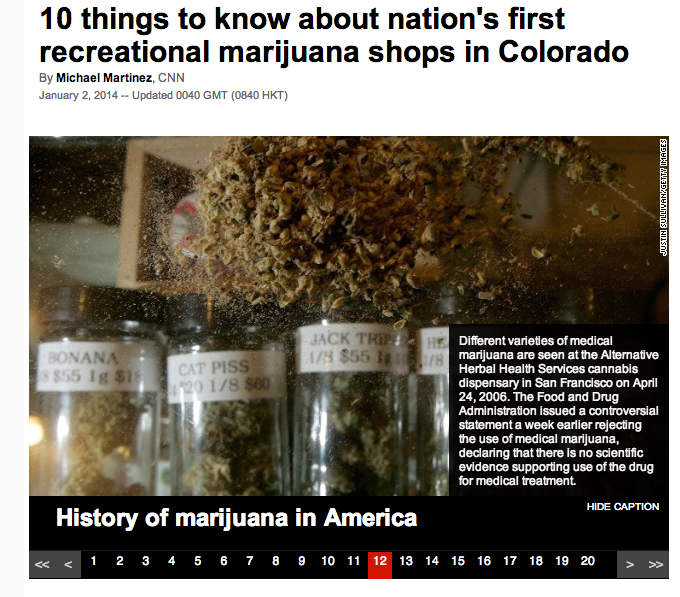
There’s one thing I want to know about what’s going to happen now that marijuana has been legalized in a couple of states in the US. And it’s not on CNN’s list. 2 No, not where a visitor can actually smoke the stuff legally, as opposed to just buying it. Or how I can get a job in the industry. What I want to know is what will happen to diversity. There are some indications that legalization may lead to an increase in intellectual property protection over particular strains. I hope someone out there is gathering the baseline data, and saving the seeds, just in case. Not to mention learning lessons that could then be applied to, I dunno, opium in Afghanistan?