- Landscape heterogeneity and farming practice alter the species composition and taxonomic breadth of pollinator communities. Pollinator species richness decreases along with landscape heterogeneity, but different taxonomic groups do different things, so you have to consider composition.
- Enhancing the sustainability of commodity supply chains in tropical forest and agricultural landscapes. You got your institutions, policies, incentives, information and technologies, and now you’ve got a framework to work out how they can combine to produce the desired outcome of less deforestation from the production of agricultural commodities like beef, cocoa, palm oil, rubber and soybean. That’s the theory done, now on with the practice. Which basically comes down to governance.
- Urban Grassland Restoration: A Neglected Opportunity for Biodiversity Conservation. Beyond green roofs. Rooves?
- A Framework to Optimize Biodiversity Restoration Efforts Based on Habitat Amount and Landscape Connectivity. I guess we should apply this to the above? It’s the lack of connectivity that’s gonna kill ya in those urban landscapes.
- Research Progress of Forage Germplasm Resources Innovation in China. Among other things, that progress came with “ion beam implantation” and “spaceship-carried”, which really makes me want to read beyond the abstract, which however would require knowledge of Chinese. If there’s anyone out there who can explain the spaceship, I’d be thrilled.
- Pasture legumes in Queensland: a new wave? Maybe, but if so very much on the cheap. No spaceships in Oz.
- Mineral composition and their genetic variability analysis in eggplant (Solanum melongena L.) germplasm. 2 out of 32 Indian genebank accessions were good for wide range of minerals.
- The Population Structure and Diversity of Eggplant from Asia and the Mediterranean Basin. An eastern and a western genepool according to SSRs, and 3 parallel morphological groups in each of these. No word on their mineral content.
- Green economy and agri-rural tourism. Marketing local eco-bio-products are the way forward for the Carpathians. Would pay money to see that.
- Genetic diversity in Swedish and Finnish heirloom apple cultivars revealed with SSR markers. The Finnish ones are weird.
- Morphological and molecular characterization of varieties and selected clones of ‘Kadarka’ grape. Formerly the widest grown red wine cultivar in Hungary, and a total nomenclatural mess.
- Using salt-tolerant sweet potato varieties in Than Hoa Province, Vietnam. Ok, maybe not peer-reviewed, but interesting as hell. From 530 genebank accessions to 2 promising cultivars, via lab and field trials.
Cemeteries reveal the secrets of pre-agricultural prairie soil
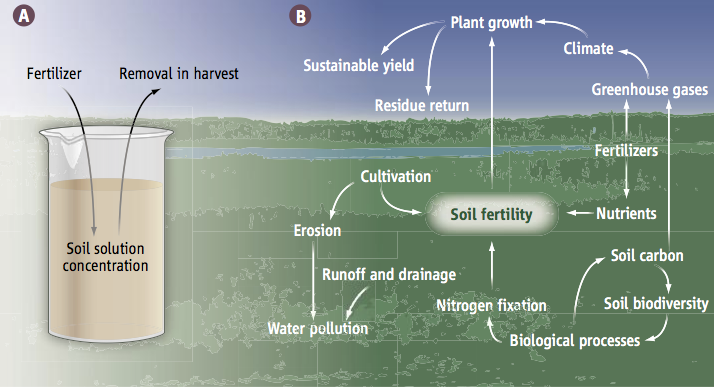
If a picture were worth a thousand words I would stop right now. But it isn’t, so I can’t. An explanation:
Exhibit A, on the left, caricatures, but only a bit, the worldview of many of those responsible for funding and carrying out research into agricultural productivity. Exhibit B, on the right, a slightly more nuanced view, lifted from an article by Mary C. Scholes and Robert J. Scholes in this week’s Science. 1 Scholes and Scholes are commenting on a paper by Noah Fierer and his colleagues in the same issue, which specifically addresses the little label in the lower right: “Soil biodiversity”.
Fierer’s paper 2 asks what the effect of agriculture might have been on the microbial diversity of soils in the tallgrass prairie of North America. There’s not that much left now, but they managed to sample 31 sites, “found primarily in cemeteries or nature preserves”. And they subjected DNA from the samples to some high-throughput DNA sequencing and analysis. The bottom line conclusion is that tallgrass prairie soils are very complex and that this complexity would be expected to affect all sorts of soil cycles, especially nitrogen and carbon.
Scholes and Scholes put those results into context, pointing out that
We have forgotten the lesson of the Dust Bowl: Even in advanced economies, human well-being depends on looking after the soil. An intact, self-restoring soil ecosystem is essential, especially in times of climate stress.
The diversity that Fierer and his team uncovered is strongly linked to functional diversity, independently measured. Prairie soils are particularly rich in Verrucomicrobia, “bacteria specialized for low-nutrient conditions, [which] are lost from the cultivated soils, making the soils less able to supply nutrients other than those provided as fertilizer”. And that’s the key to the bigger picture. Scholes and Scholes point out that:
[I]mproved technology—including the unsustainably high use of fertilizers, irrigation, and plowing—provides a false sense of security.
We need to stop thinking simplistically about the role of inorganic fertilisers and start to consider the soil in which our food grows.
An agricultural soil ecosystem that more closely approximates the close and efficient cycling in natural ecosystems, and that also benefits from the yield increases made possible by biotechnology and inorganic fertilizers, is needed to increase agricultural production to the levels that will be required while minimizing its adverse effects. Integration of the insights, innovation, and best practice from agronomy, ecology, soil biology, chemistry, physics, plant breeding, and natural resource governance is the only viable route to both feeding the world and keeping it habitable.
In other words, we have to do it, but it isn’t going to be simple. Knowing a bit more about what makes prairie soils both productive and self-sustaining may help the process of restoring degrading lands and preventing future degradation.
Seed Savers (online) Exchange
Having given pickacarrot.com a brief Nibble, I feel duty bound to report at greater length on the new online exchange of Seed Savers Exchange. The arrival of the SSE Yearbook, with its hundreds of pages of densely printed listings, heralds, for many, a winter of wondering, speculating, dreaming and, occasionally, frustration. It lists all the varieties offered by members of SSE, from whom you request seed directly. If you are after lots of different seeds, from lots of different members, that means lots of different requests.
The online exchange, while probably not as comfortable to curl up with in front of a fire (I haven’t tried it on a tablet computer) is equally enticing and a lot easier to use. At least, I think it is. In the old days, you actually had to write to someone asking for seed, and if you were doing so from outside the US, as I was, you had to find International Reply Coupons and all that stuff. The online exchange has a wishlist to which you can add your requests, so to test it I thought I’d look for Cherokee Purple, a tomato I’ve grown successfully in the past and that might amuse my Italian neighbours.
I found it easily enough, and then had to choose a member to ask for it. I decided on Neil Lockhart, in Illinois, for no good reason. Then I pressed the button to complete my order, and nothing happened. I’m not sure how I’m supposed to pay the $3 handling fee (plus, I hope, a little more to account for additional postage to me), or what happens next. Perhaps that’s because the online exchange is still in beta test. Perhaps nothing is supposed to happen. Of course, had I read all the details in advance, I would have learned that the online exchange is actually just streamlining the process of requesting seeds, by sending an automatic email from me to Neil. Now it is up to us mutually to sort out delivery and payment. It also streamlines the whole business of listing seeds members may have to offer, which is probably going to be very helpful too.
All in all, SSE’s online exchange has, I think, enormous potential. One of the most interesting and diverting aspects is the Seed Stories, which give a glimpse into the personal histories behind some of the varieties, and to which SSE is adding all the time. The online exchange has some glitches still to be ironed out, and I’m sure they will be. There might even be ways in which it could be improved but that would take inordinate amounts of human time. For now, though, especially if you are in the US, it seems like a wonderful gateway to a wealth of agricultural biodiversity.
Of course, you do have to be a member of SSE, but that’s no bad thing.
David Lynch cooks quinoa
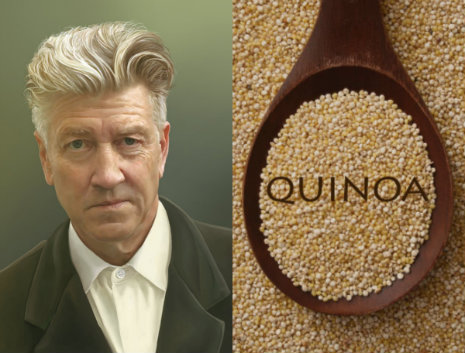
I borrowed the image from the same place that brought this — David Lynch cooks quinoa — to the world’s attention. No really. But where’s the high-quality version? And the missing minutes? C’mon. And in Part II, what sounds like Inca Cola, but isn’t. In the dark!
Seriously, this has to be seen.
Brainfood: Italian almonds, Bamboo in Europe, Ethiopian barley, Cryo bird balls, Finnish cattle products, Adaptation strategies, Soil microbes, RSA droughty SP, Livestock integration
- Genetic diversity and relationships among Italian and foreign almond germplasm as revealed by microsatellite markers. I hate it when abstracts of paywalled papers don’t really tell you anything of any use.
- Bamboo as a Crop in Western Europe – a SWOT Analysis. Yeah that’s not going to happen.
- Phenotypic Diversity for Qualitative Characters of Barley (Hordeum vulgare (L.[/efn_note] Landrace Collections from Southern Ethiopia. Need to focus conservation on Dawro, Sheka, Gamgofa and Keffa and across altitudes. I can’t believe we didn’t already know that but, unlike with the Italian almonds, at least this bit of potentially useful information is in the abstract. And the paper is free.
- Cryoconservation of avian gonads in Canada. And why not.
- Consumers as Conservers—Could Consumers’ Interest in a Specialty Product Help to Preserve Endangered Finncattle? Yes, if the consumers are green male carnivores. But then I could probably have told you that.
- What Influences Farmers’ Choice of Indigenous Adaptation Strategies for Agrobiodiversity Loss in Northern Ghana? Well, if I read this right, it is whether they have a radio, off-farm income and access to extension. But the math is complicated.
- Does agricultural crop diversity enhance soil microbial biomass and organic matter dynamics? A meta-analysis. They mean rotations, and the answer is yes.
- Evaluation of selected sweetpotato (Ipomoea batatas) accessions for drought tolerance. Gotta love it when a genebank gets some use and a student gets a degree.
- Integrated crop–livestock systems: Strategies to achieve synergy between agricultural production and environmental quality. Livestock are the key to ecologically sustainable intensification. But then they would say that, wouldn’t they.