- Crop pests and pathogens move polewards in a warming world. At 3 km/year.
- Systems for making NIAS Core Collections, single-seed-derived germplasm, and plant photo images available to the research community. The next level in genetic resources documentation?
- Recovering Genetic Resources of Some Legume Species of Latvian Origin by Plant Tissue Culture. You have to work at it.
- Overview of in vitro Preservation of Potato and Use of the Gene Bank Material in Estonia. They like coloured potatoes in Estonia.
- The key roles of seed banks in plant biodiversity management in New Zealand. Are many and varied.
- Microsatellite and flow cytometry analysis to help understand the origin of Dioscorea alata polyploids. Unreduced gametes did it.
- Genetic variation in progenies of Jacaranda cuspidifolia Mart using the fan systematic design. Yon can measure genetic variation and evaluate performance under different spacings at the same time, which is important in a tree.
- Diversity analysis in Plectranthus edulis (Vatke) Agnew collection in Ethiopia. As ever, a considerable amount of variability was found. Oh hum.
- The European seed legislation on conservation varieties: focus, implementation, present and future impact on landrace on farm conservation. There should be more landraces in the Common Catalogue.
- Characterization of Zulu sheep production system: Implications for conservation and improvement. If they’re so drought tolerant, why is drought threatening them? Well, there’s drought, and then there’s drought.
- Effects of paraquat on genetic diversity and protein profiles of six varieties of Celosia in South-Western Nigeria. That would be a tasty and diverse local leafy green. Well, before the paraquat anyway.
One more cup of coffee
For some reason, there’s been a sackful of coffee stories lately. Here’s a quick summary:
“Pistols for two, and coffee for one.”
“[Coffee] is of excellent Use in the time of Pestilence, and contributes greatly to prevent the spreading of Infection.”
“We just had to try at least a cup in every village we stopped at, and as they were small cups, sometimes more than one… The irony is that I am a ‘tea-only girl’.”
“Yes, Starbucks has announced it’s taking up shop in Bogota, Colombia. It says it wants to celebrate Colombian coffee.”
“Here, we do not work hard for survival, but we work hard to live a better life; that is what I’ve learned from working on this plantation.”
“In order to create these pre-breeding populations with enough genetic diversity for these economically important traits, WCR 1 will utilize genetic material from the current germplasm collections as well as new material coming from wild populations from the WCR GERMPLASM Project.”
Looking for Mr Soybean
I think the following Twitter exchange is pretty self-explanatory.
https://twitter.com/soyshadow/statuses/371571357550518272
But let me break it down anyway, as I have a feeling you may not be able to see the whole conversation without the sort of extra clicking that we’re always told users don’t like to do. Farmer finds 5-seed soybean pod, which is kinda unusual, apparently. Seed company makes much of it on both Twitter and Facebook. Soybean breeder says: that’s nothing, some wild species have more than 8 seeds per pod! Luigi tries to figure out which ones by trawling GRIN, to no avail. Breeder comes up with factsheet on Glycine tabacina, which is interesting enough but not really the point. Another fine day in Genebank Database Hell.
The further deconstruction of Indian onion prices
A quick follow-up to our post a couple of days back on the price of onions in India. Yesterday the Wall Street Journal, no less, weighed in on the subject, with a reference to a report commissioned by the Competition Commission of India (CCI) to get to the bottom of…
…volatility of onion prices and its relationship with distribution in the what the CCI described as a “loose and casual market.”
According to one of the authors, quoted by the WSJ:
There is almost an oligopoly kind of situation and until there are multiple players, the price will be dictated by a few traders.
So it’s all down to those pesky middlemen, it seems. Farmers have no chance:
Farmers generally take reference of the local markets’ rates, while traders compare rates of all markets, including major distant and export markets and then decide where to send their produce
Ah, but wait. There’s also news of a World Bank pilot project to crowdsource price data on agricultural commodities which may solve that little problem. Here’s the onion data from last year. 2 I’m not sure whether in due course we’ll also have this year’s, and thus be able to see that 200% year-on-year increase in July mentioned by the WSJ.
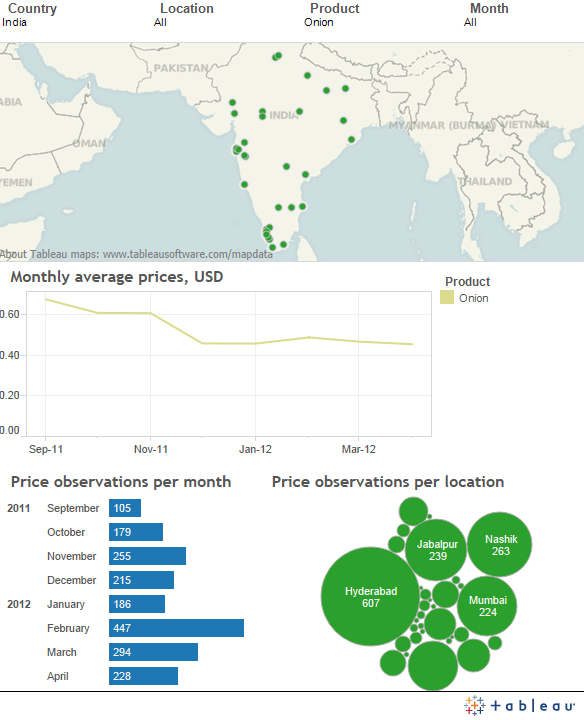
I guess the real challenge is to get these numbers out in real time, and in a way that farmers can make use of. There’s clearly a way to go:
What did we learn? The results from the pilot tell us that, yes, the crowd can collect reliable and timely prices – but you need to provide incentives and implement good verification and validation processes. The resulting data are comparable over time and space, and timeliness is pretty good — the time lag is only about a month. And, importantly, the resulting data are open to all users.
A good start, no doubt, but I’m not sure that a month after the event is going to be of much use to farmers. Other similar efforts are underway, though, so maybe one of these “thousand points of light” will emerge as a bit brighter than the others. After all, if weather, why not prices?
Why is this important for agricultural biodiversity? Well, for a start, markets have been touted as the saviours of neglected and underutilized crops, and maybe even landraces of the more successful and overused sort. Wouldn’t do if they were “loose and casual”, now would it?
Meanwhile, can we have the same for fish?
Brainfood: Touristic islands, Pearl millet diversity, Barley diversity, Maize diversity, Weird chickpea, Sweet potato diversity, Pawpaw diversity, Grewia domestication, Agrobiodiversity is the key, Sunflower relative dynamics
Sorry about the Brainfood hiatus lately. Back now, and with a vengeance.
- Plant genetic resources in a touristic island: the case of Lefkada (Ionian Islands, Greece). Landraces and tourism can coexist.
- Assessment of genetic diversity among pearl millet [Pennisetum glaucum (L.) R Br.] cultivars using SSR markers. The cultivars coming out of a given breeding programme cluster together. No!
- Population genetic structure in a social landscape: barley in a traditional Ethiopian agricultural system. Farmer management trumps even altitude.
- Environmental and social factors account for Mexican maize richness and distribution: A data mining approach. Oh no it doesn’t.
- Identification of an upright peduncle and podding genotype in chickpea germplasm conserved in the National Genebank. That’s one out of 18,873.
- Molecular, morphological and agronomic characterization of the sweet potato (Ipomoea batatas L.) germplasm collection from Mozambique: Genotype selection for drought prone regions. 6 out of 28 local genotypes are drought tolerant. No word on whether they’re yellow fleshed too.
- Genotyping a large collection of pepper (Capsicum spp.) with SSR loci brings new evidence for the wild origin of cultivated C. annuum and the structuring of genetic diversity by human selection of cultivar types. The taxonomy is ok. Human selection is reflected by genetic diversity. A quarter of the accessions can be chosen which contain 97% of the genetic diversity. In other news, France has a collection of 1,300 peppers.
- Phenotypic and Genetic Diversity of Papaya. Wild papayas from South America are closer to an allied genus than to the cultigen.
- Grewia flavescens: a potential horticultural crop? Well, maybe.
- Agricultural biodiversity as a link between traditional food systems and contemporary development, social integrity and ecological health. You need sustainable small farms tied into global markets for high value food crops and ecosystem services. Marx rolls over in his grave.
- Proximity to agriculture alters abundance and community composition of wild sunflower mutualists and antagonists. Wild relative populations nearer to cultigen have more pollinators but fewer seed and leaf munchers than those further away. Not entirely sure what that means for in situ conservation, but I’m sure it’s something.