Just a quick note to say that the Map of Life, which we blogged about a year back, now covers plants too. Still a bit weak in the sharing department, after a quick glance, but I’ll reserve final judgement until I’ve had more of a chance to play with it.
Featured: “GMO” tomato
This is too perfect for words. You’ll remember that I was a little confused by a strange report on a GM purple tomato that somehow wasn’t GM because it was bred from GM parents. Or something. Matthew now reveals that it is even more confusing than I first thought:
You’ll notice that the photo of the “GMO” purple tomato is from Oregon State University. It’s actually a photo of one experimental line from Jim Myers classical breeding program that last year released a new purple commercial variety. Here’s the press release they took it from: http://horticulture.oregonstate.edu/purple_tomato_faq.
We’ve written about those GM purple tomatoes before, and about Oregon State’s breeding programme. Nothing since then has changed my mind on the topic.
Brainfood: Grass evolution, Great Lakes fisheries, African cassava, Sustainable UK farms, USA biodiversity loss, PVS, Agriculture to the rescue
- Evidence for recent evolution of cold tolerance in grasses suggests current distribution is not limited by (low) temperature. Geography a better predictor of cold tolerance than phylogeny.
- May we eat biodiversity? How to solve the impasse of conservation and exploitation of biodiversity and fishery resources. We may, if we all agree.
- Genetic diversity of cassava (Manihot esculenta Crantz) landraces and cultivars from southern, eastern and central Africa. There isn’t any.
- Evidence of sustainable intensification among British farms. Amazingly, there is some, and aiming to increase profitability can get you there.
- Key areas for conserving United States’ biodiversity likely threatened by future land use change. To the tune of 5-8% area loss, and not counting climate change. Would be interesting to know what that will do to crop wild relatives.
- Dilemma in participatory selection of varieties. If it’s a one-time deal, as it often is, it ain’t gonna work.
- Green Revolution research saved an estimated 18 to 27 million hectares from being brought into agricultural production. And saved 2 million ha of forest. But less than Borlaug thought. More on “Agricultural innovation to save the environment” from PNAS.
Conserving forages for 30 years
That’s what the genebank at ILRI has been doing. Under the stewardship first of Jean Hanson and then Alexandra Jorge, both of whom you can see in the photo reproduced below from ILRI’s Flickr stream. Jean is the one on the right. Happy birthday, and keep up the good work!
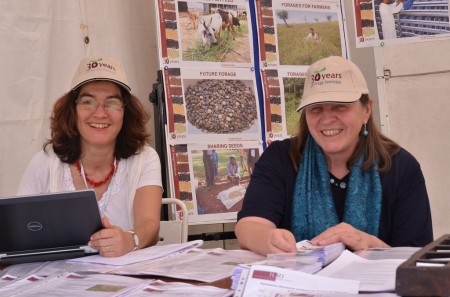
(photo credit: ILRI\Zerihun Sewunet)
Featured: Seed Law
Patrick gets it: beyond fitness for purpose, freedom of choice is all people want from seed laws.
Everything else can more effectively be dealt with through the free market. If farm-saved seed, local adaptation and the value of diversity don’t translate into farm profits and productivity, then they will cease to exist. If people want to buy DUS and VCU, and these are more productive, so be it. If one seed company produces seeds deamed in some way to be better than their competitors, then farmers can choose those seeds.
So I guess he’d agree with Dave’s point:
As to Holly point: “There’s nothing wrong with growing whatever you want.” I agree – but tell that to the people who are blocking Mexican farmers growing GM maize. The activist-imposed `regulation’ tries to stop farmers in ill-defined Centres of Crop Origins growing GM crops (brinjal in India, maize in Mexico).