- Perennial cereal crops: An initial evaluation of wheat derivatives. Early days still.
- Effects of silviculture on native tree species richness: interactions between management, landscape context and regional climate. Encourage mosaics, and don’t harvest everything.
- The global fire–productivity relationship. It’s humped, and will be changed by climate change, though for different reasons for different productivity levels. Wonder about the fire-diversity relationship, though.
- Ancient DNA Analysis Affirms the Canid from Altai as a Primitive Dog. Bit of a judgement call though.
- Genetic structure and diversity of coffee (Coffea) across Africa and the Indian Ocean islands revealed using microsatellites. Just what you would expect, given the “morpho-taxonomic species delimitations and genetic units.”
- Genetic diversity among farmer-preferred cassava landraces in Uganda. Landraces only a bit more diverse than elites overall, but half of them quite different.
- Correspondence between genetic structure and farmers’ taxonomy — a case study from dry-season sorghum landraces in northern Cameroon. Genetic units = farmer-recognized landraces.
- Plant diversity, productivity and nutritive value change following abandonment of public pastures in Japan. The best way to restore productivity (diversity doesn’t change much) in abandoned pastures is to start grazing them again.
- Genetic variability of maize stover quality and the potential for genetic improvement of fodder value. You can improve stover and grain yield simultaneously, in hybrids. In theory.
- Governance regime and location influence avoided deforestation success of protected areas in the Brazilian Amazon. Total protection better than sustainable use. Ouch. Meanwhile, in the USA…
- ICPH 2671 – the world’s first commercial food legume hybrid. Yet another milestone on the road to the complete eradication of farmers’ rights.
- Genetic improvement of grain protein content and other health-related constituents of wheat grain. Need to figure out the genetic control mechanisms, and then exploit “alien” germplasm using MAS. Oh, and GMOs too.
- Quantifying the impacts of bioenergy crops on pollinating insect abundance and diversity: a field-scale evaluation reveals taxon-specific responses. Diversity begets diversity.
- Diversity and geographical gaps in Cajanus scarabaeoides (L.) Thou. germplasm conserved at the ICRISAT genebank. Now collectors know exactly where to go.
- Tree species diversity increases fine root productivity through increased soil volume filling. Below-ground complementarity is good for everyone’s roots, presumably good for the community too.
- Making seed systems more resilient to stress. Foster informal innovation, but also information exchange (presumably including of the formal kind).
Peas that surpasseth understanding
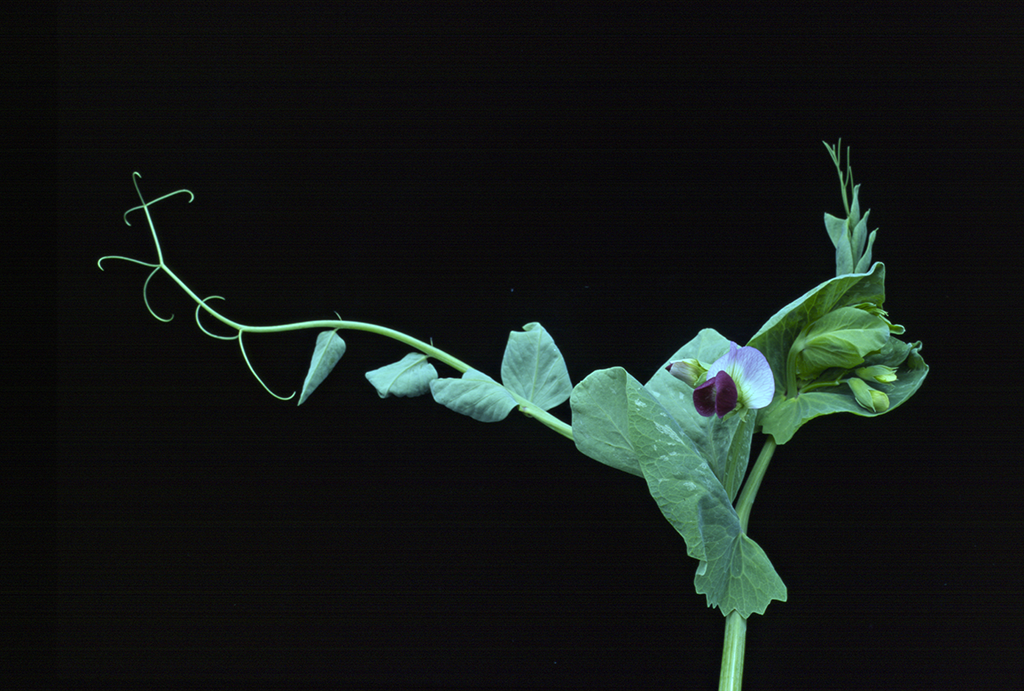
Today is Carlin Sunday. That’s a Carlin Pea up there. There is a lot more one could say about carlins. Indeed, I’ve said some of it myself. For now, let them be a reminder of all the choices we’ve been denied as a result of EU legislation.
Is this really a Roman mosaic of a pineapple?
Originally from the environs of the Villa Rufinella. Is it legit? And if truly ancient Roman, what is that in the upper right hand corner if not a pineapple?
LATER: I should add that I was pointed in the direction of that mosaic by a long, but fascinating, talk on “Mapping the Ancient Environment: The Contribution of Manuscripts and Texts,” 1 which in turn came to me thanks to a tweet from @mem_somerville.
“Expert” admits: I don’t know the story of the Enola bean
A couple of days ago, when I Nibbled Steve Savage’s “robust defence of plant patents” I said that I did not agree, and that this would never stop me linking to things. I also left a brief comment on the blog post in question. Matthew went far further in challenging Savage’s view in a lengthy, detailed and deliciously snarky comment here. Matthew also cross-posted his comment at Applied Mythology, Savage’s blog, where Steve kinda sorta replied to the points Matthew raised. You can read the exchange there and make your own mind up. But what really, really struck me about Savage’s replies was this:
I don’t know the story of the Enola bean. Perhaps you could summarize that so I and others don’t have to go searching for that information.
I’m sorry? You set yourself up as having some sort of authority in the matter of plant patents, value of, and you “don’t know the story” of one of the most important cases in plant patent lore in recent years? Forgive me if I perhaps don’t take some of your views too seriously.
Farmersourcing germplasm evaluation
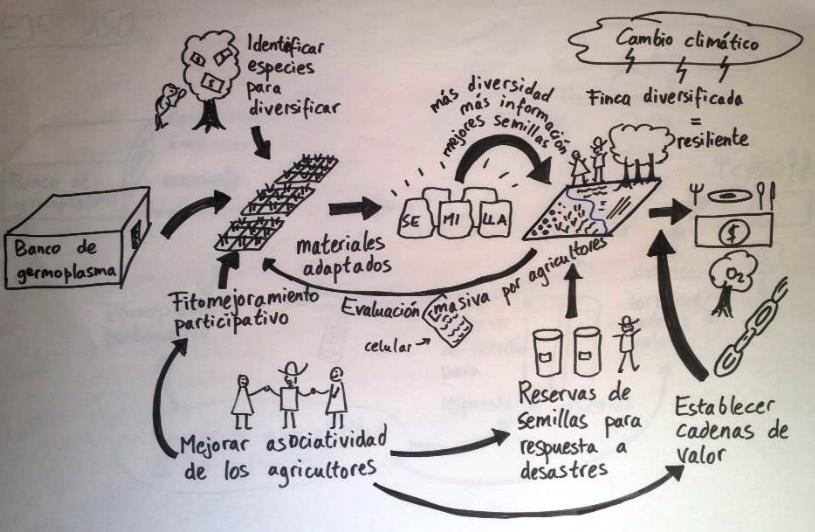
Our friend and occasional contributor Jacob van Etten has been busy. He has a piece out over at the CCAFS blog describing his work in India on crowdsourcing the evaluation of wheat varieties in the context of climate change adaptation which has been attracting some attention. He’s blogged here before about getting seeds out to farmers, but he’s also published a bit more formally on the subject, and seems now to be putting his theories into practice now at Bioversity. More power to him. If you’d like to hear him explaining his work, rather than just reading about it, you can do that too.
A bit surprisingly, Jacob doesn’t particularly highlight 2 the role of genebanks in his CCAFS piece. It would be interesting to know why. Perhaps he can tell us here. Or on his Twitter account. Anyway, I’ve found a diagram on his Facebook page which suggests that he does think genebanks have a key role to play in diversified and resilient farming systems. Here it is, for those of you who are not his “friends.”