
Scientists Seek to Clone Perfect Christmas Tree
Bloggers seek to return soon. Enjoy whatever holiday is that that you enjoy, and some Christmas Tree Diversity.
Crops, livestock, microbes, pollinators, wild relatives, agroecosystems, foodways …
Scientists Seek to Clone Perfect Christmas Tree
Bloggers seek to return soon. Enjoy whatever holiday is that that you enjoy, and some Christmas Tree Diversity.
FAO has just announced that 13 projects, involving 30 countries, have been selected for funding as contributions to the implementation of 2007’s Global Plan of Action for Animal Genetic Resources. That’s thanks to the Governments of Germany, Norway and Switzerland, who put more than US$1 million in voluntary contributions into the appropriate FAO Trust Account, as per the Funding Strategy of the GPA. What are these projects? Well, it’s not all that easy to say. These are the directions FAO gives us:
Details of the projects are available here (scroll down to the map).
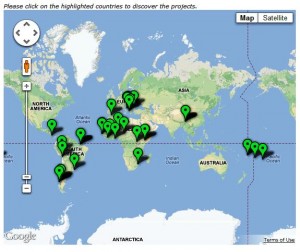 The map in question is nice enough, and clicking on the country gives you lots of information on each project, but what I really wanted was just a list, giving titles and countries. And I couldn’t find that anywhere, though maybe I just didn’t look hard enough. With just that map, interactive and all, you get a good overall idea of geographic coverage, but it’s very difficult to figure out the range of livestock species involved in the projects, or how many are single-country as opposed to multi-country initiatives, for example. A pity.
Ah, but fear not, we’ve got you covered. Here’s the list you know you wanted but FAO wouldn’t let you have, going roughly from east to west, painstakingly extracted from that ever-so-pretty map.
Funny this coming hot on the heels of the launch of FAO’s monumental new data portal.
A horizon scan of global conservation issues for 2013” by Prof. William Sutherland et al., just out in Trends in Ecology and Evolution, identifies 15 topics that “increasingly may affect conservation of biological diversity.” It’s a pretty eclectic bunch, ranging from synthetic genetics to hydropower in the Amazon. But no, “synthetic genetics” doesn’t refer to things like remaking wheat, it’s to do with “synthetic forms of nucleic acid that could function in living organisms.” In fact, there’s not much agriculture in there at all, in the sense that none of the topics identified are the sort of things that affect agricultural biodiversity, as opposed to the “natural” kind. That’s par for the course as these exercises go, of course. Agriculture (in a broad sense) does make an appearance in a couple of cases, however. So, for example, the alarm is raised over the increased use of plant-based sources in aquaculture feed.
New developments include selection and genetic modification to alter the composition of both vegetable feed sources and aquacultured organisms, changes to the processing of aquaculture feed, and new sources of aquaculture feed. New sources may include terrestrial animal by-products, waste matter from biofuels and brewing, and derivatives of bacteria, yeast, and microalgae. These changing demands bring aquaculture into more direct competition with arable and livestock farming for land and resources. Their direct and indirect effects have yet to be analysed on a global scale.
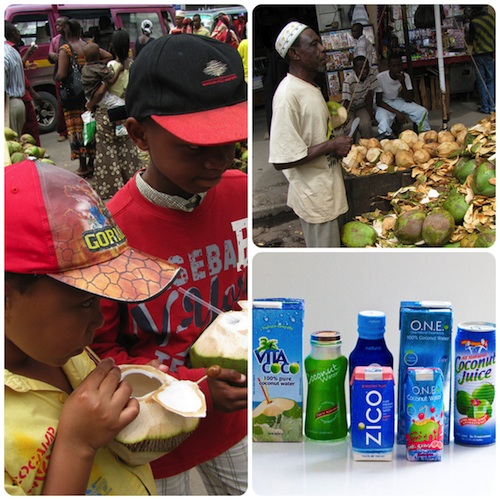
But the most intriguing of the topics discussed, from an agricultural perspective, is the “[r]apid rise in global demand for coconut water.” With many thanks to Trends and ScienceDirect, I’ll take the liberty of reproducing the relevant section in full:
There has been a rapid increase in demand for coconut water in the USA, Europe, and other large markets (http://arnoldonethicalmarketing.brandrepublic.com/2012/06/11/coconut-water-the-next-big-trend-and-billion-dollar-market-in-soft-drinks/). This is partly in response to claims that it has high potassium content but low levels of fat, carbohydrate, and sodium (http://www.motherjones.com/blue-marble/2010/07/coconut-water-sports-drinks). In 2010, commercially packaged coconut water was mostly sold in Asia, with a few brands available in specialised food outlets in the UK and USA. By 2012, over 20 coconut water brands had emerged in the UK and the product was stocked in mainstream supermarkets. In the USA, major beverage producers, such as PepsiCo and Coca-Cola, either purchased or bought shares in smaller companies based in coconut-producing countries. Exports from coconut-growing areas across the world have increased by hundreds of per cent since 2010, with the Philippines reporting a 300% increase in exports in the first quarter of 2012 (http://www.pca.da.gov.ph/pr063012a.php). The area of cultivated coconut Cocos nucifera may increase to meet this growing demand, driving land-use change and potentially affecting ecosystems in some areas. A recent study on an uninhabited Pacific island found much lower seabird abundance in areas with coconut palm, relative to areas dominated by native tree species, and consequently lower nutrient additions to local soils. However, to examine the effects of the potential land-use change, the environmental impacts of coconut cultivation would need to be compared to those of other crops, as well as native vegetation, in appropriate localities.
I had no idea about this extraordinary change in demand for coconut water. Be that as it may, surely the possible effects are not just on seabird and native trees species diversity, but also on diversity within the coconut crop itself, in places like the Philippines in which coconut cultivation might expand or switch to higher-yielding hybrids. It is unfortunately all too typical that when agriculture does come up, it is solely as the cause of problems for other biodiversity, rather than as the home of biodiversity in its way just as threatened and important as any in tropical rainforests and coral reefs.
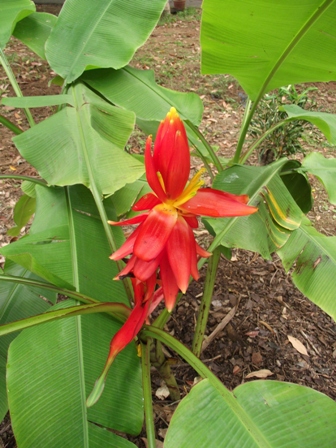
Oh dear. The Musa taxonomists among you will have spotted that the wild banana species illustrated in the previous post, with Markku Häkkinen standing beside it, was not the new species he recently discovered in Vietnam but rather Musa viridis. Markku is understandably a bit incensed about it and asked us to correct ScienceNordic’s error. We are happy to do so, with apologies for perpetuating the mistake, and to publish below Markku’s photo of the real Musa haekkinenii. I knew I should have waited for ProMusa to do its thing.
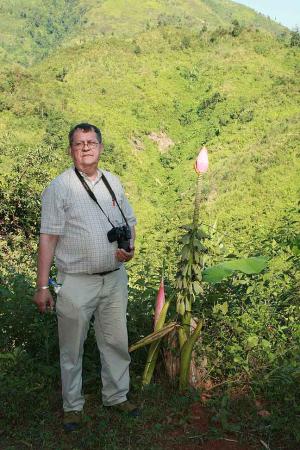
Finnish sea captain and amateur botanist Markku Häkkinen has studied wild bananas for nearly 40 years. Now he has found the new species to science.
That’s from ScienceNordic. The new species is called Musa haekkinenii, and was described earlier this year in Phytotaxa by a team of Vietnamese taxonomists, who graciously named it after Markku. Congratulations to all concerned. And we look forward to seeing the full details on ProMusa.
LATER: No, wait.