Attentive readers may well remember a Nibble from a couple of months back announcing the “Discovery of genes for resistance to black Sigatoka in bananas” by Researchers at Ecuador’s Biotechnology Research Centre (CIBE). When I posted a link on Facebook, I got an immediate response by Prof. Rodomiro Ortiz of the Dept. Plant Breeding and Biotechnology, Swedish University of Agricultural Sciences (SLU): “Black Sigatoka resistant bred-hybrids have been distributed to African farmers since 1990s.” Smelling an academic spat, I asked if he would write up his thoughts for us. Here they are. The piece is a little longer, and more technical, than our usual fare, but stay with it, there’s a lot of interesting detail about the complexities of banana breeding. Many thanks to Rodo for taking the time to contribute to our blog.
Host plant resistance genes for black Sigatoka in banana and plantain: Thinking back on two decades of Musa breeding research
Black Sigatoka (or black leaf streak) is a major global constraint for growing one of our favorite fruits: banana and plantain (Musa spp.), which are triploid (2n=3x=33 chromosomes), perennial herbs. Mycosphaerella fijiensis is the causal pathogen that attacks the leaves. Wind disseminates its spores and the pathogen infects the leaves as they unroll. The ensuing disease develops faster where humidity and rainfall are high. Yield loss to black Sigatoka ranges from 33 to 50% because this leaf spot disease affects negatively both fruit number and weight. There are chemical pesticides to control black Sigatoka but they are environmentally unsound and socio-economically inappropriate for resource-poor smallholders that grow the crop in the tropics.
Very recently, Ecuador’s Biotechnology Research Center announced the isolation of genes conferring host plant resistance to black Sigatoka from the wild diploid (2n=2x=22 chromosomes) banana accession ‘Calcutta-4’ (Musa acuminata ssp. burmannica from Myanmar). They aim to use this gene in genetic engineering new banana cultivars for export trade and plantain cultivars for local markets. It is worth highlighting, however, that the genetics and inheritance of host plant resistance to black Sigatoka in Musa was elucidated in the 1990s and acknowledged when the CGIAR King Baudouin Award was given to the International Institute of Tropical Agriculture (IITA, Nigeria) in 1994 for breeding black Sigatoka-resistant plantain-banana hybrids and making important advances in Musa genetics.
Genetic analysis was done in segregating diploid and tetraploid (2n=4x=44 chromosomes) offspring obtained from crossing triploid African plantains with ‘Calcutta 4’, which was found to be a true breeding line for this and other traits. The segregating offspring were therefore regarded as genetically equivalent to a testcross for the host response to black Sigatoka. This host plant resistance to Mycosphaerella fijiensis results mainly from the interaction of three independent alleles: a recessive allele at a major locus (bs1) and the alleles of at least two independent minor, modifying genes with additive effects (bsri). These genes show a strong dosage effect at the tetraploid level, which leads to higher levels of host plant resistance in tetraploid than in diploid hybrids. The susceptible plantains have the recessive host plant resistance genes but their expression is masked by the dominant effect of the major gene for susceptibility they bear. Figuring out the genetics behind this trait was an “Eureka moment”: one of the co-authors of the first journal article on this subject had a “heavy dream” at night and after waking up next morning thinking about the first model of inheritance he noticed that his bed had fallen through the floor of the portable cabin at IITA’s High Rainfall Station (Onne, near Port Harcourt, Rivers State, Nigeria).
The proposed genetic model was further confirmed by investigating tetrasomic segregation in a cross between a resistant and a susceptible tetraploid hybrid. Moreover, a CIRAD team found that one restriction fragment length polymorphism (RFLP) was strongly associated to host plant resistance to black Sigatoka, and also mapped a second locus accounting for this host plant resistance at a lower significance level onto another linkage group. Likewise, the role of the major gene for resistance (bs1) was assessed through the analysis of the frequency distribution in each segregating population. Host plant resistance traits displayed a normal distribution across ploidy level, thereby suggesting that additive gene action plays an important role in the response to black Sigatoka. Intra-locus interaction at the bs1 locus apparently regulates the appearance of symptoms on the leaf surface, whereas the additive effect and the intra-locus interaction of the bs1 locus affect disease development in the host plant. Therefore, the gene action(s) at the bs1 locus may provide durable resistance by slowing down disease development. It has been hypothesized that the two minor additive modifier genes (bsri), which enhanced host plant resistance to black Sigatoka, may control decreased stomatal density and increased leaf waxiness. Both characteristics may be mechanisms that lengthen the incubation time of the disease in the leaves.
It was noted that highly resistant Musa plants exhibit the longest incubation time and leaf life span as well as a hypersensitive reaction to black Sigatoka. This extremely resistant response blocks disease development at an early stage, thereby impeding the occurrence of mature leaf necrotic lesions. The susceptible cultivars have a short incubation time, evolution time and disease development time, which indicates that after infection, disease symptoms evolve quickly into necrotic spots, resulting in extensive leaf death and defoliation.
Partially resistant plantain-banana hybrids had a homeostatic host response to Sigatoka in multi-environment trials in sub-Saharan Africa. Some hybrids also achieved high and stable bunch weights across environments due to their resistance to black Sigatoka, even under low organic matter inputs. One of these black Sigatoka-resistant hybrids (‘PITA-14’) — which showed a shorter cropping cycle, higher bunch weights, more bunch harvests, and appropriate post-harvest attributes — benefits farmers in the Nigerian plantain belt. The farmers could earn more than twice income from ‘PITA-14’ than from the susceptible plantain cultivar ‘Agbagba’ due to its reduced cropping cycle and increased bunch weight. As a result of farmer-to-farmer spread, the area with new plantain hybrids trebled in six years.
The high yielding resistant hybrids can be used in mixed cultivar systems, which are common among smallholders in the tropics. Intra- and inter-specific diversity — through cultivars mixtures and intercropping, respectively — maximize land, use labor more efficiently and minimize the risk of crop failure. Such a deployment strategy for these black Sigatoka-resistant hybrids follows a non-disruptive dissemination approach in which the resistant hybrids serve as inoculum traps that reduce the spread of this disease to the susceptible cultivars and may increase the bunch weight of these cultivars that are preferred by farmers due to their culinary and rheological traits. Large-scale on-farm testing and dissemination of plantain hybrids in West Africa, shows that this approach was effective for reducing the severity of black Sigatoka on the susceptible plantain cultivar. The bunch weight of the susceptible plantain increased significantly (> 50%) when grown in mixture with the hybrids, which did not alter their high bunch weights under this enhanced performance of the susceptible plantain.
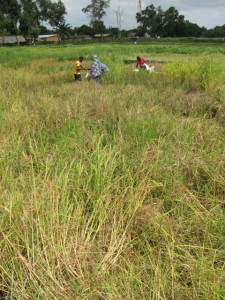 Some of you may have been wondering where I’d got to, a few weeks back. No? Nobody missed me at all? Well, I’ll tell you anyway. I was on a quick tour of West Africa, visiting the genebanks of IITA, NACGRAB (both around Ibadan in Nigeria) and AfricaRice (just outside Cotonou, Benin; its experimental fields are illustrated here to the left). It’s all in the context of the CGIAR’s new Research Programme on Genebanks. We were trying to work out the best way for the CGIAR as a system to provide an efficient and cost-effective service in long-term ex situ conservation of rice genetic resources in Africa, and indeed the rest of the world, given that three Centres have an interest in the subject. Below you’ll see the peregrinations our merry band undertook (thanks to Ruaraidh and his GPS receiver). I think you’ll have to click on the link and go to Google Maps to see the full extent of the trip. All great fun. And, I think, quite successful. I’ll post a link to the resulting document when it’s all finally agreed.