A commenter posted a link to an interview with Dr Richard Markham, a research programme manager for the Australian Centre for International Agricultural Research, on the threat to the international coconut collection in Papua New Guinea. I’m sharing the link here in case you didn’t notice it in the comments and would like a slightly more sober assessment of the threat than has been available elsewhere. Listen as he fends off a sensationalising journalist. And for those whose bandwidth will not easily allow them to hear Dr Markham’s dulcet tones, there’s a full transcript.
Brainfood: Sierra Leone rice, Bean breeding, Cacao geographic diversity, Red fleshed apples, Species richness & productivity, African maize diversity, Human expansion, Barley gaps, Wild coffee and CC, Acacia and CC, Genetic erosion
- Analysis of genetic diversity in farmers’ rice varieties in Sierra Leone using morphological and AFLP markers. Still a lot of diversity in traditional rice after the war, both among and within landraces, mostly among, organized regionally, and recognized by local names.
- Simultaneous selection for resistance to five bacterial, fungal, and viral diseases in three Andean × Middle American inter-gene pool common bean populations. Thanks goodness for multiple independent domestication events. And genebanks.
- Present Spatial Diversity Patterns of Theobroma cacao L. in the Neotropics Reflect Genetic Differentiation in Pleistocene Refugia Followed by Human-Influenced Dispersal. So need to collect in areas at the margins or just outside the refugia if you want high diversity. But of course that may already be ex situ. But wait, didn’t you just do the analysis based on the provenance of ex situ holdings?
- An ancient duplication of apple MYB transcription factors is responsible for novel red fruit-flesh phenotypes. The whole genome got duplicated during evolution of the apple and the red flesh phenotype is controlled by loci in both copies, but in different ways.
- What is the form of the productivity–animal-species-richness relationship? A critical review and meta-analysis. Positive.
- Spatial Structure and Climatic Adaptation in African Maize Revealed by Surveying SNP Diversity in Relation to Global Breeding and Landrace Panels. Distinct Sahelian, Western and Eastern clusters. Some SNPs associated with high temperatures.
- MtDNA analysis of global populations support that major population expansions began before Neolithic Time. Humans needed good weather to thrive, not agriculture.
- Genetic gap analysis of wild Hordeum taxa. Argentina?
- The Impact of Climate Change on Indigenous Arabica Coffee (Coffea arabica): Predicting Future Trends and Identifying Priorities. Generally very bad to disastrous, but some “core localities” will be ok, and therefore could be used for in situ conservation. Interestingly, genebank accession locality data not used.
- The genus Acacia (Fabaceae) in East Africa: distribution, diversity and the protected area network. No such luck for Acacia, I’m afraid.
- Monocropping Cultures into Ruin: The Loss of Food Varieties and Cultural Diversity. Are you sure you want to know what a sociologist and a political scientist have to say on the matter?
Mapping joy
Our friends at CIAT are bursting with pride; at a workshop they are testing cloud technology for sharing geographic information. All I can say is that it seems to work, and that the mappers are pleased with the drawing speeds. The rest is beyond my technical chops, although if you had the skills, you could probably do something clever like add the distance to the nearest cassava processing factory. Or something.
Never rains but it pours
As it turns out, climate change is not the only thing coffee has to contend with in East Africa. There’s the Coffee Berry Borer too. Integrated pest management is showing some promise, but, as a comment on a recent Plantwise post reminds us, the effect of climate change on the pest is “forecasted to worsen in the current Coffea arabica producing areas of Ethiopia, the Ugandan part of the Lake Victoria and Mt. Elgon regions, Mt. Kenya and the Kenyan side of Mt. Elgon, and most of Rwanda and Burundi.” That’s for the crop, of course, and things may not be so bad for wild trees, for micro-environmental if not genetic reasons. But you never know.
Coconut Plan B needed
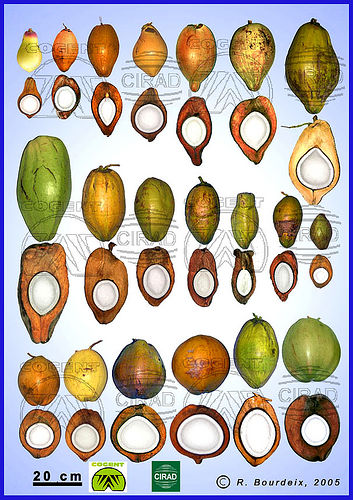 Bogia Coconut Syndrome is threatening the international coconut genebank in Papua New Guinea, one of several established in the 1990s under the International Coconut Genetic Resources Network (COGENT). That’s the warning coming out of a meeting on the Pacific coconut industry taking place in Samoa, as relayed by SciDevNet. Dr Richard Markham, now with the Australian Centre for International Agricultural Research, one of the co-sponsors of the meeting, but formerly of Bioversity, where he had responsibility for COGENT, is being admirably logical, calm and reassuring in his soundbites:
We are supporting research to try to identify the [Bogia Coconut Syndrome] vector and better understand the host range of this disease. Once we have that information, everyone will be better placed to assess the threat — both to coconuts and livelihoods in general.
But surely plans need to be put in place in case the worst happens. What to do? Roland Bourdeix, the current coordinator of COGENT, who’s responsible for the wonderful photo of coconut diversity I’m reproducing here, is talking of rescuing, relocating, duplicating. Possibly on those little isolated islets he’s so fond of. And that is no doubt an approach worth looking into. But there are 57 accessions to deal with from this genebank, and it’s going to take a while to find the necessary number of uninhabited island paradises, even if not all the 57 are unique. In vitro is an option too. COGENT has been working on an in vitro embryo collecting and transfer protocol, but it’s not quite there yet. Time to ramp that work up?
LATER: More reassuring words from Richard Markham on Facebook. No need to panic. But also no room for complacency.