Where did the purple potato come from?

Purple potato, Potato Park,Cusco/Frederik Van Oudenhoven This post is not really about purple potatoes. It is, rather, a shameless attempt to connect with Adam Mars Jones, a well-known author. In the course of eviscerating Martin Amis, another well-known author, Mars Jones writes the following:

The same sense of lostness clings to social attitudes. When Des finds a girlfriend, Dawn, the only problem is her racist father, Horace. He’s not just a racist but a throwback of a racist: ‘Your brain’s smaller and a different shape. Whilst hers is normal, yours is closer to a primate’s.’ In the allotment of nasty social attitudes this contorted purple tuber must count as a heritage potato, miraculously re-established from a seed bank.

Which is enough to bring us up short. I’m not entirely sure what point Mars Jones is trying to make — contorted purple tubers being just the job under the right (marginal, high-altitude) circumstances — I do wonder what made him think of that particular metaphor, complete with interesting reference to “seed bank”.

So if you know the man himself, or know someone who might, do please ask and relay his answer.

Markets in everything, food security edition

I know, I know, there’s been much more talk about market failure in the past couple of years than about market success. Case in point: a clever interactive map has been done showing you where markets have been bad for biodiversity, but not one showing where they’ve been good.

But all that negativity hasn’t stopped Dougal Thomson just launching a discussion on what the private sector can do for food security. It’s all to get you interested in The Economist’s Feeding the World conferences later this year of course. And to put you in an appropriately market-friendly mood for Rio +20 next week too, I suppose.

Anyway, here’s where, recession or no recession, you can channel your inner capitalist and tell the world how to “…reconcile a multinational’s need for profit with a smallholder’s need for income, a mother’s need to feed her baby and a nation’s need for food security.”

Following threats to animals along supply chains

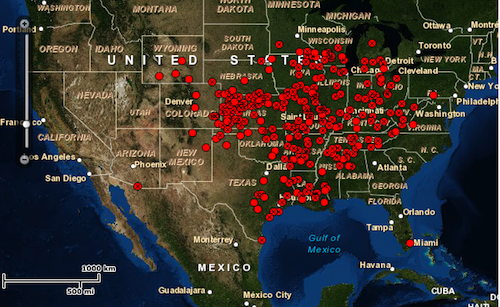
As Rio +20 looms ever nearer, everyone is scrambling to put stuff out pushing their particular agenda, taking care to note that they’re not suggesting that their agenda is any less vital than anyone else’s agenda, of course, and that in any case There Are No Silver Bullets. One of the more interesting products released to coincide with next week’s Brazilian festivities is an interactive map which uses “a new global trade database to follow the products implicated in species threats right through to the final consumers.”

The paper describing the methodology is in Nature.

We linked 25,000 Animalia species threat records from the IUCN Red List of endangered species to over 15,000 commodities produced in 187 countries. We then used the trade database to evaluate over 5 billion supply chains in terms of their biodiversity impacts.

It’s a massive undertaking, and it may be churlish to wonders why it’s not easier to export the maps it enables one to produce. So I won’t, and merely confine myself to hoping that a plant version will be available soon. Oh, and maybe also one in which agriculture is not seen only as the bad guy. In fact, would it not be nice to have the other side of the coin? That is, a map showing where supply chains may actually be contributing to conservation. Come on, there must be a few examples of that! Bird-friendly coffee, anyone?

Would you pay €50 per accession?

Bert Visser, director of the Centre for Genetic Resources, the Netherlands (CGN) has just sent the message below to colleagues in the European crop genebank network, and suggested that readers of this blog might also have an opinion. If you have, do leave it here as a comment.

Like so many genebanks, since a number of years CGN has been confronted with increasing costs and diminishing budgets for its core genebank tasks (collecting, regeneration, storage, evaluation, documentation, distribution). Moreover, CGN has observed a considerable increase in the number of distributed samples resulting in increased handling costs and accelerated exhaustion of our stocks with consequently higher yearly regeneration costs.

In order to manage a widening financial gap, in consultation with the Ministry of Economic Affairs, Agriculture and Innovation, CGN is considering a number of measures including a revision of seed viability testing protocols (based on recent findings regarding the storability of seeds under genebank conditions) and a much tighter planning of regeneration and acquisition activities. Furthermore, the private sector will be approached to discuss options for the sector’s continued involvement in regeneration of CGN germplasm.

In addition, we are considering a measure for which we seek your comments and advice. This measure regards the introduction of a handling fee for the distribution of CGN germplasm. The Treaty, in its Article 12, allows for a handling fee, whereas the distribution conditions under AEGIS do not exclude the possibility of such a fee. Globally, only few genebanks have introduced handling fees, notably NIAS (Japan) and AVRDC (global; vegetables). CGN handling fees would not apply to partners that carry out regeneration tasks for CGN, neither to NGOs.

CGN is considering handling fees that could amount up to € 50 per accession. Whereas we consider this a modest amount per accession, the request for large numbers of samples may be strongly discouraged. Therefore, discount fees for larger numbers of requested samples, or for pre-packed sets (core or elite collections) will be considered. In any case, a handling fee might encourage potential users to consider in more detail which accessions are really needed in planned research or breeding programmes, and may prevent poorly motivated requests or intended duplications of CGN germplasm in other collections.

We realise that any unilateral action of CGN may have an impact on you: users may shift from CGN to you assuming your distribution is still free, and you might be asked by your own government to introduce fees as well. There may be other consequences that we have not taken into account yet.

In any case, we do not wish to introduce a unilateral handling fee overnight and have not yet taken any definite decision, and this is why we are consulting you as our European colleagues to have your opinions and feed-back. In particular, we would be interested to hear of any other discussions on the introduction of a handling fee.