The World Urban Forum is taking place down in my home town this week. That I suppose was what provided at least part of the impetus for the United Nations Standing Committee on Nutrition (UNSCN) to issue a statement on the Nutrition Security of Urban Populations. Not to be outdone, FAO has a publication out too, Growing Greener Cities in Africa, touted as the “first status report on urban and peri-urban horticulture in Africa.” A cursory glance doesn’t reveal much on diversity in these documents, but this is an issue that’s always intrigued me. Could cities act as magnets for crop inter- and intraspecific diversity? After all, they have lots of micro-niches, and have been attracting people from all over for decades, who could have come with their seeds. Is it possible that varieties could still be grown in cities after they’ve disappeared in their native areas? Or at any rate that crop diversity in a city is higher than in the surrounding countryside? Sometime ago we did a small survey of sweet potato diversity in Nairobi roadside verges that seemed to suggest that the menu of varieties was at least somewhat different from what was available in nearby rural areas. Should write that up one day. Anybody know of similar studies?
Cheers
I can’t believe I forgot to include news of the President’s homebrew in the list of my favourite agrobiodiversity stories of the past few weeks. I suppose it was all done by the Obama campaign as part of a complicated social media strategy to deflect attention from the Republican convention, but I don’t care. I like that the hop varieties involved, Kent Goldings and Fuggles, have venerable, and not uninteresting, histories.
What I read on my summer holidays
Yeah, summer is over and I’m back at work. Maybe you noticed I haven’t contributed much here in the past month or so. Or maybe you didn’t. Jeremy kept up a steady stream of agrobiodiversity nuggets pretty much all through August. But my lack of activity on the blog doesn’t mean I haven’t tried to keep up, as you would know if you followed us on Facebook, Twitter or Scoop.it. Anyway, for those that don’t, and would like to catch up on my summer reading, here is, in nibble form, what caught my eye during the past month or so:
- “The potato is a religious commodity in America.” Explaining the governance crisis in the US using the humble spud.
- Wait a minute though: “The sizzle seems to be gone from America’s long-term relationship with the potato.” Which apparently means it needs an extreme makeover, colour-wise. For which you’ll need a genebank.
- A tree’s leaves can be genetically different from its roots. Does that mean we have to re-think all molecular phylogenies?
- And speaking of a tree’s leaves, these ones are a thousand years old and give you a buzz.
- A toff with a passion for pigs. P.G. Wodehouse had something to say about this, didn’t he?
- Turns out WFP has a podcast. And ICIMOD has an RSS feed.
- A mathematician factchecks Michael Pollan.
- Pear with me please, while I tell you about another USDA fruit collection.
- 15 Africa-changing innovations include orange-fleshed sweet potatoes. As if they weren’t there before. Anyway, they were THE story for a couple of weeks in August.
- 12 food security innovations include increasing crop diversity. With orange-fleshed sweet potatoes?
- How to put that banana genome to some use.
- Getting the most out of your enumerators.
- IUCN’s Conservation Campus. Any ag? And on a similar topic, training materials in anthropology.
- Automating conservation assessment of plants. You’ll need provenance data from herbaria such as this one at CIP, of course. Oh, and speaking of CIP, they need a phylogeneticist.
- A market opportunity for the mother-in-law?
- Measuring the health of the oceans. Hey, but it’s not all bad for fish.
- Ten species which rely on ex situ conservation. And why that number will go up. How to pay for it all, though?
- Book on the recent history of agricultural research reviewed. I wonder if they looked at the private sector. Because it seems there may be a case to answer.
- Another big grant for taxonomic databases. Ah but this is all going to be community-driven.
- Looks like this Australian genebank could have done with a decent database, community-driven or not.
Sweet video on honey and bees in the US
Where Kasalath rice landrace really comes from
The conversation about Kasalath rice continues, with some actual information about the accession in question. The back story has kinda sorta made its way into the mainstream media too. Reuters published the picture below yesterday (30 August).
A scientist locates the rice variety kasalath inside the gene bank at the International Rice Research Institute in Los Banos, Laguna
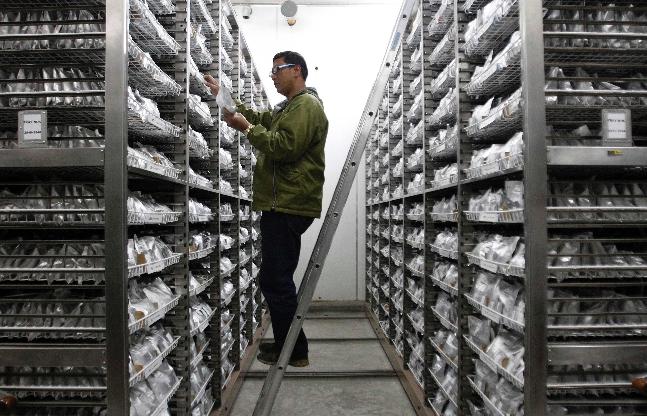
I guess we’ll just have to take Reuters’ word that the scientist is indeed locating Kasalath and not some other sample.