Rosario Falcon heard our cry for help from Genebank Database Hell, and took pity on us:
This is the link for Puca Lliclla
This is for Pallay Poncho
Thank you, Rosario!
Agrobiodiversity is crops, livestock, foodways, microbes, pollinators, wild relatives …
Rosario Falcon heard our cry for help from Genebank Database Hell, and took pity on us:
This is the link for Puca Lliclla
This is for Pallay Poncho
Thank you, Rosario!
There seems — inevitably — to be something of a competition out there to produce maps of changes in climatic suitability for different crops. And I’m not saying that’s necessarily a bad thing. The recent launch of FAO’s GAEZ Data Portal gives us a much-needed alternative to the all-but-unusable offering by CCAFS. Sad to say, it is not much of an alternative.
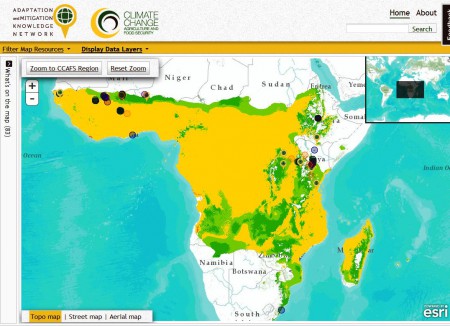
Here’s the quick version. CCAFS’s Adaptation and Mitigation Knowledge Network allows you to map current suitability, future suitability and change in suitability for a few crops. The example below is change of suitability for Phaseolus beans in Africa. I wasn’t able to get rid of those extraneous place markers, nor to export the results other than by screengrab, nor to import my own data to super-impose, nor to include the legend in any sensible way.
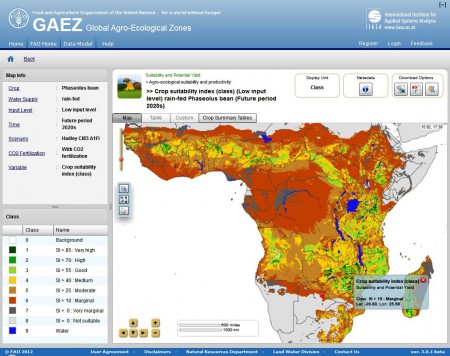
FAO tries to fill the gaping hole left by this well-meaning but flawed tool by providing something that: has menus which are extremely cumbersome to navigate; does not include change in suitability, but then doesn’t let you combine present and future suitability to do your own analysis; does allow you to choose different climate models, but again not to combine the results; does allow various download options, none of them particularly useful, and then only if you register; and, needless to say, doesn’t allow you to import data.
It’s hard to say how one could better replicate, and in fact accentuate, the bad features of one tool, while ignoring whatever good things it had. Frankly, I’m running out of patience with websites which are clearly designed by one set of geeks for another set of geeks. Meanwhile, users — you know, the people for whom this stuff is allegedly produced — are left to cry over their keyboards, and think of what might have been. And regret the fact that they’ll never get back the hour they’ve just wasted.
News of a healthy new oat variety sent me scurrying to the Pedigrees of Oat Lines (POOL) website at Agriculture Canada, but alas BetaGene is not there. However, our source on all things oats tells us of another US cultivar, released some years ago, called HiFi, which is also high in those heart-friendly beta glucans. Our source thinks HiFi was probably involved in developing BetaGene.
HiFi, by the way, includes a whole bunch of wild relatives in its pedigree, including Avena magna, A. longiglumis and A. sterilis. Interestingly, when you check up on that A. magna in GRIN, it turns out that the accession used, which was collected in Khemisset, Morocco in 1964, was originally labelled A. sterilis. It looks as though seeds of a couple of different species were inadvertently placed into a single collecting bag on that far-off summer day in North Africa. The mishap was only recognized when the material was later processed in the USDA genebank, which led to the original sample being divided up. Ah, the perils of crop wild relatives collecting! And ah, the value-adding that genebanks do!
Incidentally, there’s material from at least half a dozen different countries in HiFi’s 1 pedigree. And that, of course, 2 is the standard argument for both genebanks holding diverse collections, and a multilateral system of access to (and sharing of the benefits deriving from the use of) that diversity. Too bad that point is not made in any of the news items about the new variety that have been appearing.
I don’t really understand that. I think “the public” would find it interesting that their porridge, or whatever, includes genetic material from all over the world, and that people have been working very hard for many years to put in place the conditions to allow such sharing to continue. Including an international treaty, no less. Which should really be telling us these stories.
LATER: …as opposed to these.
Jeremy’s recent piece of detective work with the current edition of the Garden Seed Inventory, coming hot on the heels of my own piece on how diversity in French wheat has changed during the past hundred years, reminded me of a post of ours a couple of years back that could now bear revisiting. It was about a paper that had re-analyzed historical data from vegetable seed catalogues old and new to suggest that maybe the metanarrative of genetic erosion had been overdone:
If the meaning of diversity is linked to the survival of ancient varieties, then the lessons of the twentieth century are grim. If it refers instead to the multiplicity of present choices available to breeders, then the story is more hopeful. Perhaps the most accurate measure of diversity would be found in a comparative DNA analysis of equal random samples of old and new varieties, work that remains to be done.
The alleged grounds for hopefulness are that Drs Heald and Chapman, the authors, found 7100 varieties in 2004 catalogues, “only 2 percent fewer than one hundred years earlier. By this measure, consumers of seeds have seen almost no loss of overall varietal diversity”. Well of course that French wheat work is indeed as close as we’re likely to get to the “DNA analysis of equal random samples of old and new varieties.” And, alas, it shows what Jeremy said at the time was all too possible, and that is that genetic diversity can go down even when varietal diversity, meaning the number of cultivars of a crop, goes up. Grim after all.
Trawling seed catalogues is good fun, and can give you some clues as to what genetic erosion may be happening, but in the end it is diversity at the genetic level that really counts, let’s remember that. The geneticist JBS Haldane famously said that he would lay down his life for two of his brothers or eight of his cousins. That’s just a striking way of saying that you’re more closely related to your brother than to your cousin. The corollary of that is that there’s more genetic diversity in a group of cousins than in a group featuring the same, or indeed even a greater, number of brothers.
We still don’t know if those 7100 varieties in the 2004 catalogues are more brothers or cousins, but, if French wheat is anything to go by, the former is more likely. 3 You may think you have a “multiplicity of present choices”, but if in fact you only have brothers to choose from, you could be forgiven for the temptation to trade a whole bunch of them for a cousin or two.
Assuming you can get hold of them, that is.