Using MAPPR, a policymaker can identify regions of a country with high concentrations of both poverty and cropland, or an investor thinking about building a food-processing plant can search for locations that combine production of sufficient quantities of a particular crop with good access to markets.
Well that sounds like fun. I’m an investor. I’m thinking of ploughing my hard-earned cash into a cassava processing plant in Tanzania. Let’s see if MAPPR can help me.
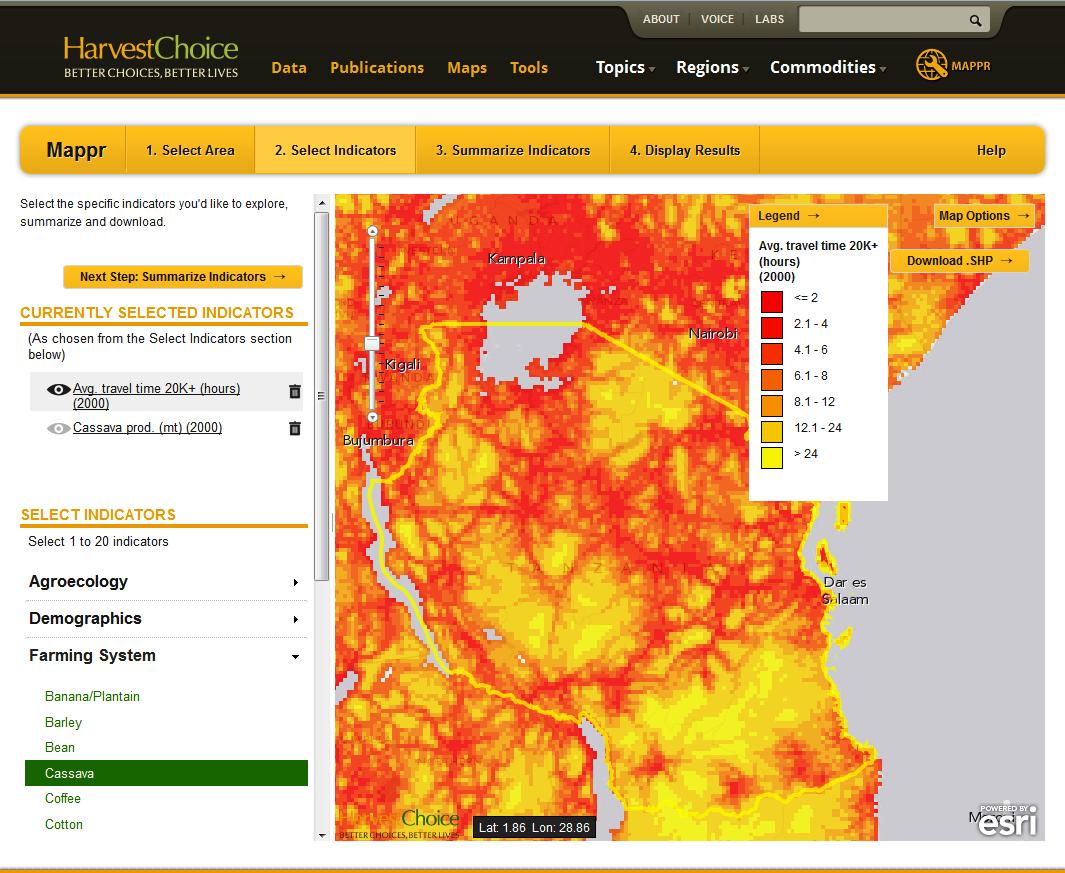
You can indeed produce a map of both cassava production and average travel time for Tanzania, and fairly easily. Here’s what you get for “Median travel time to human settlement of 20,000 or greater population”, for example.
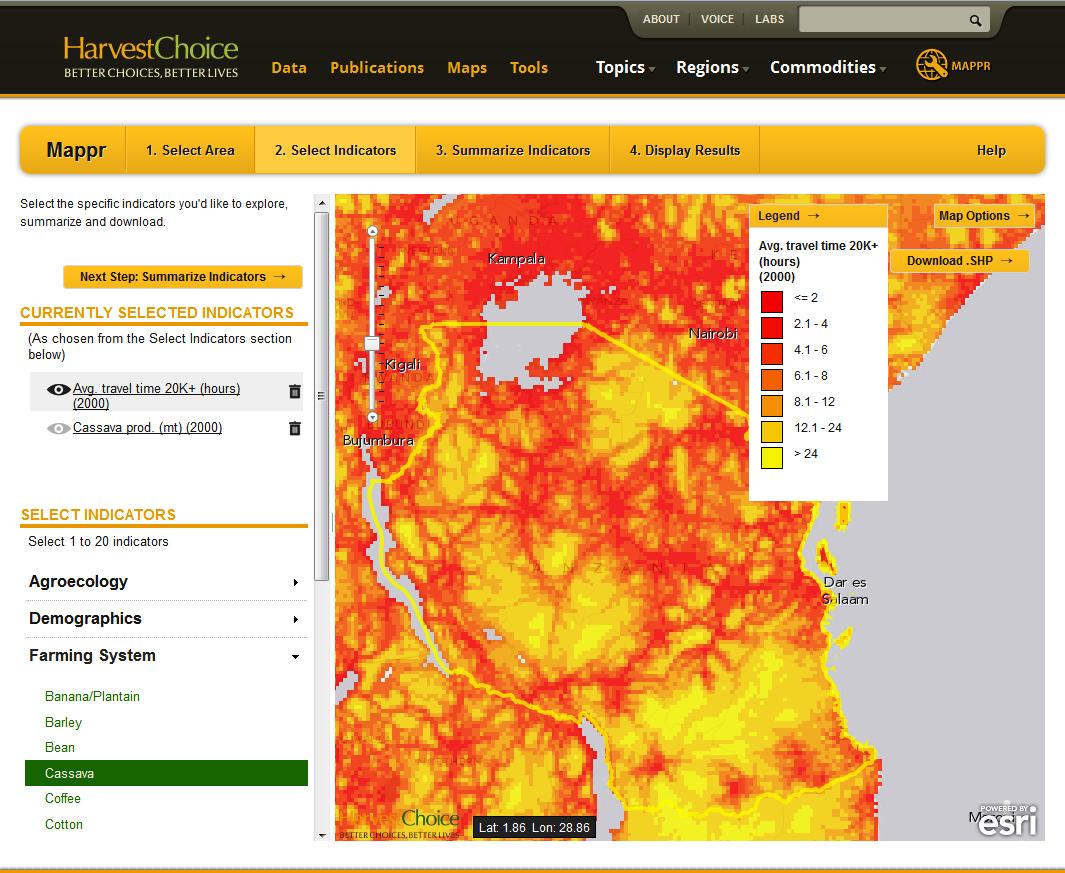
You can also very easily produce a map of cassava yield, production and area in Tanzania. You do that by clicking on the little eye thingie on the left of the map, where is says “Cassava Prod. (mt) (2000).” Problem is, when you do that, your map of travel time disappears, and I can see no way of showing the two together to tell me where short travel time to a village coincides with high cassava production, assuming that’s a sensible thing to want to know. Short of printing out the two maps on transparent paper and looking through the two of them on a light table, that is. Gosh, I used to do that back in the 80s. Ah, but you can’t even print the maps out easily. You have to do the screen capture thing. As an investor, I’ve already given up on MAPPR.
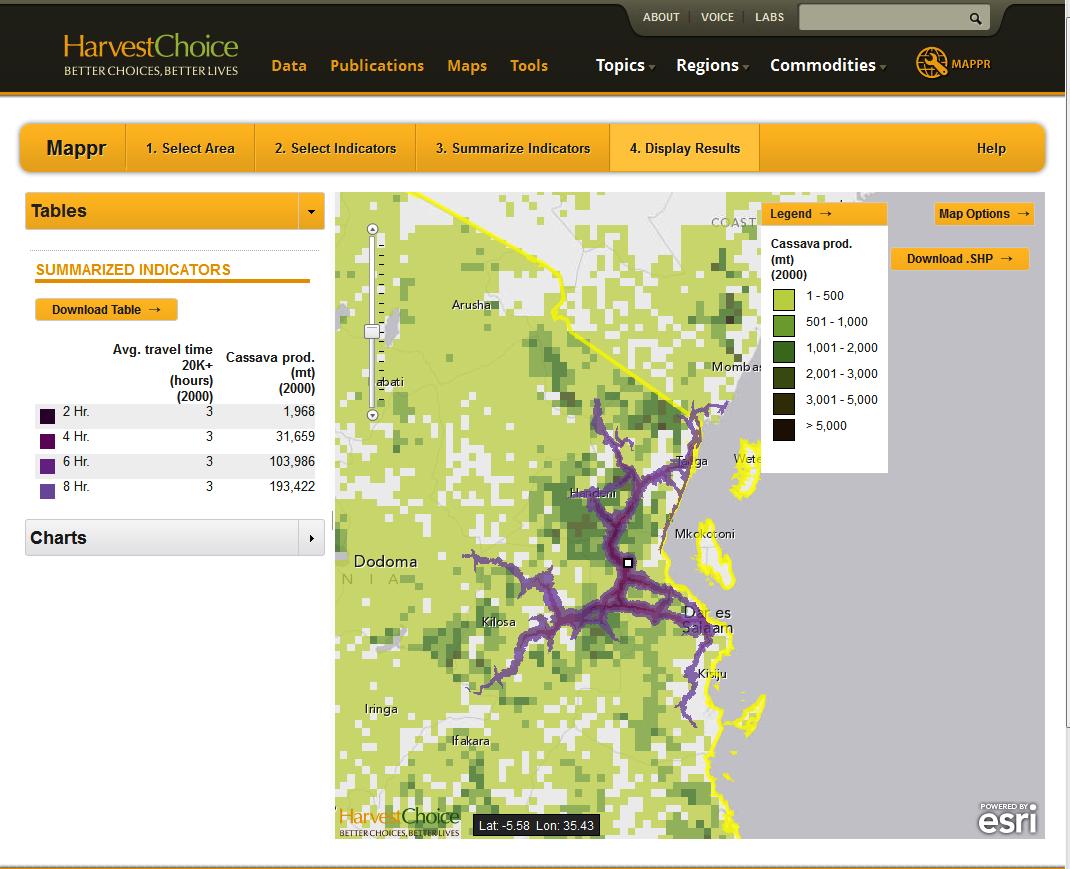
But I’m not an investor, I’m a sucker for punishment, so I persevere. Maybe this “Summarize indicators” option will help me. Well, it does, thankfully. You can pick a specific location, or define a custom area, or a domain (an agroecological zone, say), and MAPPR will give you summary information for both travel time and cassava production. So, for example, this is the result of combining “Median travel time to human settlement of 20,000 or greater population” and “Cassava Prod. (mt) (2000)” for a specific location I chose at random.
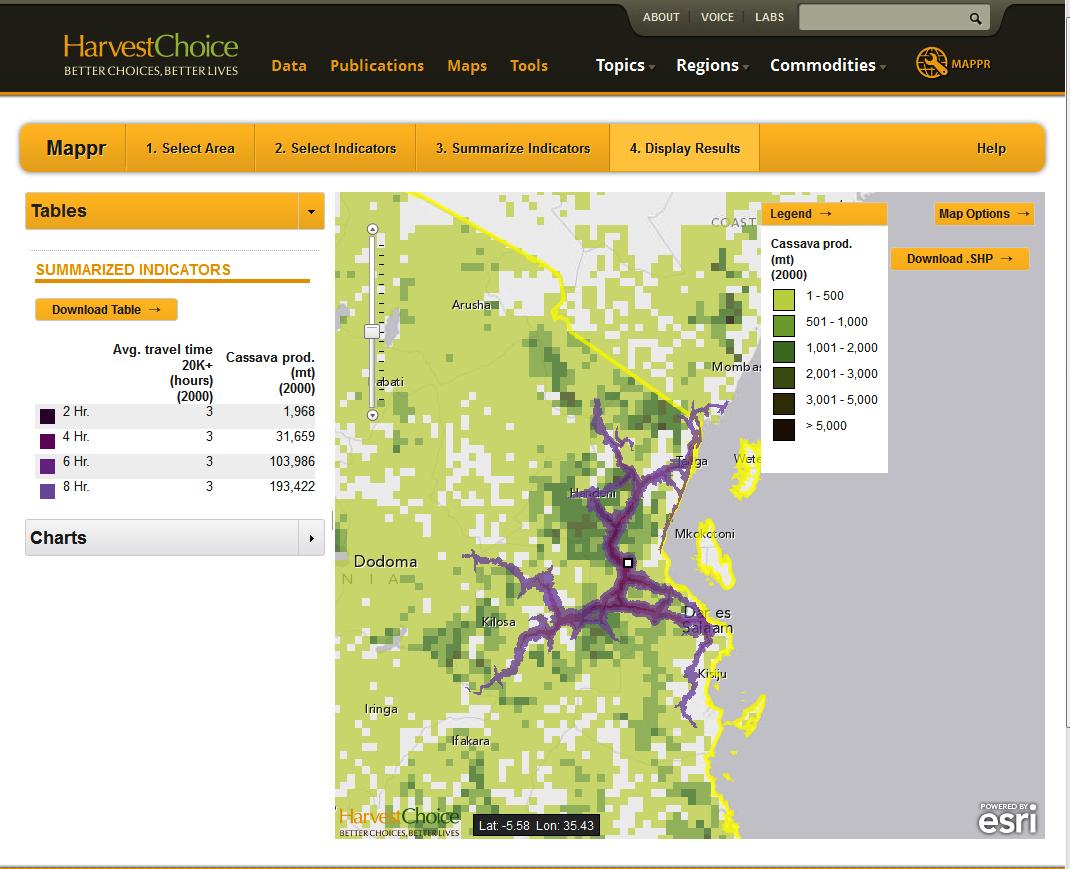
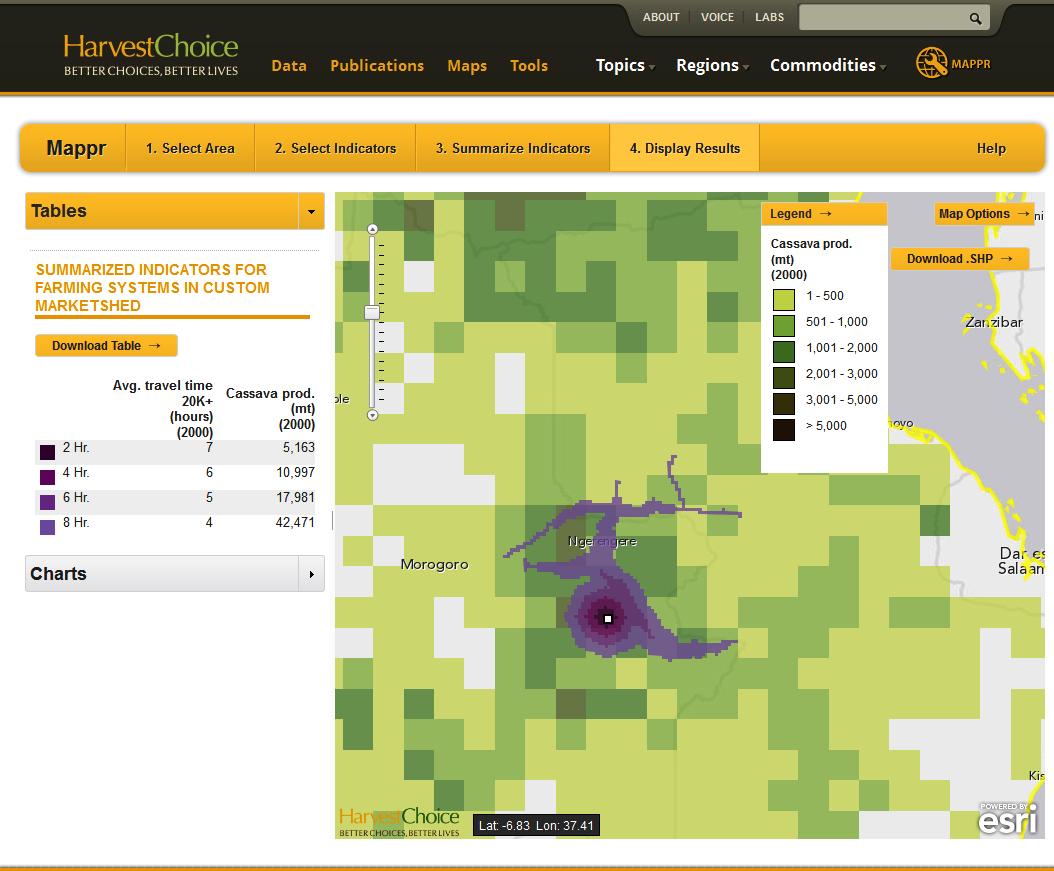
Perhaps somewhat more helpfully to our imaginary investor, you can also get a map of travel time to a specific location, and cassava production within different travel times of that location.
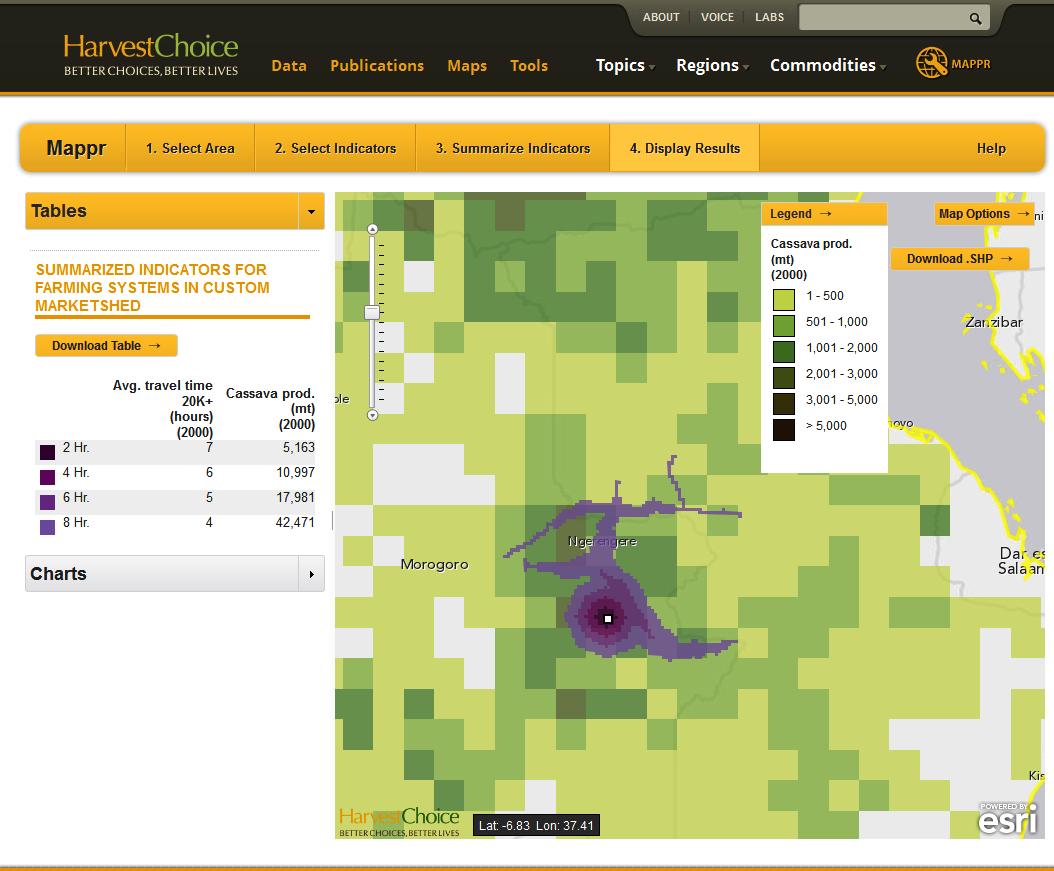
Unfortunately, sharing this result is problematic. Basically the only thing you can do is a screen grab. Trying to export the shapefile so you can use the map in your own GIS, and maybe do further analysis, or combine it with your own data (cassava accessions in genebanks, anyone?), or even produce a nice image, results in the dreaded “404 – File or directory not found. The resource you are looking for might have been removed, had its name changed, or is temporarily unavailable.” And if you try to go back to your result, MAPPR flings you back to the beginning and you have to start the whole process over again. Ouch.
So actually, if you are “an investor thinking about building a food-processing plant can search for locations that combine production of sufficient quantities of a particular crop with good access to markets” I think you will find MAPPR pretty useless. You’d have to have a number of a priori options for siting your plant, and then you could go through all of the above for each of those sites, and then maybe by comparing the results pick your best bet. But you wouldn’t be able to work out where the very best place to site your plant in the whole of Tanzania might be. And you wouldn’t be able to export your results and do your own analysis based on the data that is available.
And even if you could, because let’s say I’ve missed something in the functionality, you wouldn’t be able to share your results in a way that lets others explore them further.
But don’t take my word for it. You be that policymaker in the blurb that wants to “identify regions of a country with high concentrations of both poverty and cropland.” If you can do that, I promise to host the results here. And apologize to the MAPPR team. Until then, I maintain that this is not a tool that the average policymaker or investor is going to use, at least more than once. And neither will I. Believe it or not, I’m really sorry about that.