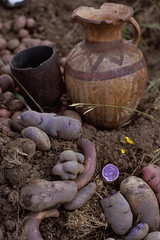
Featured: Oca

Gregory Vaughan has news for fans of oca, and other Andean roots and tubers.

I just got back from the Parque de la Papa, and it turns out that they are indeed in the midst of a new repatriation of something like 78 accessions of virus-free oca (I think it’s just oca, with no mashua or ulluco yet) from CIP. They have transferred the vitro plants to soil bags that they are raising in a sterile greenhouse.

If anyone is interested, I’m working on a project with the UPTC in Tunja, Colombia to investigate and promote our local varieties of these tubers and other native Andean crops.

And yes Gregory, we’re interested.

The Origins of some basic mistakes about genebanks

I’m not sure how we missed it, but Origins, “a project of the Public History Initiative and eHistory in the History Department at The Ohio State University,” had a longish piece called “Conserving Diversity at the Dinner Table: Plants, Food Security and Gene Banks” last month. You can read it, or listen to it. The author is Nurcan Atalan-Helicke Visiting Assistant Professor of Environmental Studies at Skidmore College, Saratoga Springs, NY.

It’s a pretty straightforward account of the practice and history of crop diversity conservation and use, but with a clear slant.

In the long run, the most efficient way to conserve agrobiodiversity is to maintain farmers’ cultivation of traditional varieties.

Admittedly, there’s not much evidence brought forward for this statement, which is treated almost as self-evident, but it is not made any easier to swallow by being preceded by the likes of this:

The Soviet Union was the first to establish gene banks for crops. However, Russian botanist Nikolay Vavilov’s effort to collect seeds worldwide in the 1920s and 1930s was aimed at research alone, not the protection of seed diversity.

I feel sure Vavilov would beg to differ. Or this:

Working in collaboration with hundreds of governments, civil society organizations, and private businesses around the world, CGIAR today supports 15 international centers for agricultural research and about 1,750 gene banks. Together, these gene banks contain a total of 6 million accessions of all crops and represent 95 percent of all cereal landraces worldwide. These are public or non-profit entities whose goal is to sustain “food for people.”

The bit about the CGIAR’s 1,750 genebanks will come as a bit of a shock to the CGIAR. Not to mention the 1,750 genebanks. Then there’s this:

The CGIAR gene banks are located primarily in the global South but their funding and guidance comes primarily from Northern donors. CGIAR ensures that seeds and plant germplasm are stored in duplicate and kept below freezing so that they can remain viable for decades. They are cultivated under sterile conditions with fertilizers.

Sterile conditions I suppose refers to in vitro collections. But what’s with the fertilizers? And also:

There is also a question of access. Whereas many of the CGIAR centers are open access resources, the newer ones are not. Both the Svalbard and the Millennium Seed Bank are more restrictive, with access limited to those with permission from countries that make deposits.

Well, actually, in the case of Svalbard, it is only the depositing institutes which can access the material they send up there for safe-keeping.

I could go on. Plus there’s no mention of the International Treaty on Plant Genetic Resources for Food and Agriculture. The mistakes and omissions are a pity because Dr Atalan-Helicke makes a couple of astute points. For example:

Many countries continue to depend on CGIAR’s gene banks to improve their agriculture, taking advantage of the CGIAR’s open access to resources for research, breeding, conservation, and training. Between 1974 and 2001, Kenya and Uganda received a total of 12,000 unique accessions from all CGIAR gene banks that were collected from other countries. In the same period, about 4,000 accessions collected from Kenya and Uganda were distributed to the world.

You rarely see this kind of statement about the value of the international collections in pieces which are trying to make the point that yes, sure, genebanks are ok, but there’s a better way to conserve crop diversity.

Anyway, if the Public History Initiative ever does another piece on agricultural biodiversity, we’d be happy to do the fact-checking.

Brainfood: Chicken domestication, Financial crisis and conservation, Cucurbit domestication, Tamarind future, Biofortification via bacteria, Cowpea nutritional composition, Roman bottlegourd, Noug, Rice blast diversity, Pearl millet domestication, Cacao genotyping, Organic ag, Marcela, In situ vs ex situ, Artocarpus roots

Darwin Day 2012: b’lieve I’m fixing to live

I confess to being somewhat peeved this morning, on several counts.

First, I thought it was the 11th, giving me a day to be ready with a post for Darwin Day 2012.

Then, I couldn’t find any evidence of an online celebration of Darwin Day 2012, which seems to have just gone extinct some time around 2010. There are plenty of meatspace celebrations, it is true, including one that is a source of yet more peevishness.

Visible man at the Turin Museum of Human Anatomy Yesterday, Turin University demonstrated huge adaptability in bending Darwin Day to its will. Reasoning, possibly correctly, that nobody would actually come out for an event genuinely about evolution, the University hosted, instead, a seminar on The Evolution of the Blues. I kid you not. And in the Museum of Human Anatomy, no less, where I snapped that revelatory image in November 2008. Don’t get me wrong; I think that The Evolution of the Blues is an admirable subject for a Darwin Day celebration and I can’t think of a better venue than the Museum of Human Anatomy. In fact, I wish I’d been there. But yet another source of peevishness is that the Museum shares a building with a Museum of Fruit & Veg Diversity. Wouldn’t it be nice (hint, hint) if that were the locus and subject for the University of Turin’s celebration of Darwin Day 2013?

But enough whinging. Fortunately, there is something to celebrate for Darwin Day 2012: an excellent explanation by Ford Denison of some of the mysteries of the relationship between nitrogen-fixing bacteria and their plant hosts, based on a recently published paper by Ford and a couple of his ex-students. Such relationships are often called symbiosis, or mutualism, with the clear implication that both sides benefit. The central mystery of such relationships remains: what prevents cheating?

Previous work by Denison’s group had shown that the host plant sanctions rhizobia that don’t fix nitrogen. The nodules formed by non-fixing bacteria are smaller than those of bacteria that do fix nitrogen, consistent with sanctions of some sort. In keeping with the nature of natural selection, they take pains to explain that:

We have called these plant responses “sanctions”, without any implication that plants are self-aware or that sanctions will change the behavior of rhizobia, except via evolutionary decreases in the frequency of rhizobial “cheaters” over generations.

The latest paper takes things further, asking whether partial cheats, which fix a bit of nitrogen but not as much as other strains, also trigger sanctions. As Denison explains it, other researchers have shown that even though nodules of non-fixing bacteria are smaller, they contain similar numbers of rhizobia. Numbers are more important than size for bacterial evolutionary fitness, so the sanctions may not in fact be selecting against non-fixing bacteria. There’s more to the story, which remains inconclusive for now, and I urge you to head to Ford Denison’s blog to read it in full.

Darwin Day and Denison’s post also offer a timely reminder that in agriculture, based as it generally is on artificial selection, fitness, in the evolutionary sense, is seldom straightforward. Dwarf cereals, for example, are a good thing (for us, and for themselves) only if they are growing in a field of other dwarf cereals. As a spontaneous mutation in a stand of normal-height plants, they would be rapidly out-competed. Denison covers this enormous and important subject in his new book Darwinian Agriculture: How Understanding Evolution Can Improve Agriculture, which I was thrilled to learn from Amazon two days ago might be delivered a week earlier than promised.