Dr Sandra Knapp of the Botany Department of the Natural History Museum in London was interviewed by the BBC’s Today Programme this morning about the tomato genome, which of course has been all over the news lately. You can hear her 54:20 minutes in, or, if that doesn’t work, here. Particularly cool that she squeezes in a mention of the wild relative that was also sequenced.
Sonalika searching
A blog post from CIMMYT presented a welcome opportunity to play around with a range of online information resources on wheat varieties, despite the fact that some of the links are broken.
So let’s say I want to find out about a particular variety. Sonalika, for example. I heard about it as being an important older Indian variety, and want to find out more: a pedigree, maybe some performance data, maybe even get some seed. First, I headed on over to the IWIS-Bib database, which “is a supplement to the International Wheat Information System. Each record in IWIS-Bib identifies a publication, and each publication describes a cultivar.” For Sonalika, that returns the citations of 11 references. Good start, though I do now have to get hold of the publications themselves. Maybe in the future I’ll be able to download a PDF, or there will be a link to Google Scholar, or whatever.
Let’s move on. I was not able to find a way of getting performance data for Sonalika from IWIS proper, though I was at the time pretty sure I’d be able to order seed of it from CIMMYT. But, having thought that, I then checked, and Sonalika does not feature in a Genesys search as being conserved at CIMMYT, although you get hits from various other genebanks, including USDA. And there’s plenty of characterization and evaluation data there. I may be doing CIMMYT a disservice here, though. Maybe I didn’t look hard enough, but certainly there was no way of getting easily from a bibliographic hit on a particular variety to evaluation data on it. Which it would be nice to be able to do.
Moving on again, I then headed over to the Genetic Resources Information and Analytical System for Wheat and Triticale (GRIS), the main subject of the blog post I mentioned at the beginning. Entering Sonalika in the little search box gave me a whole lot of very cool stuff. Like a pedigree: II-53-388/ANDES//(SIB)PITIC-62/3/LERMA-ROJO-64. Which you might like to compare with the one on GRIN: II53-388/Andes//Pitic 62 sib/3/Lerma Rojo 64. Reassuringly similar. And accession numbers; which interestingly do not include CIMMYT. So it does look like I wouldn’t be able to get Sonalika from them after all. You also get summary evaluation data and even recommendations for use, which is very handy. And a pedigree diagram, which is, however, frustratingly impossible to export.
So, overall, a not uninteresting though ultimately somewhat disappointing experience, mainly because of the necessity of hopping between websites. But maybe those linkages will come now that a bunch of the people concerned have had a meeting, as described in the post that started all this. Fingers crossed.
The Food Programme and some of its meta-narratives
I’ve been catching up on the BBC’s Food Programme by way of its handy podcasts, and, amid a certain amount of fare that, it must be said, can perhaps most charitably be described as filling, there have been some undoubted gourmet morsels. 1 I was particularly struck by how, for chocolate, beer and gin (and others, for all I know), the past few years have seen an explosion of small manufacturers and tiny niche products, especially in the US. That famous Long Tail at work, I guess. The other common thread is an increase in consumption of such relative luxury goods in the developing world. Quite a combination, but what’s not clear to me is the kind of dent the financial crisis has put into these trends. Nor, of rather more direct interest, do I know the exact geographic location where one might expect to benefit maximally from them. But I suspect the masher-uppers are working on that.
Uniting the conversation
We recently read Sweeping the Sleaze, by Oliver Reichenstein, 2 and agreed with much of what he said. So we got rid of the various sharing buttons on this blog, which weren’t actually being used all that much. But then, how to bring the conversations on various social sites together? Reichenstein answers the same rhetorical question thusly:
Is there a better way to “integrate Social Media”? Well, why don’t you just post the best reactions on the bottom of the article? Like this:
So we might try that. Over on Facebook, for example, Dirk Enneking, who thinks sourdough is superior to yeast 3 had this to say in response to my comment that a sourdough without yeast would be a very sorry affair.
@ Jeremy, it depends on who you subscribe to, some sourdoughs include yeasts, others are more purist: lB=Lactobacillus Lb. sanfransiscensis, Lb. farciminis, Lb. fermentum, Lb. brevis, Lb. plantarum, Lb. amylovorus, Lb. reuteri, Lb. pontis, Lb. panis, Lb. alimentarius, W. ciboria (F. Leroy, L. De Vuyst / Trends in Food Science & Technology 15 (2004) 67–78_
To which I responded:
@Dirk Enneking I wonder; the article you cite is a specifically industrial view of a culture for fermentation that is designed with uniformity and other “important functionality” in mind. I would be willing to bet that any starter culture (and sourdough is often a misnomer as the resulting bread can be not in the least sour) used by artisanal bakers and home bakers would contains yeasts as well as lactobacilli and other bacteria. But then, you probably know that: http://sourdough.com/forum/fake-sourdough
That last link is a dig at the fact that Dirk is in Australia, home of major fake sourdoughness.
The big question, of course, is whether we should continue to follow Reichenstein’s advice and copy conversations here. What do you reckon?
Global system for monitoring vegetation disturbance launched
The redoubtable Mongabay.com has just announced the beta version of the Global Forest Disturbance Alert System (GloF-DAS). How it works is that four times a year (at the end of March, June, September and December) the CASA ecosystem modeling team at the NASA Ames Research Center produce something called the “Quarterly Indicator of Cover Change” (QUICC). This compares global vegetation index images from NASA’s Moderate Resolution Imaging Spectroradiometer (MODIS) from exactly a year before with the ones they just got. GloF-DAS then takes the QUICC data and maps the location of forest disturbance as the center points of 5×5 km areas where there was a >40% loss of forest greenness cover over the previous 12 months.
Here’s the result for Europe, for the year period ending March 2012.
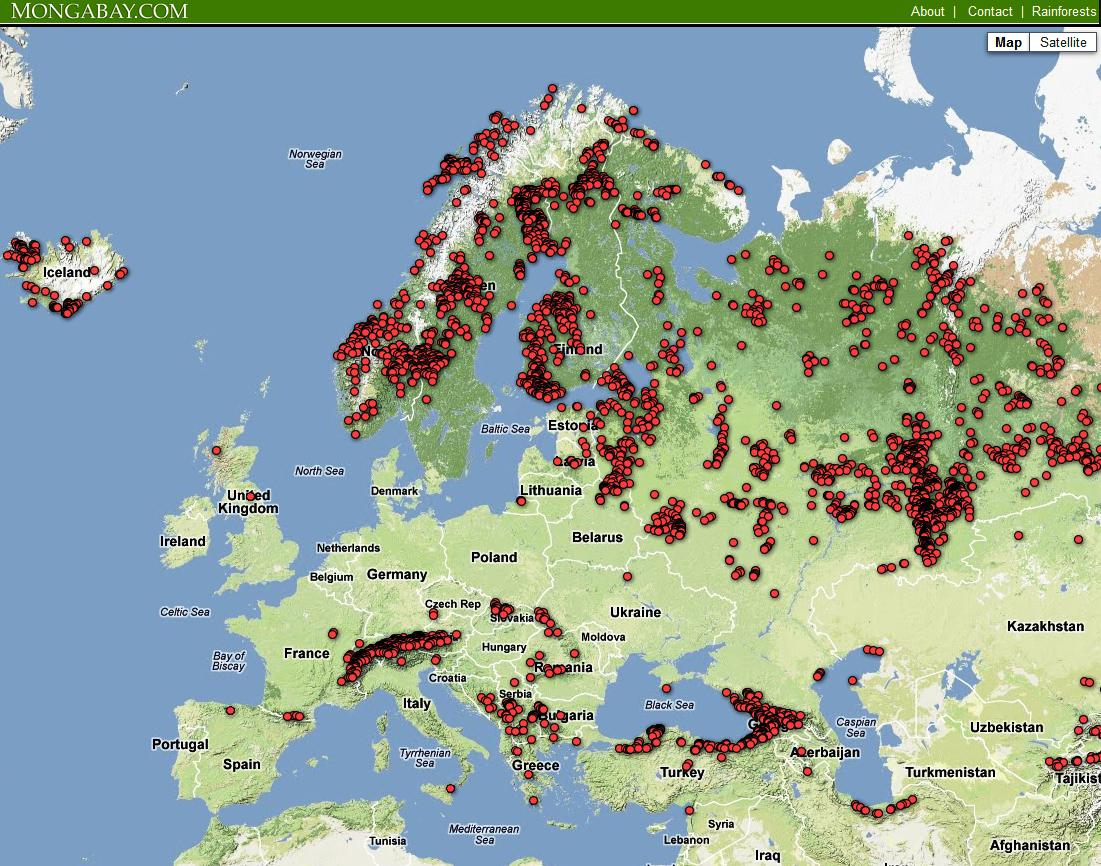
There’s some issue I’d take with this approach. Most importantly, comparing March with March is not necessarily comparing vegetation at the same level of seasonal development in the temperate zone. But I think this is a great step forward in developing a global system for monitoring threats of genetic erosion. As the developers point out:
The cause(s) of any forest disturbance point detected in this map has yet to be confirmed.
Disturbance locations and impacts are subject to verification through local observations.
So imagine a next iteration of the system where local observers can annotate some of those potential disturbance points. A bit like what happens in the National Phenology Network in the USA, though for a different purpose. 4 And information will flow out more freely too.
In coming months, GloF-DAS will offer an alert system whereby users can sign up to get notifications via email or SMS text message on recent changes in forest cover for a specified location or country.
Of course, for this to be truly a game-changer we who are interested in monitoring threats to crop wild relatives, say, would need the ability to combine the potential threat data of GloF-DAS with our own data on species occurrence or diversity. It doesn’t look to me like that’s possible just now, but perhaps it is something that we as a community can suggest to the developers.