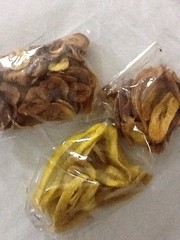
One of the many perks associated with holding meetings in West Africa.
Waxing lyrical about heirloom grains
Yes, of course this is a self-indulgent bit of film. But fun for all that. They’ve tried to pack too much in — does everyone out there watching actually know what Carolina Gold is, or recognise those panicles? — and at times fitting it all in works against clarity. I got very distracted trying to see whether the chef’s tattoo was what I thought it was. And it was.
Found it here.
Non-traditional, non-indigenous knowledge is important
When I first came to Rome, I grew potfuls of Lantana (probably L. camara, but not sure precisely what species). Sure, it’s an invasive, noxious weed, but nobody’s perfect, and I liked the succession of flowers and that strange, almost catty scent of the crushed leaves. And in the autumn, I noticed a strange thing. Unlike all the other plant pots, there was nary a single weed growing beneath the Lantanas. That was an observation odd enough to make me check, and discover that Lantana is allelopathic; it makes life hard for anything growing underneath it.
An article by Professor Anil Gupta reminded me of this. The article was partly about Auta Gravetas, a Ugandan farmer who noticed that sweet potatoes at the edge of a field bordered by Lantana had fewer pests than plants near the centre of the plot. He experimented with putting lantana leaves between layers of dried slices of sweet potato, which extended their shelf-life by six weeks or more, an important consideration for very poor farmers. In 2000, this discovery won Auta Gravetas 1 first prize in a competition organised by IFAD. As Gupta observes:
The weed became a resource. … Neither lantana camara was indigenous nor had the knowledge been transferred by one generation to another over centuries. The way of knowing was traditional — by observing an odd phenomenon, discriminating, abstracting, hypothesising, testing and developing a robust rule or technology.
There’s probably a lot more that Lantana could be used for; given its anti-microbial (and other) properties. Gupta has a bit of a bee in his bonnet about this story, and writes about it often. But the point is well taken. Farmers can innovate in unexpected ways, and it requires all parties to be alert to the possibilities if those innovations are to be spread. And quite by coincidence, I’m sure, BBC News Africa reports today on a Cameroonian innovator and entrepreneur who also transformed his local food system.
Brainfood: Beans, Potatoes, Lettuce, Agave, Gaming, Mangroves, Ancient millets, Ancient missions
- Mesoamerican origin of the common bean (Phaseolus vulgaris L.) is revealed by sequence data. Revealed is kinda strong isn’t it? This from a bean expert of my acquaintance: “Yes, we knew that, as it seems to be the case of all species of the Phaseoli section. They could have done a bit better in including the 2 populations of Cordoba mountain, in order to see whether these belong to the first migration to the Andes, or the second one. Wild vulgaris from western Panama, or Venezuela, could have helped in this regard too. We have shown years ago that the complex genetic structure in Mexico and in Colombia is the result of these floristic migrations combined with gene flow events because beans cross among themselves.”
- The Enigma of Solanum maglia in the Origin of the Chilean Cultivated Potato, Solanum tuberosum Chilotanum Group. These are long-day adapted and therefore crucial to the history of the potato in Europe. But the various sorts of evidence looked at to investigate their relationship to the rare Chilean wild relative S. maglia just do not agree. Bummer.
- Wild and weedy Lactuca species, their distribution, ecogeography and ecobiology in USA and Canada. So Iowa is a wild lettuce hotspot. If you’re interested in the germplasm, it’ll be in the genebank of Palacký University in the Czech Republic.
- Sustainability of the traditional management of Agave genetic resources in the elaboration of mezcal and tequila spirits in western Mexico. Tequila industrial agriculture should learn from the traditional kind.
- Fate of the World: computer gaming for conservation. Worth a try. No, really.
- The Economic Value of Mangroves: A Meta-Analysis. You might think there would be a value in the abstract; you would be wrong.
- Early millet use in northern China. That would be Setaria italica and Panicum miliaceum, and new evidence from ancient starch grain on pottery and grinding stones found in archaeological sites has pushed back their cultivation in N China by 1000 and 2000 years respectively, to about 9500-7500 BC. The Archaeobotanist has more, as ever.
- Digitization and online availability of original collecting mission data to improve data quality and enhance the conservation and use of plant genetic resources. They’re there (and here; what’s up with that?) to consult and make use of if you want.
And don’t forget, you can join our group on Mendeley, subscribe to the feed, and have all this filtered goodness delivered to the RSS reader of your choice.
Vavilov varieties repatriated to Sardinia
It has come to my attention 2 that the University of Sassari in Sardinia recently celebrated its 450th anniversary. And among the gifts it received were some seeds of oat and barley varieties collected by NI Vavilov on his 1926 expedition to the island. Fresh ones, I hope. A silver pin of Vavilov and two books — Five Continents and Vavilov and his Institute — rounded out the package. Igor Loskutov, author of the second book, gave a lecture on “Plant genetic resources collections heritage of the humankind”.
We’re trying to find out more about the repatriated varieties.