- Can bison play a role in conserving habitat for endangered sandhills species in Canada? Maybe, hence the recommendation to re-introduce them. Incidentally, there are a few crop wild relatives on the list of threatened plants of Canada.
- Genetic improvement of farmed tilapias: Genetic parameters for body weight at harvest in Nile tilapia (Oreochromis niloticus) during five generations of testing in multiple environments. The 10-year “Genetic Improvement of Farmed Tilapias” (GIFT) project was not a complete waste of time. The GIFT population will respond well to selection for increased body mass, and you dont have to do the evaluation in lots of different environments.
- Mycorrhizal colonization of major banana genotypes in six East African environments. Different banana genotypes had different levels of infection, but environment also plays an important role. Important because arbuscular mycorrhizal fungi may increase production.
- On the use of depth camera for 3D phenotyping of entire plants. An example of this.
- Genetic and phenotypic diversity in a germplasm working collection of cultivated tropical yams (Dioscorea spp.). Should be a good starting point for improvement programmes. Kind of like the GIFT population, then, eh? But starting point? Haven’t people been breeding yams for a while?
- Cytogeography of the Humifusa clade of Opuntia s.s. Mill. 1754 (Cactaceae, Opuntioideae, Opuntieae): correlations with pleistocene refugia and morphological traits in a polyploid complex. The southeastern and southwestern U.S. represent glacial refugia for diploid members of the clade, and a whole bunch of polyploids resulted when the taxa spread out again after glacial episodes. How many of these are eaten is what I’d like to know, and whether ploidy affects that. I suppose climate change will lead to further complications?
- The impact of agricultural intensification and land-use change on the European arable flora. Is significant. Not least because some crop wild relatives are involved, although that’s not really discussed here.
Five peas in a pod
So, just to recap, that Afghan pea accession with resistance to a couple of different strains of Peronospora viciae (which causes downy mildew):
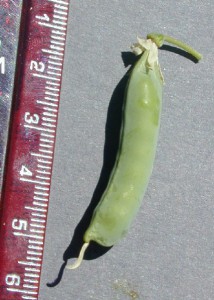 PS 998 = WBH 2126 (Plant Breeding Institution, Weibullsholm, Landskrona) = NGB 102126 = ATC 2432 (Australian Temperate Field Crops Collection, Horsham) = PI 222117 sel.
Thanks to Jenny Davidson, Dirk Enneking, Tony Leonforte, Bob Redden and assorted databases for helping to sort that one out.
What makes a good country?
Is it not ironic that on the same day that Bill Gates suggests national targets and reports cards for agricultural productivity, boffins are decrying the use of unidimensional indicators of country-level success in another sphere? Report cards for agricultural sustainability, anyone? For levels of agricultural biodiversity in situ and ex situ?
Featured: Ceora’s origins
The Ceora grasspea story has generated quite some response. Dirk has an answer to the problem of documenting the pedigrees of new varieties:
The simplest solution is to ask breeders when they decide to publish their pedigrees (some may have good commercial reasons not to), to reference any of their parent material, which originated from gene bank collections, with the original donor’s ID numbers.
Jeremy wants to know about DOIs. And you can also hear from Ceora’s main breeder, Colin Hanbury, that some things will probably remain a mystery.
Crowdsourcing land cover data
You know how we’ve occasionally wondered out loud here whether it might be possible to crowdsource information on the geographic distribution of a crop (or indeed crop wild relatives), or even of threats to crop diversity. Well, some clever folks have gone out there and are actually doing it, for global land cover. And making it fun to boot. Now we have no excuse.