- Land, Food, and Biodiversity. Agriculture will expand, but that is bad for biodiversity. It probably must expand, actually, but this can be kept to a minimum by addressing land-use planning, governance and law enforcement, productivity, and market drivers. Oil palm as an example.
- Time to change how we describe biodiversity. By finally tackling the digitization of phenome annotations, apparently. NiM 1
- Genomic and metabolic prediction of complex heterotic traits in hybrid maize. Amazingly, genotype (SNP) can predict phenotype (biomass traits) pretty well. But in a population where a bunch of dents were crossed with a couple of testers. Will it work with a diverse genebank collection of landraces?
- Forest productivity increases with evenness, species richness and trait variation: a global meta-analysis. In over 50 studies, polycultures come out about 24% better than monocultures, with evenness having more of an effect than richness. Much more commentary and context at ConservationBytes.com. Compare with that recent drylands diversity and ecosystem function paper.
- All Is Not Loss: Plant Biodiversity in the Anthropocene. A model says there have been “gains in exotics caused by species invasions and the introduction of agricultural domesticates and ornamental exotic plants”. Oooh! Contrarian!
Telling it like it is for rice in Nepal
I’d like to pretend that our absence yesterday was a mark of solidarity with all the netizens protesting against the proposed SOPA/PIPA laws in the US. It wasn’t; we were just both snowed under. But we do think SOPA/PIPA is a mistake.
The latest issue of IRRI’s magnificent organ Rice Today contains an article on Seeds of life in Nepal. All good stuff, about how private companies and the state supply less than 10% of Nepal’s rice seed needs. The rest comes from the informal seed sector. IRRI stigmatizes those seeds as being “low quality”. So, along with the National Rice Research Program, IRRI swung into action, setting up farmer trials of modern varieties, which “within a short time … were identified as superior to local lines”.
They were Radha-32, Ghaiya-2, IR55435-5, Pakhejhinuwa, Radha-4, Ram Dhan, Barkhe-3017, Sunaulo sugandha, Barkhe-2024, and NR-1824-21-1-1.
To get seed to farmers, the project helped set up local seed producer groups, which ramped up production from 4 tonnes to 30 tonnes over three years. Even that, however, was enough for only about 1 in 10 of the farmers in the immediate neighbourhood. More groups followed in other villages, and everyone is now happy.
Except us and some people in Nepal.
The article boasts that “millet and maize that used to replace rice on the table are now feeds for livestock and poultry”. Is that an unalloyed good thing?
Were the local varieties really that bad, and were they conserved? Nepal has a good record of participatory plant breeding (PPB) and community seedbanks and seed producers, set up with local NGOs and other research centres, although one wouldn’t know it from IRRI’s article. Some of the PPB varieties produced in those projects were used by IRRI in the on-farm trials; no mention of those either. Were they rubbish? Or are their names in the list without saying where they came from? LI-BIRD, the NGO most closely associated with PPB and seed producer groups in Nepal, recently published its report for 2009-2010; it contains an article on Community based seed production and another on Community seed banks.
European Botanic Gardens Congress calling for papers one last time
But you’ve only got a few more days! The Congress itself will be in late May on the island of Chios. Word around the campfire has it that Nigel Maxted will be putting together a workshop on “Wild Species Conservation in Genetic Reserves.”
Celebrating the donkey
It looks like the biennial Donkey and Mule Conference, usually held on the Greek island of Hydra, will take place in London this year, appropriately enough during International Donkey Week in May. So Prof. William Gervase Clarence-Smith of the School of Oriental and African Studies and Ed Emery, the conference organizer, inform DAD-Net anyway. I coudn’t find a website, but the last livestock-themed SOSA conference even had a Facebook page, so there must be one in the offing.
Starving Striga of essential micronutrients
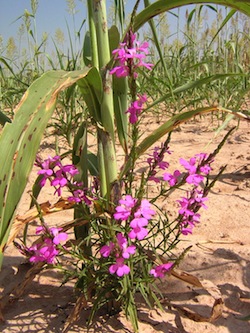 Interesting, and temporally confusing, news item from Wageningen University. Dated 12 January, it tells us that on 11 January Muhammad Jamil will be defending his doctoral research on the very pretty but also very devastating parasitic weed Striga. 2 And fascinating research it is too.
Striga seeds germinate in response to strigolactones, which are secreted by the host plant’s roots, and which effectively tell the parasite that there is a host nearby. Strigolactones are made from carotenes, which are the precursors of vitamin A, an essential micronutrient for people. Jamil’s research shows that the less carotene a plant produces, the less likely it is to be parasitised by Striga. Jamil also demonstrated considerable differences among rice varieties in the amount of strigalactones they produce under identical conditions.
Which raises lots of lovely questions. Will crops bred for higher levels of carotene — say to improve human nutrition — be more susceptible to Striga parasitism? Is the solution to breed those self-same crops to block the production of strigalactones? Could this be a job for life for high-tech plant breeders? And what’s wrong with the push-pull approach to controlling Striga? Does it, for example, not work on rice?
I do hope Muhammad is now Dr Jamil.