Too much fun to save for the New Year.
Make of this what you will, hidden-message-wise. Just because I found it on Paul Krugman’s blog doesn’t signify anything.
Crops, livestock, microbes, pollinators, wild relatives, agroecosystems, foodways …
Too much fun to save for the New Year.
Make of this what you will, hidden-message-wise. Just because I found it on Paul Krugman’s blog doesn’t signify anything.
As is customary at this time of year, we’re taking a break. see you on or around 9 January 2012. Meanwhile, here’s a little something to tide you over, which we think admirably expresses our philosophy here at ABD towers.
The Guardian has a slideshow on small-scale farming in Ethiopia, mostly showcasing the Wrold Food Programme’s Meret project. Which is great, if it draws attention to the ways in which the Ethiopian people are working to make themselves more food secure. But (and there’s always a but, because we always want more) can you really trust the information in the picture captions? Slide 6, for example; is that really pigeon pea the women are harvesting? Doesn’t look like it to me. And slide 13? The plants shown are said to include “false banana (it looks like a banana tree, but is actually cassava)”.
The pedant will sneer at banana being described as a tree; we’re OK with that. But what is this false banana cassava, “called kobe in Amharic“? 1 Many more sources seem to think “false banana” is ensete (Ensete ventricosum). That makes sense. and quite a few refer to the fermented starchy corms of the plant, called kocho. But of a link to Manihot esculenta, not a sign.
What’s that you say? “Look who’s a pedant now?” You clearly don’t understand our thirst for true knowledge. Someone, somewhere must know for sure whether someone, somewhere, truly calls enset cassava.
What’s that they say about a little knowledge? I knew the Aztecs ate dogs. I knew they kept a hairless breed of dog. So I naturally assumed they bred the hairless breed for food. So much more convenient not having to deal with all that hair in the kitchen.
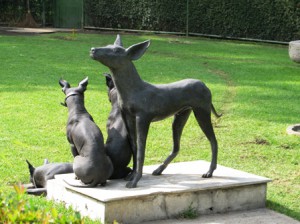 Wrong. I’m sure there’s a name for this kind of logical fallacy. Be that as it may, a recent visit to the Dolores Olmedo Patiño Museum, in Xochimilco, Mexico City, where they keep a pack of that hairless breed, which is called Xoloitzcuintle by the way, quickly disabused me. A notice there points out that the name Xoloitzcuintle makes reference to Xolotl, a god associated with death (among other things). Dogs were supposed to accompany the dead on their way to the next world. Not the done thing to eat them, then, surely. It must have been other breeds that were eaten.
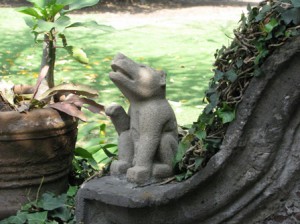 Well, maybe. The Wikipedia article on Xolotl says that “the meat of the Xoloitzcuintle was very much part of the diet of some of the ancient peoples of the region.” There’s no reference for that, though. What seems clear is that there were, indeed, other dog breeds. Many of the representations of dogs don’t really look like the Xoloitzcuintle at all. Squatter and fatter. Dare I say it? Jucier. There are many of them, mainly in pottery, at the museum, though I was not allowed to photograph the ones indoors.
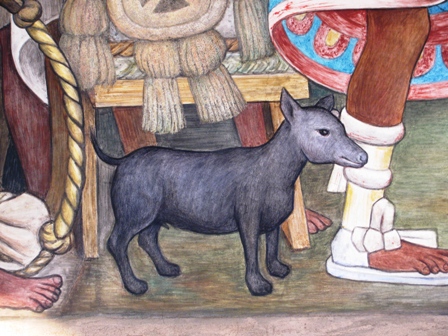
Diego Rivera seems to have had a thing about Aztec dogs, by the way. He painted them a number of times. Here’s an example from the Palacio Nacional mural. Interestingly, though, they look a lot more like the pottery pieces than the actual Xoloitzcuintle specimens roaming around the gardens of his friend Dolores’ house.