Neglected and underutilized?
Taking Climate Analogues for a drive around the block
I’ve been holding off taking a proper test drive of CCAFS’s new dream machine, Climate Analogues, despite all the media attention, because I heard that the boys and girls in the pits at CIAT were still tightening the cylinder head bolts and optimizing the valve timing. But now it seems they’re done fiddling, at least for now, and I’m going to take it out for a spin.
It’s a simple idea. If you want to help a farming community adapt to climate change, you need to have some idea of what their climate is going to look like down the line. In terms of agrobiodiversity, for example, it would be nice to know of places which right now have a climate like your site will have in 2030, or whatever date, because that’s where you’d look for crop varieties with the climatic adaptations they’re going to need. That is the guts of Climate Analogues. You can of course fiddle with emission scenarios, climate models, length of growing season, whether to deal with temperature and/or rainfall, and dissimilarity thresholds (how dissimilar do two places have to be to really matter?), and the manual takes you through all those options in detail, but what it basically does is compare the climate of a reference site, now and in the future, to the climate of all other places on earth, now and in the future. 1
Easy enough to say, and extremely worthy, but clearly technically complex. That hasn’t stopped these guys before, though. Alas, the implementation in this case is not perhaps as elegant as one has come to expect. It’s still in beta, of course, so things are hopefully going to improve, but I’m sorry to have to report that I did not have an altogether smooth user experience.
Let’s get the little things out of the way first. Like if you don’t know that the default base map is called “Streets” it is a somewhat annoying process to get back to it. Like if you produce a pdf of your results you can’t then get back to your interactive map where you left it, unless you remember to open the said pdf in a separate tab. Like in the results pdf the legend of the map is totally different to the one you’ve just struggled to get to grips with in the online version. Like the fact that in that online map legend red means high dissimilarity, where really what I for one would want to highlight is low dissimilarity, or high similarity, between sites. Like the fact that the place where you change probably the most crucial thing, unless you’re a total climate geek, which is the direction of comparison (now with now, or future with now, or now with future), is buried in a menu called “Additional parameters.” Like the fact that it’s not entirely clear what future year we’re talking about anyway.
Forget all that, I’m probably just a pernickety user who hasn’t read the manual attentively enough and these smallish details will anyway be dealt with in time, no doubt. What I can’t really excuse is that you’re not really enabled to directly use the maps you get, to do anything else with them once you get them. Not unless you download the results and import them into your GIS and fiddle with them there. This seems to me CGIAR GIS geeks producing a tool for other GIS geeks. The blurb talks about facilitating farmer-to-farmer exchange of information. As things stand, the only way that’s going to happen is if there’s a person with a GIS mediating the exchange. Good for GIS people, not so good for your average researcher or policy maker. Whether good or bad for the farmer is moot, I would say.
Let me give you an example. Here’s a screen grab (because that’s the only way I could think of to export a bit of the map) of the results, using all the defaults for simplicity, for the now-to-now comparison of the climate of my mother-in-law’s farm in the Limuru highlands (X=36.679110, Y=-1.077666).
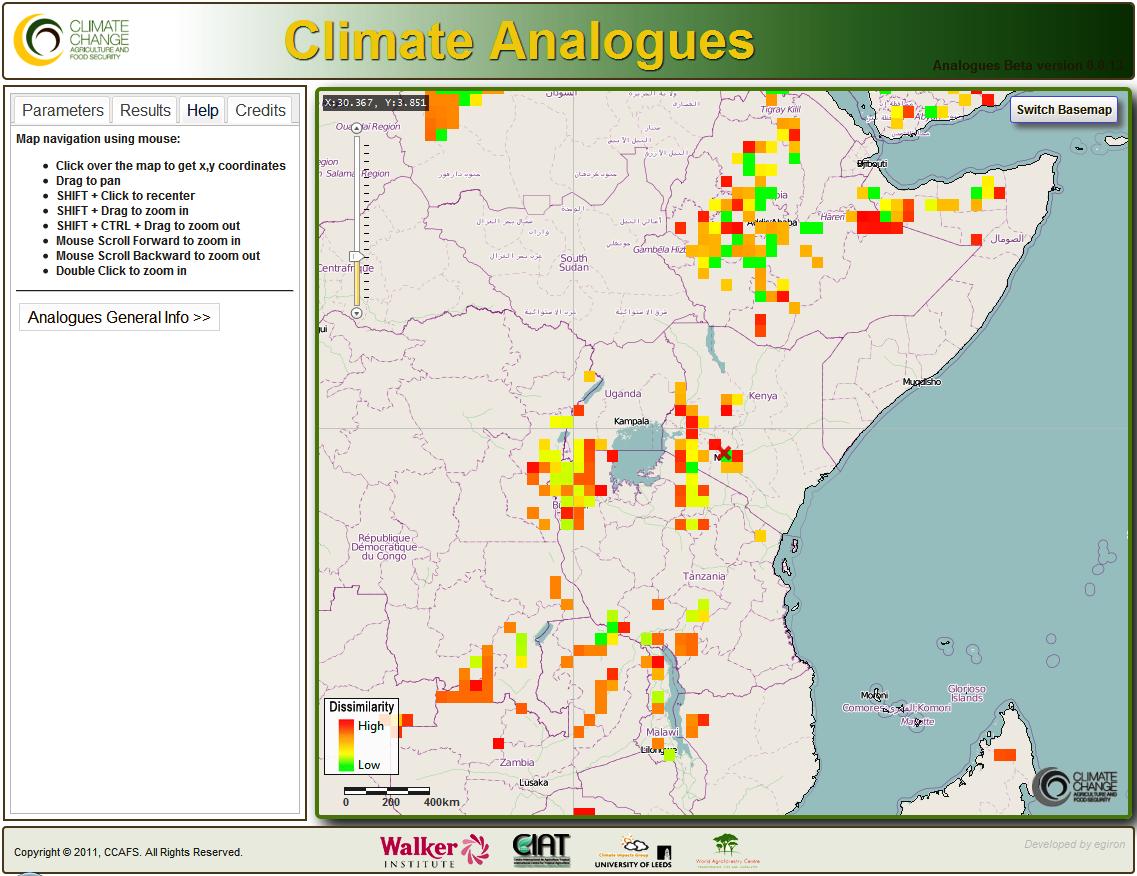
Let’s say we want to give my mother-in-law beans adapted to her current climate. Remember that what we’re looking for is high similarity, which means low dissimilarity, which means green, according to this legend (as I said, it’s a different legend in the “Results” tab). Phew. Anyway, we should look for the beans in Ethiopia, shouldn’t we. Result! Then we say to grandma, well you also need to look ahead, so here’s a map of places which right now look like your place will look like in 2030. You need beans from there too, madam.
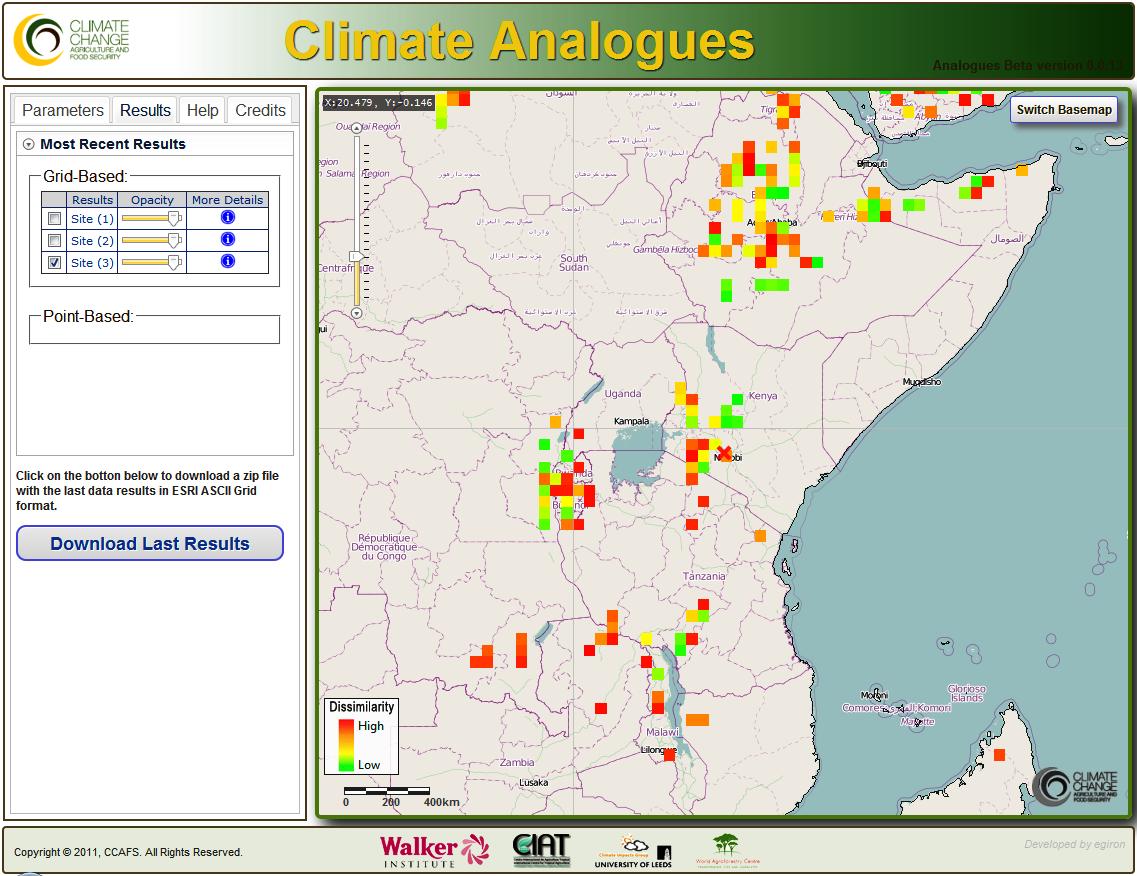
Aha! Grandma needs beans from a bit further north in Kenya and the Great Lakes region as well as some bits of Ethiopia. 2 Yes, but wouldn’t it be nice at this stage to import a dataset of bean accessions worldwide and see if any of them come from green squares in either map? Can’t do it here, that I can see. Need to call the guy with the GIS, I suppose. Or wouldn’t it be nice to print out a nice map of Kenya that grandma can use to drive to the green squares and find bean farmers and swap some germplasm? Can’t do it here, that I can see. Need to call that GIS guy again, it seems. 3
So, in summary, a great idea, a significant technical achievement, and a potentially really useful tool for climate change adaptation. But it seems to me that if the greasemonkeys at CIAT really want this baby driven around at full speed by people other than other mechanics, they need to get back under the hood and do a thorough tune-up. Or tell me I’m wrong. I’d love to hear from you. Seriously. This is important.
Featured: Livestock databases
Peter Ballantyne sees a way to avoid Livestock Breed Database Hell:
For the ILRI part, we have been working on a more integrated approach that brings together all our ‘animal genetic resources’ sites into a unified AnGR knowledge space. Thus it would include at least DAGRIS, AGTR (which is training materials), and a related CDROM ‘virtual library.’ The problem is that each was built in isolation from the other, each has content buried inside a proprietary system (that we are moving to open), and none systematically and smartly (from a info architecture perspective) pull in the diverse content of the others .. and elsewhere. So we are moving to a more integrated set of services that share content (photos, documents etc) and allow for searching across etc. There’s also some work on ‘country’ views of DAGRIS. But it takes some time still!
Good luck, Peter!
Is Livestock Breed Database Hell beckoning?
I’ve said before that I thought the animal genetic resources community had got its act together a bit better than us plants people as far as information and communications are concerned. But now I’m having second thoughts. Let’s start with FAO’s Animal Production and Health Division. It has a webpage on Implementing the Global Plan of Action for Animal Genetic Resources. One component of that is the Domestic Animal Diversity Information System (DAD-IS). So far so good. But that includes a database of breeds. And so does ILRI’s Domestic Animal Genetic Resources Information System (DAGRIS), though admittedly this one has trait information too. And I haven’t even begun to dig into the national and regional stuff. Is this the beginning of Livestock Breed Database Hell? Oh, and ILRI also has a separate site on Animal Genetic Training Resources (AGTR).
Ox-cart racing in the Punjab
This wonderfully evocative piece on ox-cart racing in Pakistan was originally posted to DAD-Net by Dr M. Sajjad Khan, professor in the Department of Animal Breeding & Genetics at the University of Agriculture, Faisalabad, Pakistan. It is reprinted here, along with a photograph of the event, by kind permission of the author. Our thanks to him, and our best wishes for his work.
I thought to share a very learning experience of organizing (more correctly, witnessing) an ox-race competition. The competition was organized in connection with University’s golden jubilee celebrations this year at one of the sub-campuses of the University (Toba Tek Singh), some 90 km from Faisalabad and 200 km from Lahore, the capital of Punjab province. This was part of the Technology Transfer Day and Kissan Mela. I had seen a few ox-related competitions before, including fast ploughing, load pulling, circular speeding, speed threshing, ox-walk etc etc. This was ox-cart racing.
Some 60 ox-pairs (with cart behind), driven by an experienced rider, competed in 10 heats and a final. There were no written rules but everybody understood them. Judges did not have any special uniform but their decisions were final. No grass on the ground. No pistol and no flag at the starting point, just a call by the starter (who has been doing this since his teenage years). No lines except the finish line (marked by white lime powder and redrawn just before the final, the eleventh race). No police to control the mob of thousands (all volunteers plus few boy scouts that we had added).
The high ground near the finish line had by this time been covered with tents and chairs for a few of us and for guests (who cannot sit on feet for hours). The ground was some 1540 feet long. The roar of mob indicated that the race had started. Each race lasted for less than a minute, and ended with thousands of people running after the participants. Then one could only hear the loud voice of drums and see the storm of dust moving and settling. The oxen were covered with decorated clothes again. The Rs bills are thrown into the air repeatedly and many dance around the winners. The festivity would continue for about half an hour with the last fifteen minutes also used for reorganizing things for the next heat. Villages were competing with villages, casts with casts, localities with localities, and there were some individual clashes as well. Some of the heats were a photo-finish and a video camera did help to resolve which foot (not nose) touched the white line first.
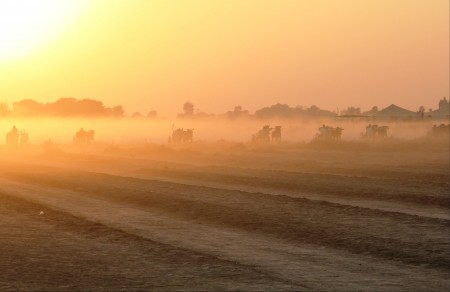
Two indigenous breeds were generally represented: Hissar (mainly) and Dhann (which is the main breed in such competitions held in northern Punjab). Some were crosses between nondescript Desi and Dhanni. I did chat with at least a few who had been competing for decades. I recall that when I was doing the State of the World report for Pakistan, I thought breeds historically used for ploughing might fade out soon, but now my feeling is that it will take a lot longer than I had thought. People are taking care of some of the indigenous breeds very differently. Most of the bulls had a price tag of a million Rs. Judging for beauty was a challenge but I found many experienced hands helping me to go through it honorably without a feud.
I am really exposed to a new world yet again (after the goat show). Yes, we should encourage these activities and help people to have improved and humane utilization of indigenous resources. At the University, we are likely to develop an ox-cart race track in near future and it will be fun to be part of such festivities.
The photos of the event will be posted on the project website soon.