I recently posted the following quote on the Biodiversity for Nutrition group.
Papua New Guinea’s taro and aibika are high in Iron and Zinc compounds which are important for human health but such nutritional information is not available for the public, says Nelson Simbiken, a PhD student at the Australian National University in Canberra.
The quote comes from a blog on PNG agriculture, and I must say I expected a strong reaction. I was not disappointed. This has just come in in reply from Wila Saweri-van Hulzen, who worked as a nutritionist in the Department of Health in PNG for some 20 years.
There is information on the nutrition composition of PNG foods. It may not be recent, and it may be applicable to small part of the country, but it is available.
Brand JC, Thomas DE and Hyndman D. Composition of the subsistence foods of the Wopkaimin people of Papua New Guinea. PNG Medical Journal 34:35-48, 1991.
It gives information on taro and Hibiscus manihot (or aibika).
Ohtsuka R, Kawabe T, Inaoka T, Suzuki T, Hongo T, Akimichi T, Sugahara T. Composition of local and purchased foods consumed by the Gidra in lowland Papua. Ecology of Food and Nutrition 15:159-169, 1984.
The Pacific Islands food composition tables, 2nd edition, FAO, Rome, 2004 used this information in its food composition tables. The difficulty is that these tables uses Fijian local food names, so the name edible hibiscus is used, rather than aibika. (Appendix VI lists aibika and refers to edible hibiscus.) The scientific name is Abelmoschus manihot or Hibiscus manihot.
The South Pacific Commission in Noumea (New Caledonia) has published several booklets and leaflets with food composition information. A few are The Leaves We Eat, The Fruits We Eat, The Staples We Eat. Again, they use Fijian local names, so one has to figure out what the PNG name would be.
At the moment I have no internet access, so I am unable to read the newsletter.
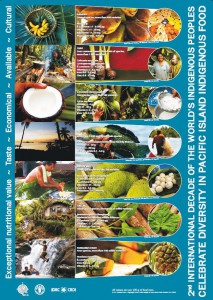 That’s surely correct. And I could add other sources. There are plenty of data on the nutritional composition of Pacific foods. But are these data available to “the public” in PNG? That, I think, was Mr Simbiken’s original point, and I think it’s a good one. The answer must be no, if the data are only published in obscure journals and under Fijian names. But I can’t believe that’s the case. I seem to remember seeing posters in tok pisin extolling the health virtues of various local foods. Someone please tell me I didn’t just imagine them.


