The CGIAR’s Systemwide Livestock Programme 1 has just announced the release of its latest database, this one on the nutritive value of feeds in Sub-Saharan Africa. You put in the name of some sort of feed, typically a plant species, and you get out data on nutritional composition, often from multiple samples, arranged in a couple of different ways, and downloadable. Nice enough, and very useful, I’m sure, for its target audience. However, at the risk of burnishing to a well-nigh mirror-like finish my reputation as a nay-sayer, I’d have to say that I missed a couple of things. One would be the ability to search on particular nutritional values. Then when a species with the appropriate combination of qualities pops up you could work out if you can grow it in your shamba using another nifty ILRI tool. And the other thing would be some kind of link to genebank accessions. Surely some of the samples analyzed were of material that’s conserved in the ILRI forages genebank? Maybe for ver. 2.0.
Crawling the web for agrobiodiversity threats
We have often mused here — mainly idly, it must be said — about the possibility of an automated, internet-based system for monitoring the threat of genetic erosion. While we muse, it seems, others roll their sleeves up and, well, do stuff. Welcome to the Threat News Explorer, news of which has reached us via Resilience Science. We’re talking here about “multiple interacting threats (wildfire, insects, disease, invasive species, climate change, land use change)” to “wildlands,” rather than agricultural biodiversity, and so far it looks like mainly in the US. But still, it’s a start. And perhaps of interest to our friends working on the crop wild relatives of the US.
LATER: If you were doing agrobiodiversity threats, you might look at new disease records, for example…
Featured: Kenyan hoes
Diana weighs in on the whole hoe thing:
This could be a misprint and-or misunderstanding on the part of the writer? Though, even at the ‘correct’ price, hoes can be a major investment for poorer smallholders. That is the case here in Burundi, where a hoe may be shared by several families and is often included as part of an agricultural ‘package’. In the 19th century in central-east Africa, economic transactions were frequently carried out with hoes.
Which kind of puts the whole thing in perspective.
Getting genebanks right
There are 5,000 varieties of potatoes in the gene bank in Chile. Wotske, this year, is growing 17.
Wotske is Rosemary Wotske, owner of Poplar Bluff Farm near Strathmore in Canada, and more power to her. But what about this large potato genebank in Chile? That sounds interesting.
Too interesting, it turns out. Because of course there isn’t one, as anyone who has spent even five minutes looking into potato genebanks can ascertain. Or rather, there is a potato genebank in Chile but it’s got about 700 accessions and not 5,000 — or it did the last time the data in WIEWS were updated. And there is a much larger, international genebank not too far away, at the International Potato Center (CIP), but it’s got about 4,300 potato landraces, and Peru isn’t Chile is it?
The price of hoes in Kenya
This post is not really about agricultural biodiversity, but I think it is worth stretching a point on some occasions. Take a look at the caption for this photograph. It’s the last in a gallery from The Guardian which goes with a nice write-up of what sounds like a very worthy Farm Africa project.
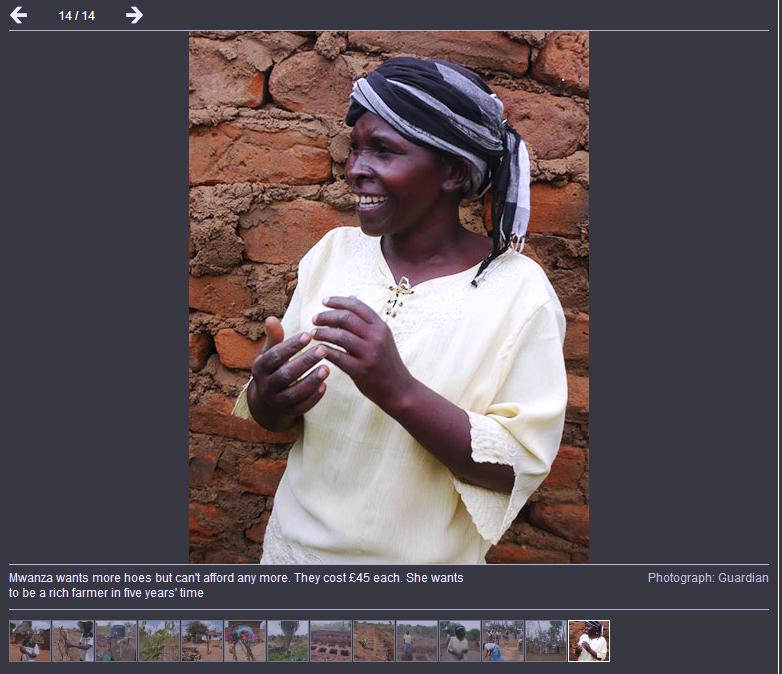
Forty-five pounds for a hoe? Forty-five pounds? I must say I’d missed that when I first went through the photos, but when Jeremy pointed it out I had to admit that seemed a bit steep for a hoe.
Well, is it just us? What do we know about the price of hoes in Kenya, right? Internal evidence in the article suggests that £45 is a lot of money, but a fair price for a hoe.
But low-tech can still be costly. Mwanza says she would like more hoes, but at £45 a hoe, it is far more than she can afford. The simple brick house she lives in with one of her children is no bigger than a small bedroom.
But googling comes up with a much cheaper price in Uganda:
“A hoe is a very cheap thing. It costs Shs 7,500 each and when I buy one it can last more than two years,” Nyakoojo said.
That would be about £1.70. And when the wife sent text messages to everyone she could think of in Kenya she got back figures closer to the Ugandan than The Guardian. A very fancy hoe goes for about KSh 1,200, or £8, we were told.
So what’s going on? Normally, I’d probably just dismiss it as a misplaced decimal point somewhere. Or perhaps a misunderstanding about what exactly the tool involved is. But it appears that this “hoe” is the weapon of choice in the Manichean fight against GMOs.
Small African farmers such as Mwanza stand on the frontline in the battle for higher productivity and agricultural development, a struggle being fought not with tractors and GM crops but with hoes, wheelbarrows and indigenous drought-resistant crops: cowpeas, pigeon peas, green grams, sorghum and millet.
So I think we should all be extra clear about what one costs. Starting with The Guardian. And the Gates Foundation.